What the Cell
C1.2

Cell respiration

4 hours6 statementsTextbook pp. 405–411

Guiding questions

  1. What do hydrogen and oxygen contribute to releasing energy in cells?
  2. How is energy shared out and used within cells?

Slides

Slide 1 of 15

Notes

Written for this site from the class slides. The chapter is on pages 405–411 of the course textbook. Image credits are on slide 15.

C1.2.1

ATP distributes energy within cells

pp. 405–411

ATP (adenosine triphosphate) is a nucleotide. It is soluble, so it moves easily around a cell. It cannot pass through membranes, so it stays where it is needed. It also releases a useful quantity of energy, enough for many tasks.
C1.2.2

What ATP is used for

pp. 405–411
  • Active transport across membranes
  • Synthesis of macromolecules, which is anabolism
  • Movement of the whole cell, or of components such as chromosomes
C1.2.3

ATP and ADP

pp. 405–411

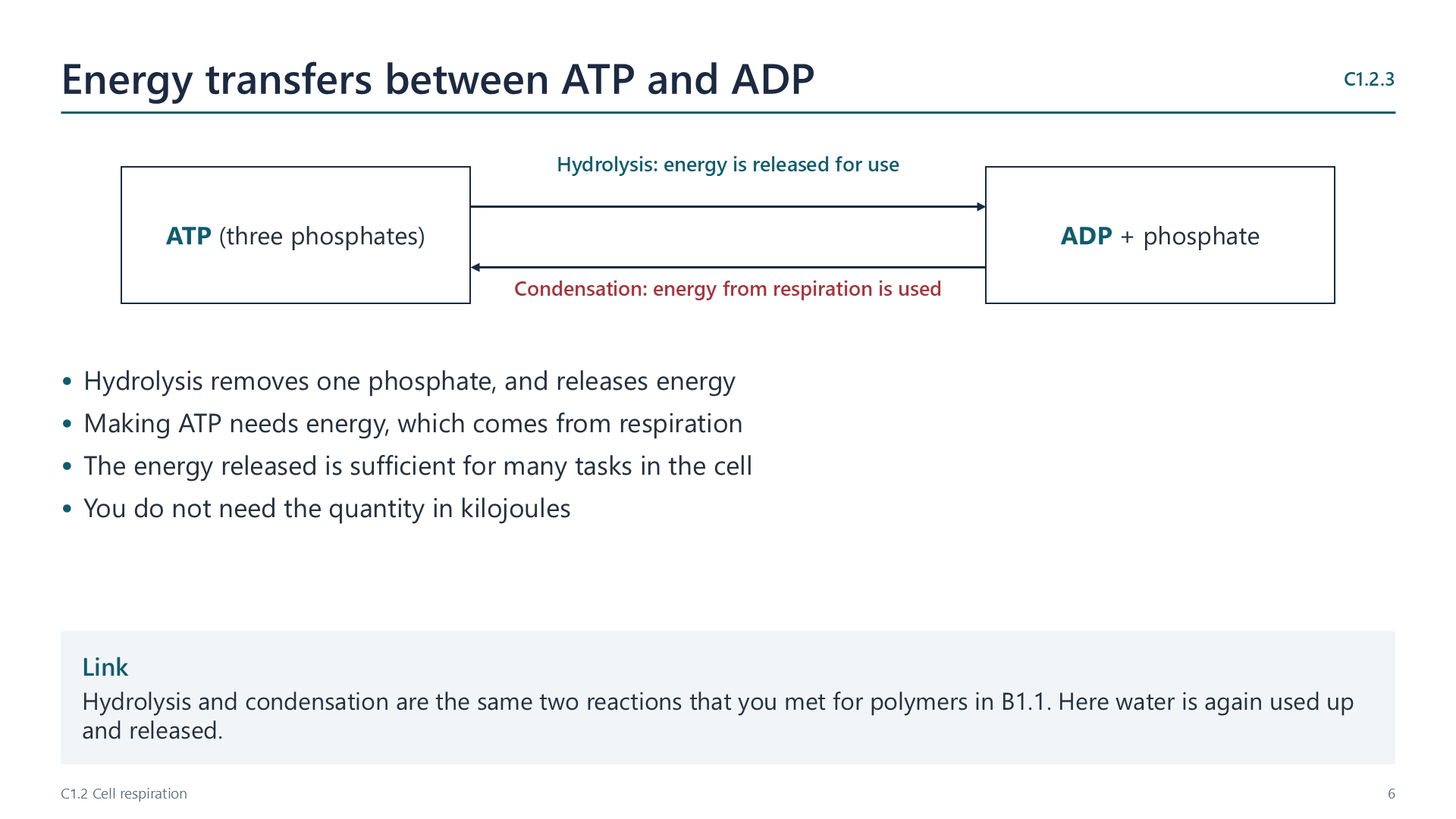
Hydrolysis of ATP to ADP and phosphate releases energy. Energy from respiration is required to make ATP from ADP and phosphate.

Slide: the cycle between ATP and ADP
C1.2.4

Respiration as a system for producing ATP

pp. 405–411

Respiration uses the energy that carbon compounds release to produce ATP. Glucose and fatty acids are the main substrates, but many others can be used.

Watch out: respiration is a set of reactions in cells. Gas exchange is the movement of oxygen and carbon dioxide across a surface.

C1.2.5

Anaerobic and aerobic respiration in humans

pp. 405–411
AnaerobicAerobic
Word equationglucose → lactateglucose + oxygen → carbon dioxide + water
SubstratesGlucose onlyGlucose, fatty acids and others
Yield of ATPSmall, but fastLarge
Waste productsLactateCarbon dioxide and water
WhereCytoplasmCytoplasm and mitochondria
C1.2.6

Variables and rates of respiration

pp. 405–411

Temperature, substrate and oxygen supply all affect the rate. A respirometer measures oxygen uptake: a CO2 absorber removes carbon dioxide, so a drop of liquid moves as oxygen is used. If a drop moves 45 mm in 15 minutes in a tube of 1 mm², the rate is 3 mm³ per minute.

Videos

Select a video to play it here. Select it again to close it.

Note-taking sheet

Print this guide and complete it as you work through the slides and videos. It asks for your own explanations, so close the notes while you try each section.

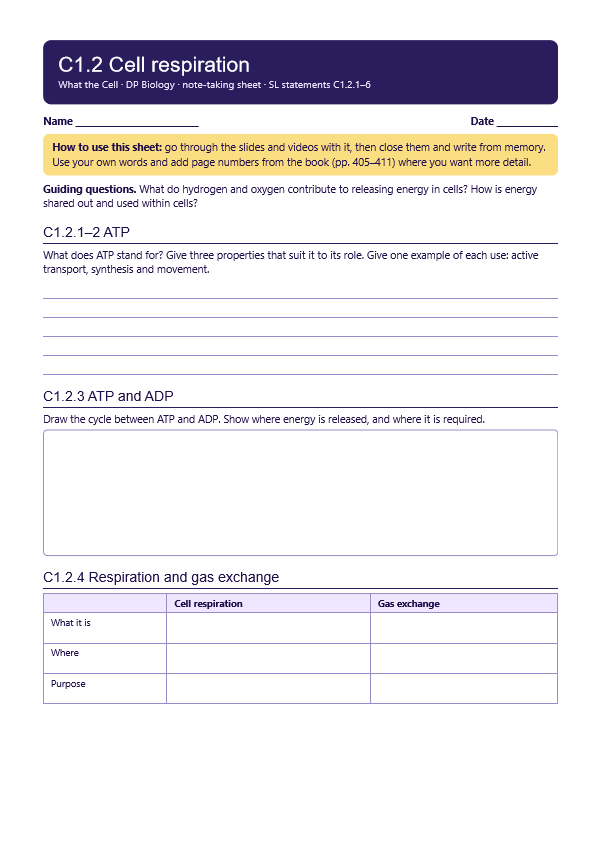
First page of the note-taking sheet

Quick self-check

The self-check needs JavaScript to run.

Practice questions

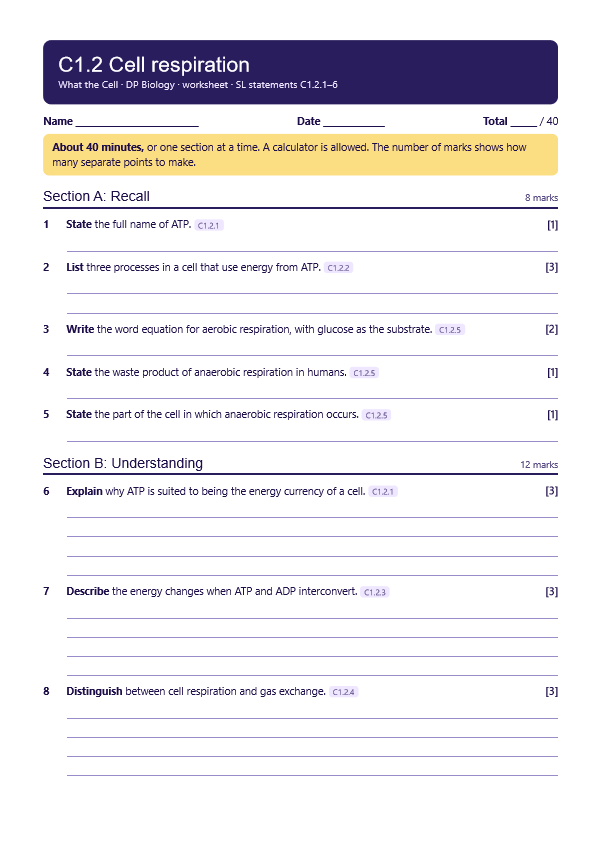
A printable worksheet covering all six statements, from quick recall to a data question and a longer answer. It has 40 marks and takes about 40 minutes, or you can do one section at a time.

Your teacher has the mark scheme.

First page of the worksheet

Data-based questions

Questions built on realistic experimental data, in the style of Paper 1B and Paper 2. Work them on paper and show your working. 23 marks in total. Your teacher has the mark scheme.

Respiratory quotient in finches

8 marks

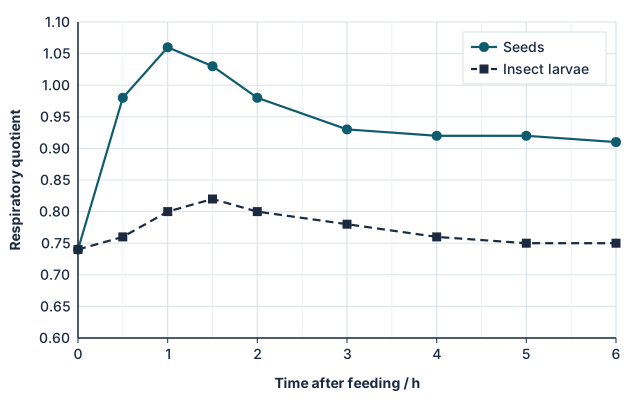
The respiratory quotient (RQ) is the volume of carbon dioxide produced divided by the volume of oxygen used. Zebra finches were fasted overnight, then fed either seeds (mostly carbohydrate) or insect larvae (mostly lipid and protein). Their RQ was measured for six hours. Typical RQ values: carbohydrate 1.0, protein 0.8, lipid 0.7.

Line graph of RQ against time after feeding. Both start at 0.74. Seed-fed birds rise to 1.06 at 1 hour, then fall to 0.91 by 6 hours. Larva-fed birds rise only to 0.82 at 1.5 hours, then fall to 0.75.
  1. State the RQ before feeding, and deduce the main respiratory substrate being used. [2]
  2. Compare the RQ of the two groups between 1 and 3 hours after feeding. [2]
  3. Suggest why the RQ of the seed-fed birds rises above 1.0. [1]
  4. A bird produced 3.8 cm3 of carbon dioxide while using 4.2 cm3 of oxygen. Calculate its RQ. [1]
  5. Explain why the RQ of the larva-fed birds stays lower than that of the seed-fed birds. [2]

Temperature and metabolic rate in mice

8 marks

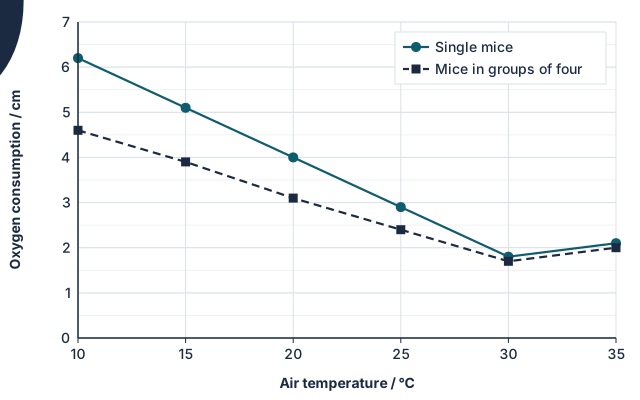
Oxygen consumption of house mice was measured at different air temperatures. Mice were tested alone, or in groups of four that could huddle together.

Line graph of oxygen consumption against air temperature. Single mice fall from 6.2 at 10 degrees to 1.8 at 30, then rise to 2.1 at 35. Grouped mice fall from 4.6 to 1.7, then rise to 2.0.
  1. State the oxygen consumption of single mice at 15 °C. [1]
  2. Calculate how much lower, as a percentage, oxygen consumption is for grouped mice than single mice at 15 °C. [2]
  3. Outline the relationship between air temperature and oxygen consumption from 10 to 30 °C. [1]
  4. Explain why oxygen consumption can be used as a measure of metabolic rate. [2]
  5. Suggest why mice in groups use less oxygen in cold air. [1]
  6. Suggest why oxygen consumption rises again at 35 °C. [1]

Mitochondrial myopathy

7 marks
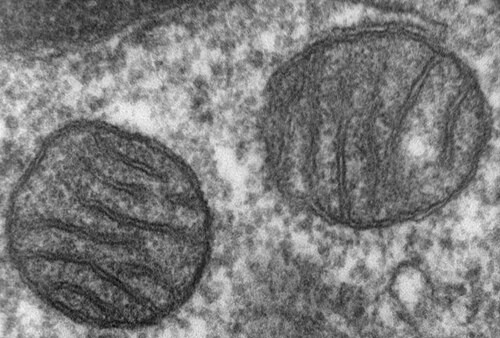
Electron micrograph of a mitochondrion
Photo: Louisa Howard, Public domain, Wikimedia Commons.

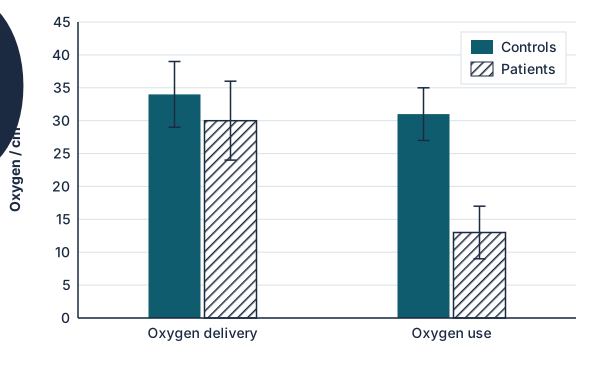
Mitochondrial myopathy is a group of disorders in which the electron transport chain does not work properly. Thirty patients and thirty healthy people (controls) cycled to exhaustion. Oxygen delivery to the muscles (from blood flow) and oxygen use by the muscle cells were measured at peak exercise. Error bars show ± 1 SD.

Bar chart. Oxygen delivery: controls 34, patients 30. Oxygen use: controls 31, patients 13, in cubic centimetres per kilogram per minute.
  1. Calculate the percentage difference in oxygen use by the patients compared with the controls. [2]
  2. Compare oxygen delivery and oxygen use in the patients. [2]
  3. Explain why patients become tired at low levels of exercise. [2]
  4. Suggest why oxygen delivery is similar in both groups. [1]

Practical

Yeast respiration and temperature

Lab40 minC1.2.6

You will need: Dried yeast, sugar solution, flasks or bottles, balloons, water baths, string and ruler

  1. Add equal yeast and sugar solution to each flask and fit a balloon
  2. Stand flasks at three or more temperatures
  3. Measure balloon circumference every five minutes
  4. Plot the results, and explain what affects the rate of respiration

Safety: Keep water baths below 45 C. Vent flasks at the end and wash hands.

Carry this out with your teacher's supervision and follow your school's lab rules.

Nature of science and TOK

Syllabus statements

Summarised in our own words. Use each code to find the exact wording in your textbook or the IB subject guide.

  • C1.2.1ATP as the molecule that moves energy around a cellp. 405
  • C1.2.2The cell processes powered by ATPp. 407
  • C1.2.3Energy changes as ATP and ADP convert into each otherp. 407
  • C1.2.4Cell respiration: how cells use energy from carbon compounds to make ATPp. 407
  • C1.2.5Aerobic and anaerobic respiration in humans comparedp. 408
  • C1.2.6Factors that change the rate of cell respirationp. 409

HL extension

© 2026 Akash Parthi Bendran. Please ask before using or sharing any resources from this site: see permission to use.