What the Cell
A3.1

Diversity of organisms

HL extension
2 hours4 statementsTextbook pp. 118–124

Guiding questions

  1. How do we define a species?
  2. What patterns of genome diversity appear within and between species?

Slides

Slide 1 of 13

Notes

Written for this site from the class slides, with textbook page references for each statement. The chapter is on pages 118–124 of the course textbook. Image credits are on slide 13.

What counts as a species?

A3.1.12

Limits of the species concept

pp. 118–120

The biological species concept depends on interbreeding. Asexual organisms produce clones and never interbreed, so each line could count as a separate species. Bacteria also pass genes sideways by horizontal gene transfer, even between distant groups, so their gene pools are not isolated.
A3.1.13

Chromosome number

p. 120
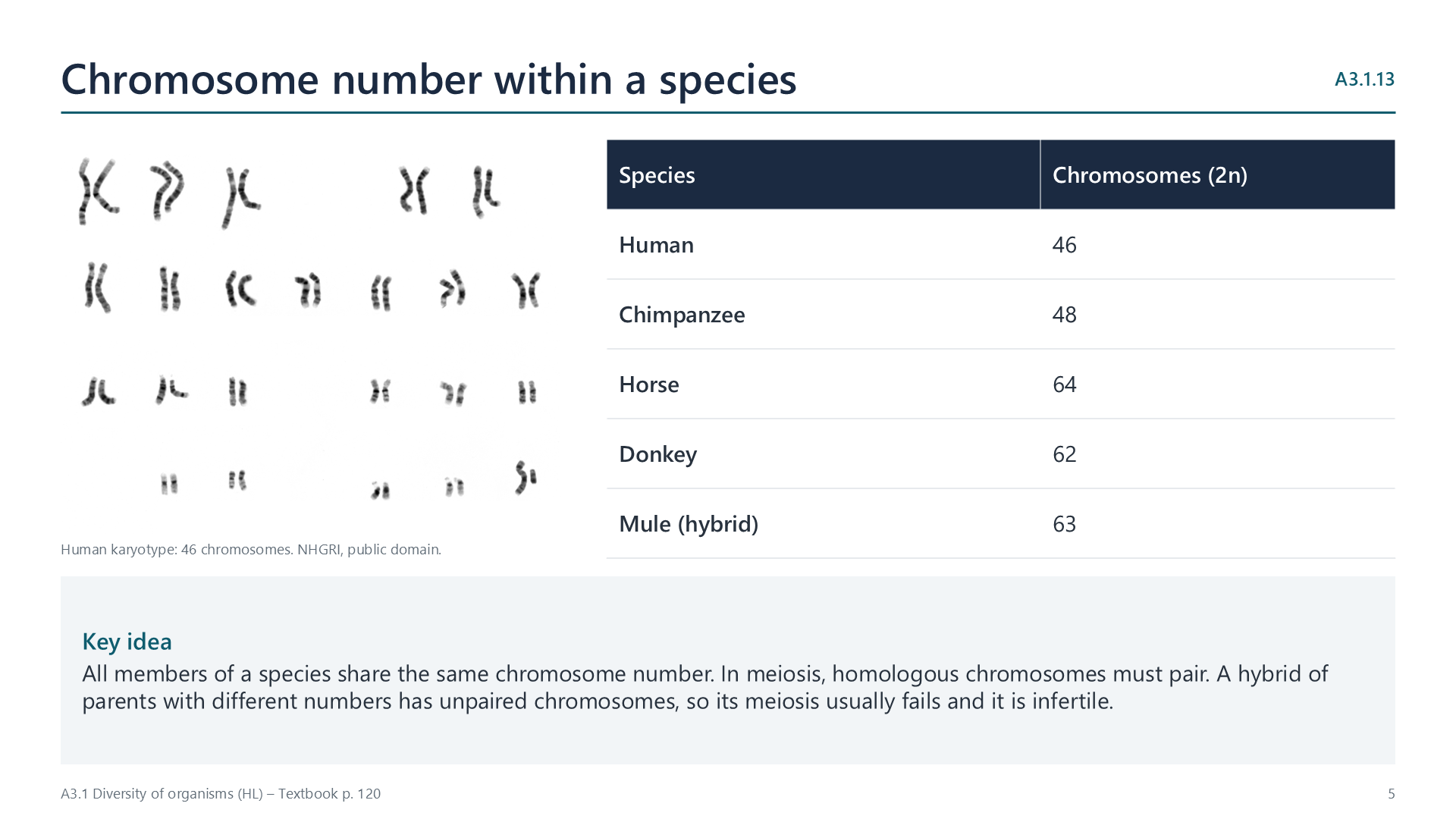
Slide: human karyotype and a table of chromosome numbers, including horse, donkey and mule

Members of a species share one chromosome number. A hybrid of parents with different numbers, such as a mule (63), has chromosomes that cannot all pair in meiosis, so it is usually infertile.

Identifying species

A3.1.14

Dichotomous keys

pp. 121–123

A key is a series of couplets: pairs of opposite statements about one feature. Use features that are easy to see and do not vary, and check that every route ends at one species. Test your key by swapping it with another group.

A3.1.15

eDNA and barcodes

p. 124
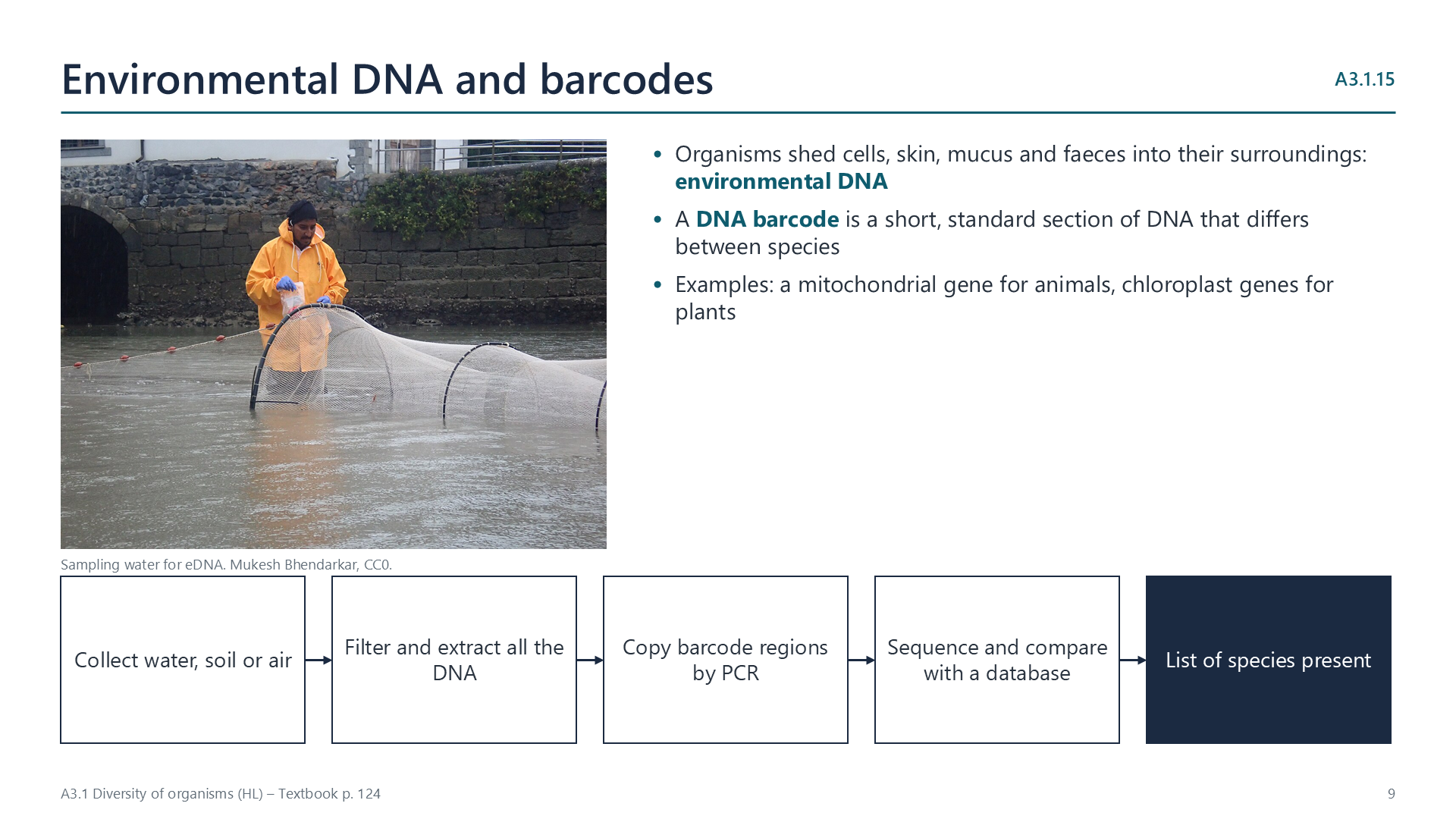
Slide: the steps from a water sample to a list of species

Organisms shed DNA into water, soil and air. Barcode regions, short standard sections that differ between species, are copied by PCR, sequenced and matched to a database. This shows quickly which species are present, but not how many individuals there are.

Videos

Select a video to play it here. Select it again to close it.

Note-taking sheet

Print this guide and complete it as you work through the slides and videos. It asks for your own explanations, so close the notes while you try each section.

First page of the note-taking sheet

Quick self-check

The self-check needs JavaScript to run.

Practice questions

A printable worksheet covering all four statements, from quick recall to data questions and a longer answer. It has 20 marks and takes about 20 minutes, or you can do one section at a time.

Your teacher has the mark scheme.

First page of the worksheet

Practical

Making a dichotomous key

Field45 minA3.1.14

You will need: Six to eight local plants or leaves, photographs, ruler

  1. Collect or photograph local specimens
  2. Choose a visible feature that divides them into two groups
  3. Keep dividing until each specimen is identified
  4. Test your key on a classmate, and improve it

Safety: Avoid plants that irritate skin, and do not pick protected plants. Wash hands afterwards.

Carry this out with your teacher's supervision and follow your school's lab rules.

Nature of science and TOK

Syllabus statements

Summarised in our own words. Use each code to find the exact wording in your textbook or the IB subject guide.

  • A3.1.12Why the biological species concept struggles with asexual species and with bacteria that transfer genes horizontallyp. 118
  • A3.1.13Chromosome number as a trait shared across a speciesp. 120
  • A3.1.14Building a dichotomous key for local plants or animalsp. 121
  • A3.1.15Using DNA barcodes in environmental samples to identify the species in a habitatp. 124

More of A3.1 in this course

© 2026 Akash Parthi Bendran. Please ask before using or sharing any resources from this site: see permission to use.