What the Cell
A4.1

Evolution and speciation

HL extension
2 hours4 statementsTextbook pp. 151–155

Guiding questions

  1. What evidence supports evolution?
  2. What do analogous and homologous structures show about what organisms share and how they differ?

Slides

Slide 1 of 12

Notes

Written for this site from the class slides, with textbook page references for each statement. The chapter is on pages 151–155 of the course textbook. Image credits are on slide 12.

Speciation

A4.1.8

Allopatric and sympatric speciation

pp. 151–152

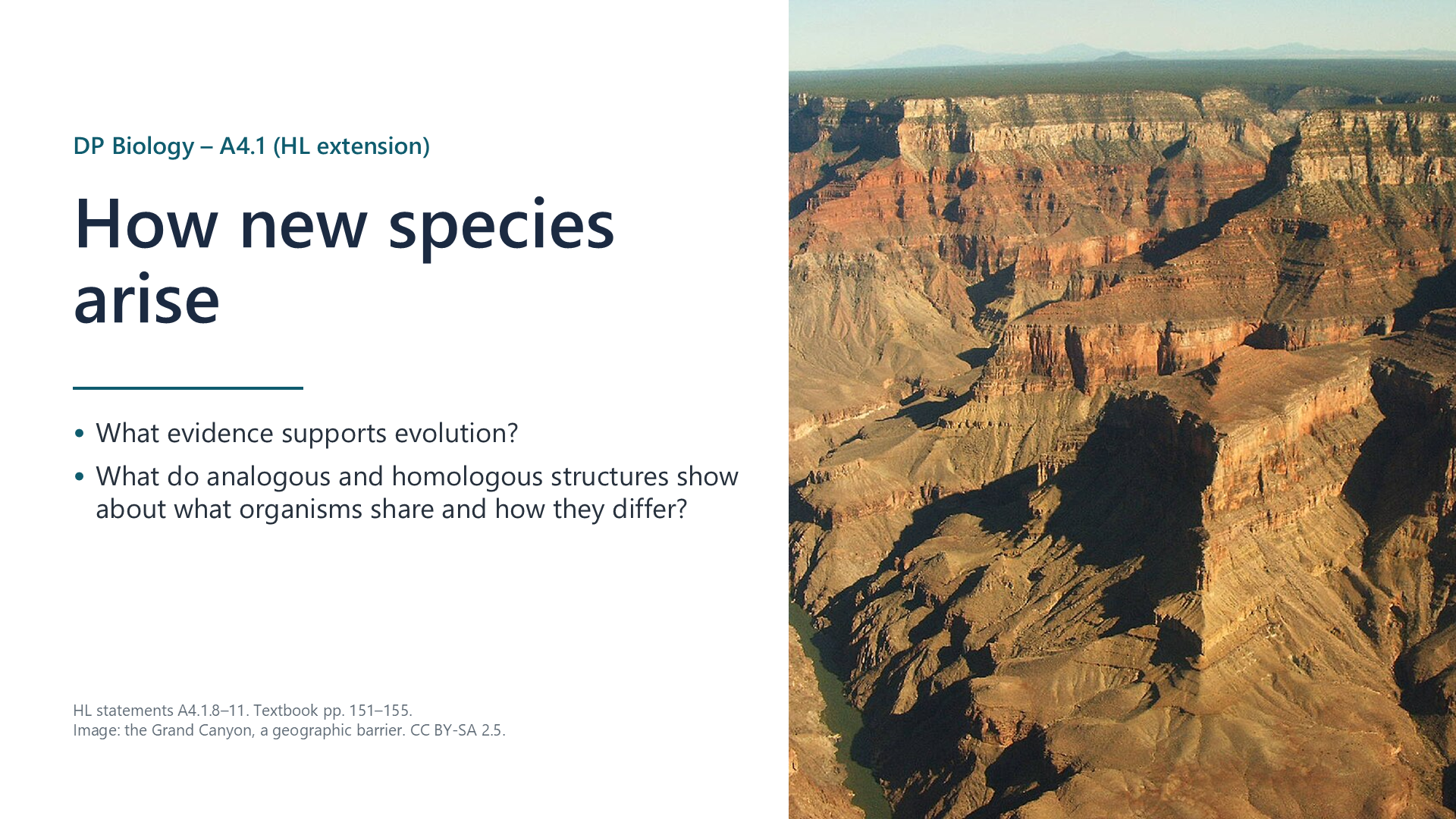
In both, gene pools are isolated and then diverge. In allopatric speciation the populations are separated geographically; in sympatric speciation they share an area but are isolated by behaviour or timing.
A4.1.9

Adaptive radiation

pp. 152–153

One ancestral species diversifies into many that fill different niches, as in Galápagos finches or bromeliads. Because they use different resources, close relatives can coexist without competing, which raises biodiversity.

A4.1.10

Barriers to hybridization

pp. 153–154

Species-specific courtship usually stops animals mating with other species. If hybrids do form, they are often sterile, as mules are, so alleles do not pass between species.

A4.1.11

Abrupt speciation in plants

pp. 154–155
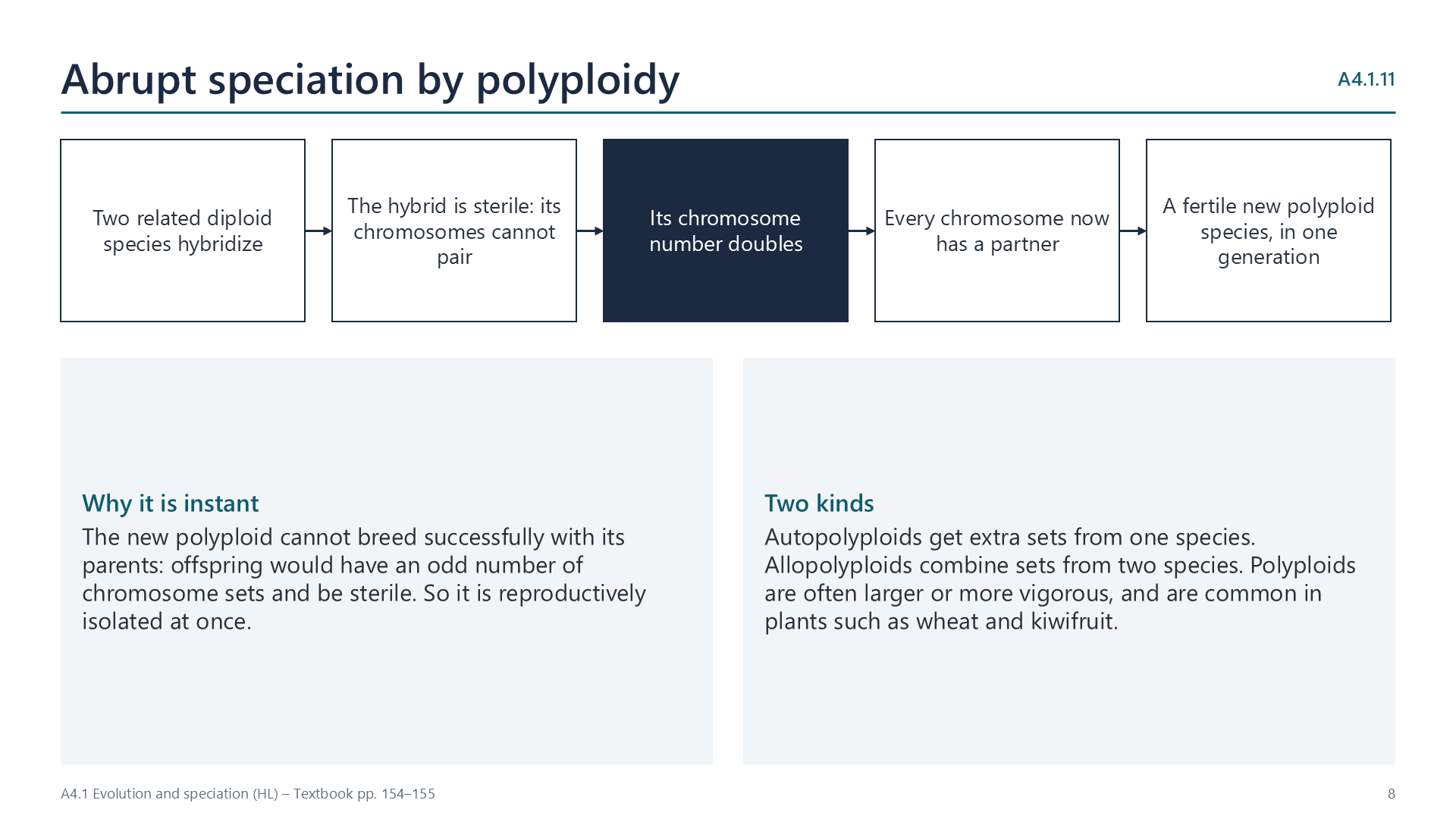
Slide: steps from hybridization to a fertile polyploid species

Two species hybridize; the sterile hybrid doubles its chromosomes and becomes fertile. The new polyploid cannot breed successfully with its parents, so it is a new species at once. Many species of Persicaria (knotweeds and smartweeds) arose this way.

Videos

Select a video to play it here. Select it again to close it.

Note-taking sheet

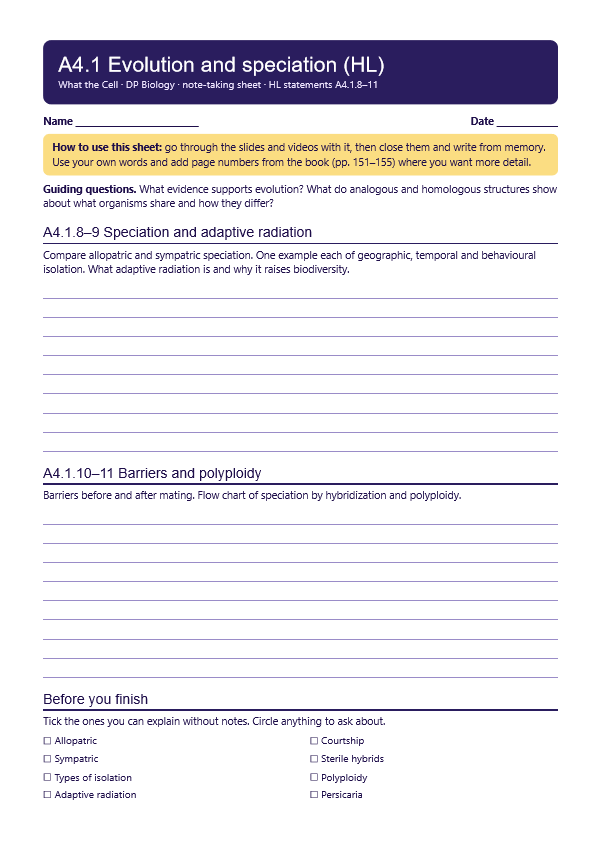
Print this guide and complete it as you work through the slides and videos. It asks for your own explanations, so close the notes while you try each section.

First page of the note-taking sheet

Quick self-check

The self-check needs JavaScript to run.

Practice questions

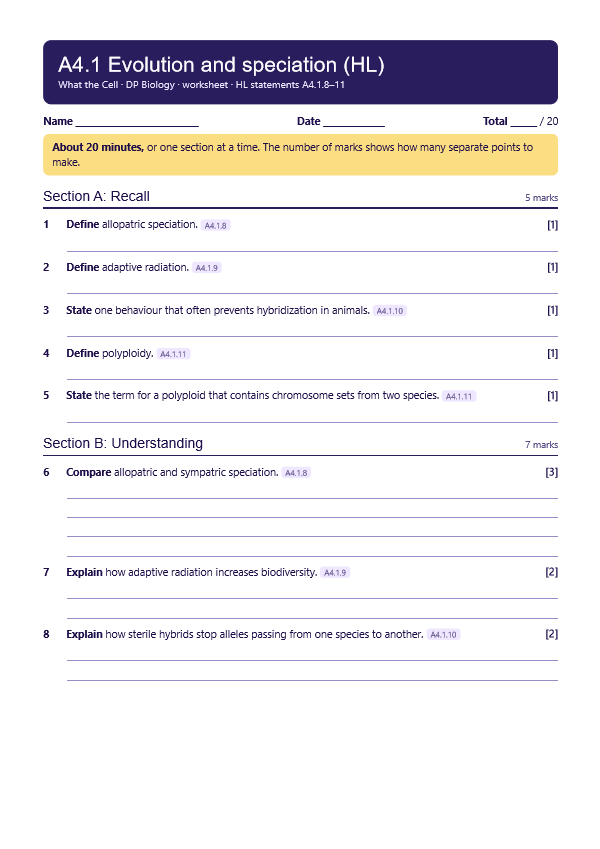
A printable worksheet covering all four statements, from quick recall to data questions and a longer answer. It has 20 marks and takes about 20 minutes, or you can do one section at a time.

Your teacher has the mark scheme.

First page of the worksheet

Practical

Modelling allopatric speciation

Model35 minA4.1.8

You will need: Two cups, coloured beads as alleles, dice, a different selection rule for each cup

  1. Split a starting bead population into two cups
  2. Apply a different selection rule to each for five generations
  3. Compare the bead frequencies
  4. Discuss how separation could lead to speciation, and how sympatric speciation would differ

Safety: Keep beads off the floor to avoid slips.

Carry this out with your teacher's supervision and follow your school's lab rules.

Nature of science and TOK

Syllabus statements

Summarised in our own words. Use each code to find the exact wording in your textbook or the IB subject guide.

  • A4.1.8How sympatric and allopatric speciation comparep. 151
  • A4.1.9Adaptive radiation as a source of new biodiversityp. 152
  • A4.1.10How hybridization barriers and sterile hybrids keep the alleles of species apartp. 153
  • A4.1.11Sudden speciation in plants through hybridization and polyploidyp. 154

More of A4.1 in this course

© 2026 Akash Parthi Bendran. Please ask before using or sharing any resources from this site: see permission to use.