What the Cell
C1.1

Enzymes and metabolism

HL extension
4 hours7 statementsTextbook pp. 396–404

Guiding questions

  1. How do enzymes act on, and respond to, other molecules?
  2. Which parts of metabolism depend on one another?

Slides

Slide 1 of 14

Notes

Written for this site from the class slides, with textbook page references for each statement. The chapter is on pages 396–404 of the course textbook. Image credits are on slide 14.

Metabolism

C1.1.11

Intracellular and extracellular reactions

p. 396

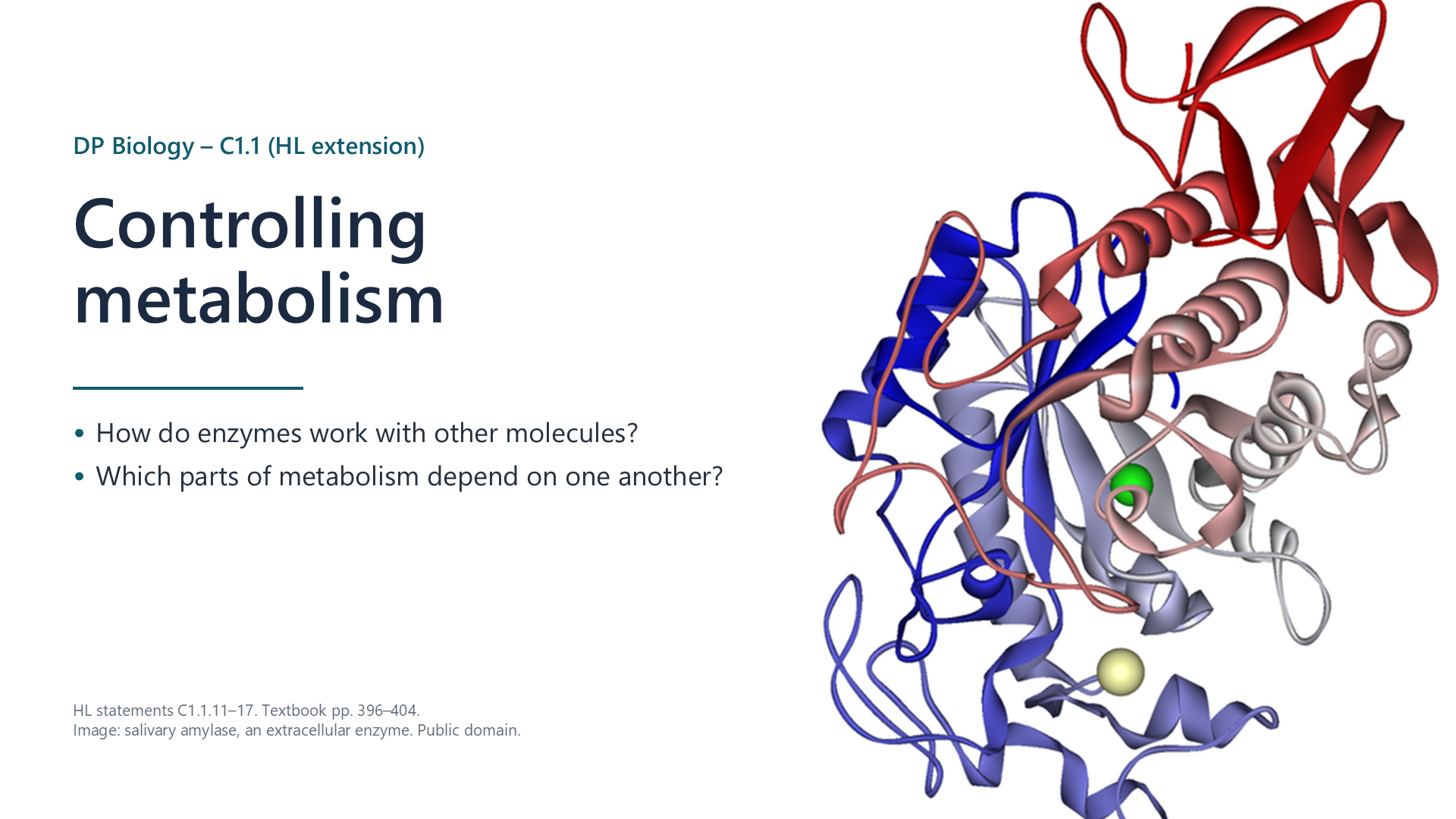
Most enzymes work inside the cell that made them, for example in glycolysis (cytoplasm) and the Krebs cycle (mitochondrial matrix). Some are secreted by exocytosis and work outside the cell, such as the digestive enzymes that break down food in the gut.
C1.1.12

Metabolism releases heat

pp. 396–397

No energy transfer in metabolism is 100% efficient, so heat is always released. Mammals and birds use this heat to keep a constant body temperature, and can raise it by shivering or by brown fat, which releases energy from respiration as heat.

C1.1.13

Linear and cyclical pathways

pp. 397–398

Metabolic pathways are series of enzyme-catalysed steps. In a linear pathway, such as glycolysis, a substrate is converted to an end product. In a cyclical pathway, such as the Krebs cycle and the Calvin cycle, the last step regenerates the first compound, so a small amount of it can process many molecules.

Inhibition

C1.1.14

Allosteric (non-competitive) inhibition

pp. 398–399

An allosteric site is a binding site away from the active site. Only specific molecules fit it. Binding changes the shape of the enzyme so the active site can no longer catalyse the reaction. Binding is reversible, and adding more substrate does not overcome the inhibition, so the maximum rate is lowered.

C1.1.15

Competitive inhibition

pp. 401–402
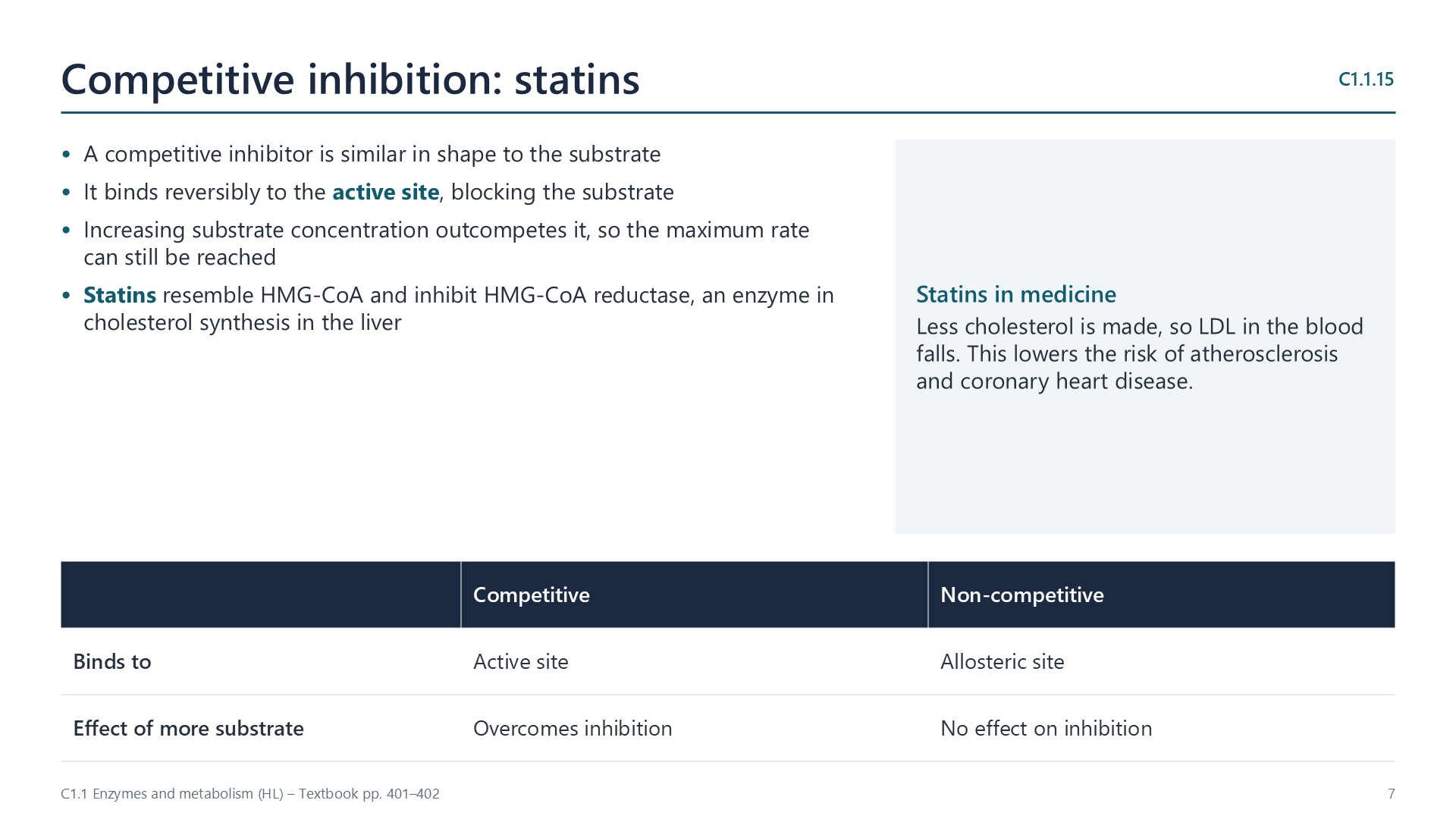
Slide: how statins inhibit HMG-CoA reductase, and a table comparing competitive and non-competitive inhibition

A competitive inhibitor resembles the substrate and binds reversibly to the active site. At high substrate concentration the substrate outcompetes it, so the maximum rate can still be reached. Statins inhibit HMG-CoA reductase in this way, reducing cholesterol synthesis in the liver and lowering LDL in the blood.

C1.1.16

Feedback inhibition

pp. 402–403

In bacteria and plants, isoleucine is made from threonine in a pathway of several steps. When isoleucine builds up, it binds to the allosteric site of the first enzyme, threonine deaminase, and slows the whole pathway. As isoleucine is used, it leaves the enzyme and production restarts. This negative feedback avoids wasting resources.

C1.1.17

Mechanism-based inhibition: penicillin

pp. 403–404

Bacteria use transpeptidases to cross-link peptidoglycan in their walls. Penicillin enters the active site, its four-membered ring opens and it forms a covalent bond with the enzyme, permanently inactivating it. Bacteria with a changed transpeptidase, whose active site binds penicillin poorly but still cross-links the wall, are resistant.

Videos

Select a video to play it here. Select it again to close it.

Note-taking sheet

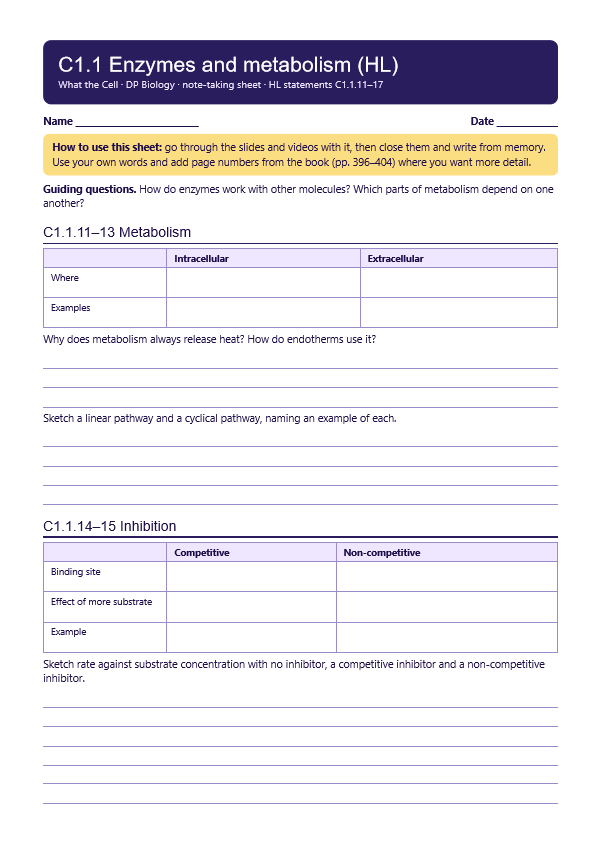
Print this guide and complete it as you work through the slides and videos. It asks for your own explanations, so close the notes while you try each section.

First page of the note-taking sheet

Quick self-check

The self-check needs JavaScript to run.

Practice questions

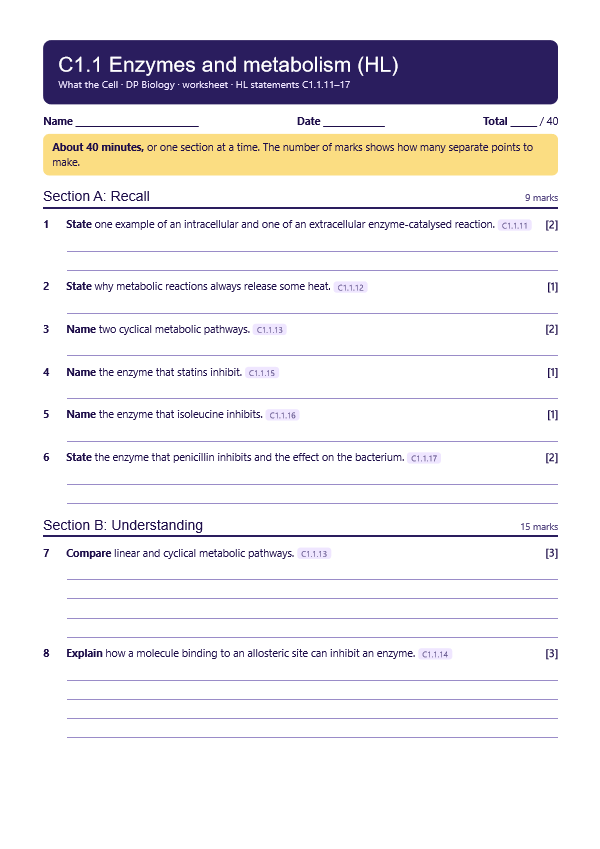
A printable worksheet covering all seven statements, from quick recall to data questions and a longer answer. It has 40 marks and takes about 40 minutes, or you can do one section at a time.

Your teacher has the mark scheme.

First page of the worksheet

Practical

Modelling competitive inhibition

Model30 minC1.1.15

You will need: Toothpicks as substrate, hands as enzymes, paper clips as inhibitor, timer

  1. Break as many toothpicks as you can in 30 seconds, picking them from a pile
  2. Repeat with a greater number of toothpicks
  3. Mix in paper clips, which must be picked up and held briefly first
  4. Plot rate against substrate, and explain the effect of the inhibitor

Safety: Eye protection, since toothpick pieces can fly. Keep hands away from broken ends.

Carry this out with your teacher's supervision and follow your school's lab rules.

Nature of science and TOK

Syllabus statements

Summarised in our own words. Use each code to find the exact wording in your textbook or the IB subject guide.

  • C1.1.11Enzyme reactions inside and outside cellsp. 396
  • C1.1.12Why metabolic reactions release heatp. 396
  • C1.1.13Linear and cyclical metabolic pathwaysp. 397
  • C1.1.14Inhibitors binding away from the active site: allosteric sites and non-competitive inhibitionp. 399
  • C1.1.15Competitive inhibition: an inhibitor bound reversibly at the active sitep. 401
  • C1.1.16How feedback inhibition controls metabolic pathwaysp. 402
  • C1.1.17Mechanism-based inhibition: an inhibitor binds permanently and chemically changes the active sitep. 403

More of C1.1 in this course

© 2026 Akash Parthi Bendran. Please ask before using or sharing any resources from this site: see permission to use.