What the Cell
B1.2

Proteins

HL extension
3 hours7 statementsTextbook pp. 210–222

Guiding questions

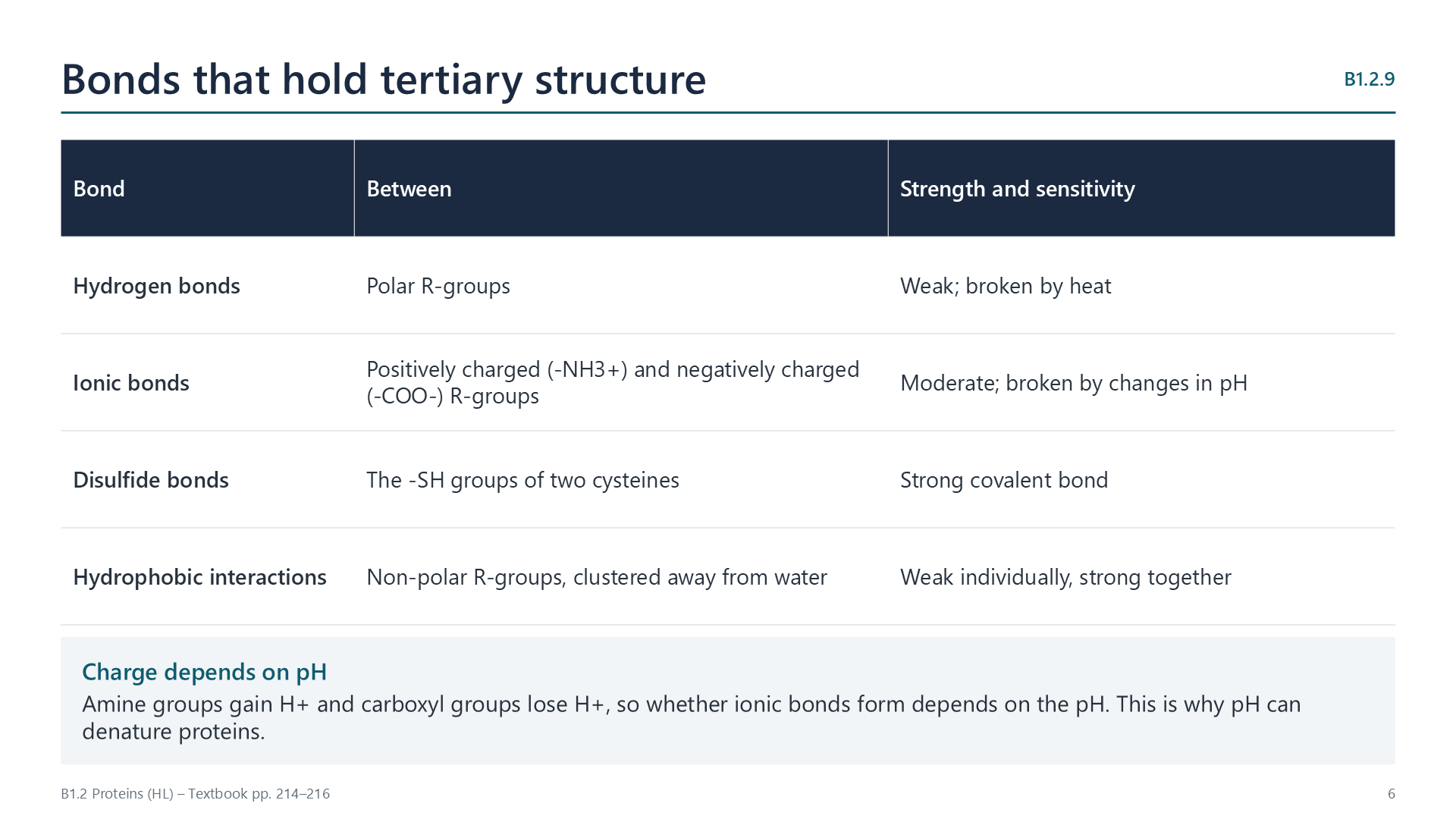
  1. How does the order of amino acids produce such a variety of protein forms and functions?
  2. How do chemical and physical conditions affect protein molecules?

Slides

Slide 1 of 14

Notes

Written for this site from the class slides, with textbook page references for each statement. The chapter is on pages 210–222 of the course textbook. Image credits are on slide 14.

From sequence to shape

B1.2.6

R-groups

pp. 211–212

All amino acids share an amine group, a carboxyl group and a hydrogen on one carbon; they differ in their R-group. R-groups are non-polar (hydrophobic) or hydrophilic; hydrophilic ones are polar or charged, either acidic (negative) or basic (positive). Twenty R-groups in any order give an almost endless variety of proteins, because the R-groups decide how a chain folds and what it binds.
B1.2.7

Primary structure determines shape

pp. 212–213

The primary structure is the sequence of amino acids, set by the gene. The sequence fixes where every R-group sits, so it determines the three-dimensional shape. That is why proteins have precise, repeatable structures, and why small unfolded proteins can refold correctly on their own.

B1.2.8

Secondary structure

pp. 213–214

Parts of the chain coil into an alpha helix or lie side by side as a beta-pleated sheet. Both are stabilized by hydrogen bonds at regular positions between the C=O of one amino acid and the N-H of another in the backbone, not between R-groups.

Folding and assembly

B1.2.9

Bonds in tertiary structure

pp. 214–216
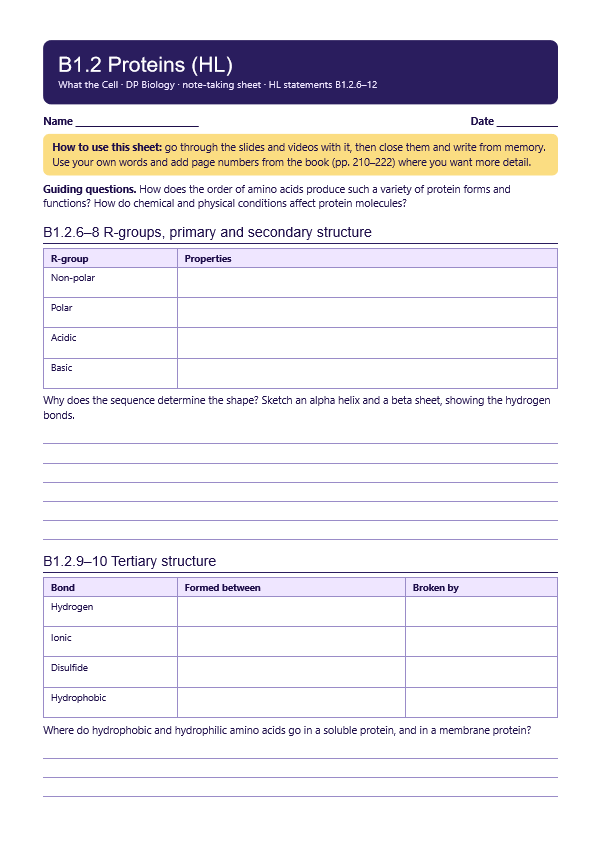
Slide: table of the four kinds of bond that hold tertiary structure

Tertiary structure is held by bonds between R-groups: hydrogen bonds between polar groups, ionic bonds between charged groups, disulfide bonds between pairs of cysteines, and hydrophobic interactions among non-polar groups. Amine and carboxyl groups gain or lose H+, so their charge, and the ionic bonds, depend on pH.

B1.2.10

Hydrophobic and hydrophilic amino acids

pp. 216–217

In soluble globular proteins, non-polar amino acids cluster in the core and polar ones face the water. Integral membrane proteins have non-polar regions where they cross the lipid bilayer and polar regions where they meet water; channel proteins also have polar amino acids lining the pore.

B1.2.11

Quaternary structure

pp. 217–220

Some proteins have two or more polypeptides. Insulin (two chains joined by disulfide bonds) and collagen (three chains in a triple helix) are non-conjugated. Haemoglobin has four chains, each with a haem prosthetic group containing iron, so it is a conjugated protein.

B1.2.12

Globular and fibrous proteins

pp. 220–222

Globular proteins such as insulin are compact and soluble; insulin’s precise shape lets it bind its receptor as it travels in the blood. Fibrous proteins such as collagen are long and insoluble; collagen’s repeating sequence, with glycine at every third position, lets three chains pack into a strong rope, giving tendons and skin tensile strength.

Videos

Select a video to play it here. Select it again to close it.

Note-taking sheet

Print this guide and complete it as you work through the slides and videos. It asks for your own explanations, so close the notes while you try each section.

First page of the note-taking sheet

Quick self-check

The self-check needs JavaScript to run.

Practice questions

A printable worksheet covering all seven statements, from quick recall to data questions and a longer answer. It has 40 marks and takes about 40 minutes, or you can do one section at a time.

Your teacher has the mark scheme.

First page of the worksheet

Practical

Folding a model protein

Model35 minB1.2.7, B1.2.8, B1.2.9

You will need: Pipe cleaners, coloured beads for polar, non-polar and charged R-groups

  1. Thread beads in a chosen order to represent primary structure
  2. Coil and pleat sections to show secondary structure
  3. Fold it, keeping non-polar beads inside, to form tertiary structure
  4. Change one bead and explain how this could alter the shape

Safety: No practical hazards. Take care with sharp pipe cleaner ends.

Carry this out with your teacher's supervision and follow your school's lab rules.

Nature of science and TOK

Syllabus statements

Summarised in our own words. Use each code to find the exact wording in your textbook or the IB subject guide.

  • B1.2.6How the varied chemistry of R-groups creates the huge range of protein forms and functionsp. 211
  • B1.2.7How primary structure determines the shape of a proteinp. 212
  • B1.2.8Secondary structure: pleated sheets and coiled helicesp. 213
  • B1.2.9The bonds that hold tertiary structure: hydrogen, ionic, disulfide and hydrophobic interactionsp. 214
  • B1.2.10How polar and non-polar amino acids shape tertiary structurep. 210
  • B1.2.11Proteins built from several chains, with or without non-protein parts: quaternary structurep. 217
  • B1.2.12How form relates to function in globular and fibrous proteinsp. 221

More of B1.2 in this course

© 2026 Akash Parthi Bendran. Please ask before using or sharing any resources from this site: see permission to use.