What the Cell
D1.3

Mutation and gene editing

HL extension
2 hours3 statementsTextbook pp. 643–647

Guiding questions

  1. How do mutations in genes arise?
  2. What effects do gene mutations have?

Slides

Slide 1 of 11

Notes

Written for this site from the class slides, with textbook page references for each statement. The chapter is on pages 643–647 of the course textbook. Image credits are on slide 11.

Studying and editing genes

D1.3.8

Gene knockout

pp. 643–645
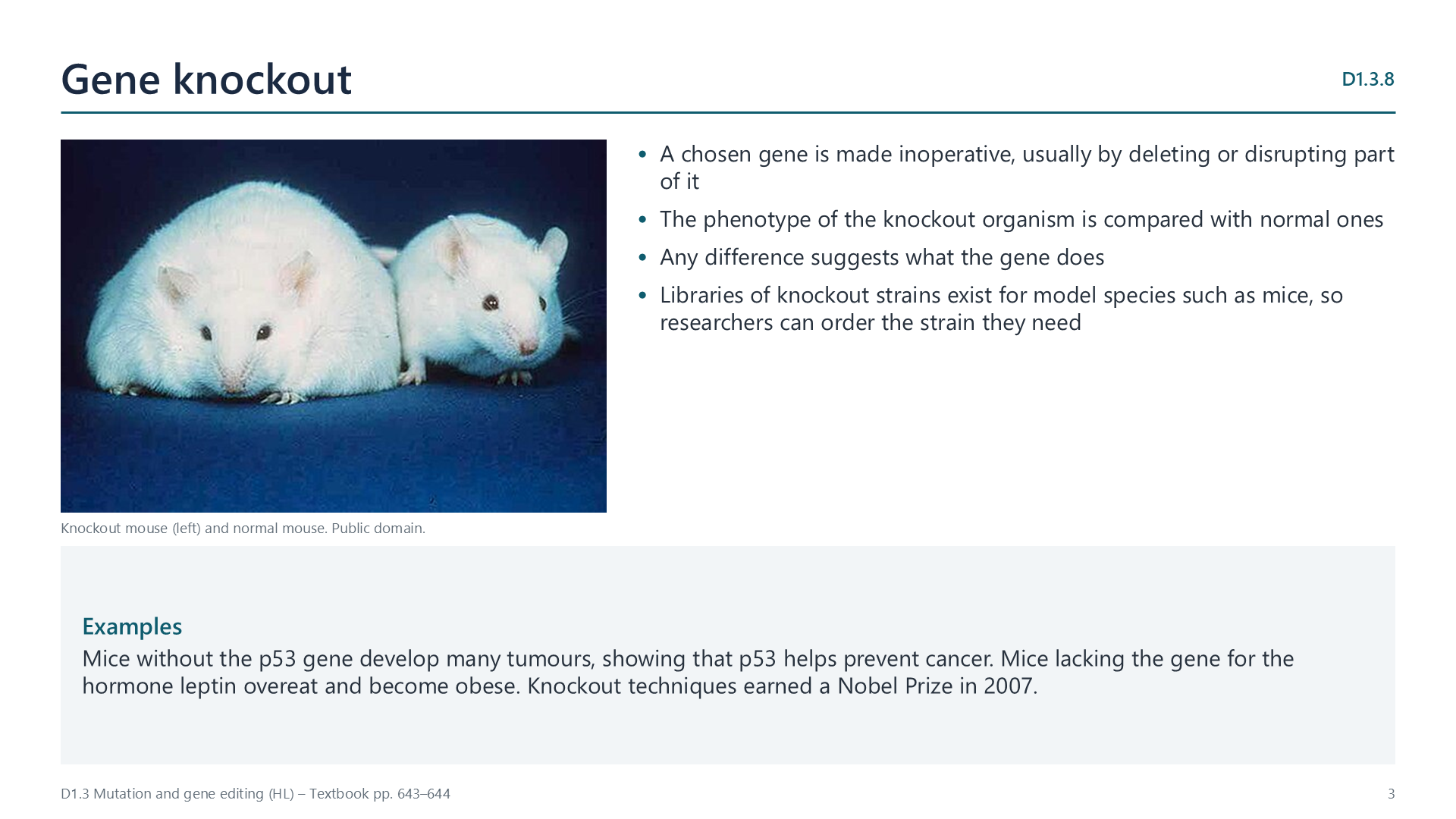
Slide: an obese knockout mouse beside a normal mouse, with notes on gene knockout

A gene knockout makes a chosen gene inoperative, usually by deleting or disrupting part of it. Comparing the knockout organism with normal ones shows what the gene does: mice without p53 develop many tumours; mice without the leptin gene overeat and become obese. Libraries of knockout strains exist for model species such as mice. Results may not transfer exactly to humans, and other genes can compensate.
D1.3.9

CRISPR-Cas9

pp. 645–646

Scientists design a guide RNA whose bases match the target DNA. It binds the enzyme Cas9, which is led to the matching sequence and cuts both strands. When the cell repairs the cut, the gene can be disabled or new DNA inserted. A successful use: blood stem cells from people with sickle cell disease are edited so their red blood cells make foetal haemoglobin, which does not sickle; the treatment was approved in 2023.

D1.3.10

Conserved sequences

pp. 646–647

Conserved sequences are identical or similar across a species or group; highly conserved sequences have stayed similar over long periods of evolution, like histone genes in peas and humans. Two hypotheses explain this: the product only works with that sequence, so selection removes changes; or those regions have a slower rate of mutation.

Videos

Select a video to play it here. Select it again to close it.

Note-taking sheet

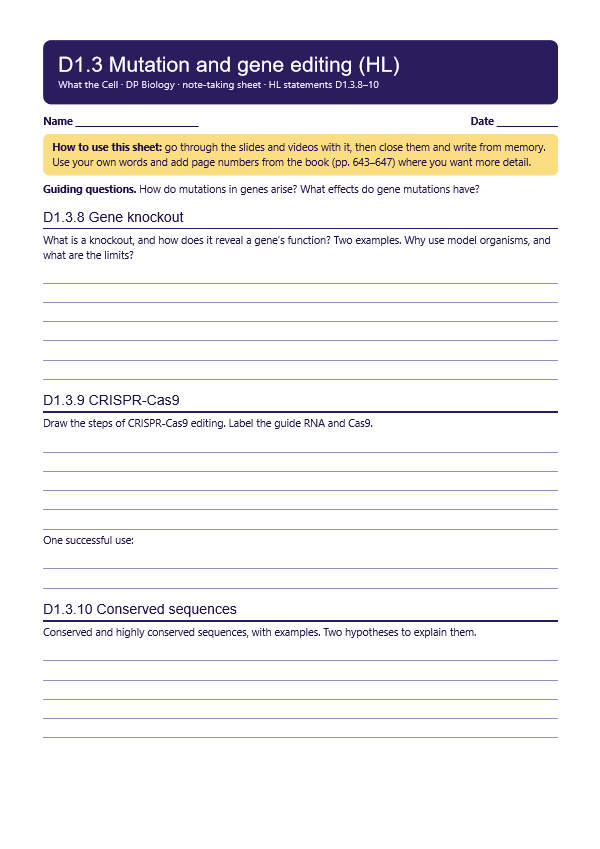
Print this guide and complete it as you work through the slides and videos. It asks for your own explanations, so close the notes while you try each section.

First page of the note-taking sheet

Quick self-check

The self-check needs JavaScript to run.

Practice questions

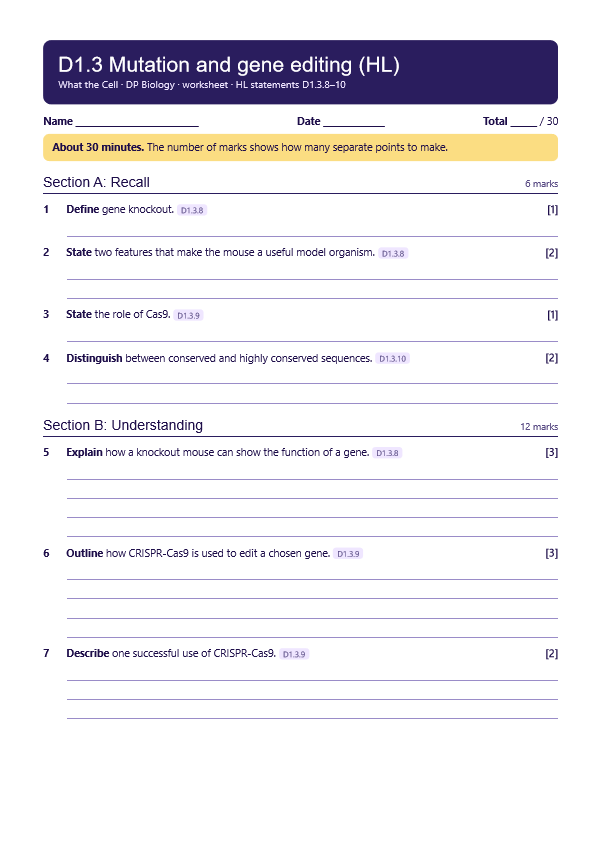
A printable worksheet covering all three statements, from quick recall to data questions and a longer answer. It has 30 marks and takes about 30 minutes, or you can do one section at a time.

Your teacher has the mark scheme.

First page of the worksheet

Practical

Modelling gene editing with CRISPR-Cas9

Model25 minD1.3.9

You will need: Paper strip DNA sequence, guide RNA card, scissors as Cas9, tape, replacement sequence

  1. Slide the guide RNA along the DNA until it matches
  2. Cut at that location with the scissors
  3. Tape in the replacement sequence
  4. Discuss why the guide must be specific, and the ethical questions that editing raises

Safety: Take care with scissors.

Carry this out with your teacher's supervision and follow your school's lab rules.

Nature of science and TOK

Syllabus statements

Summarised in our own words. Use each code to find the exact wording in your textbook or the IB subject guide.

  • D1.3.8Gene knockout: switching off a gene to discover what it doesp. 643
  • D1.3.9How CRISPR sequences and Cas9 are used to edit genesp. 644
  • D1.3.10Ideas that explain why some gene sequences are highly conservedp. 647

More of D1.3 in this course

© 2026 Akash Parthi Bendran. Please ask before using or sharing any resources from this site: see permission to use.