What the Cell
D4.2

Stability and change

HL extension
3 hours4 statementsTextbook pp. 814–819

Guiding questions

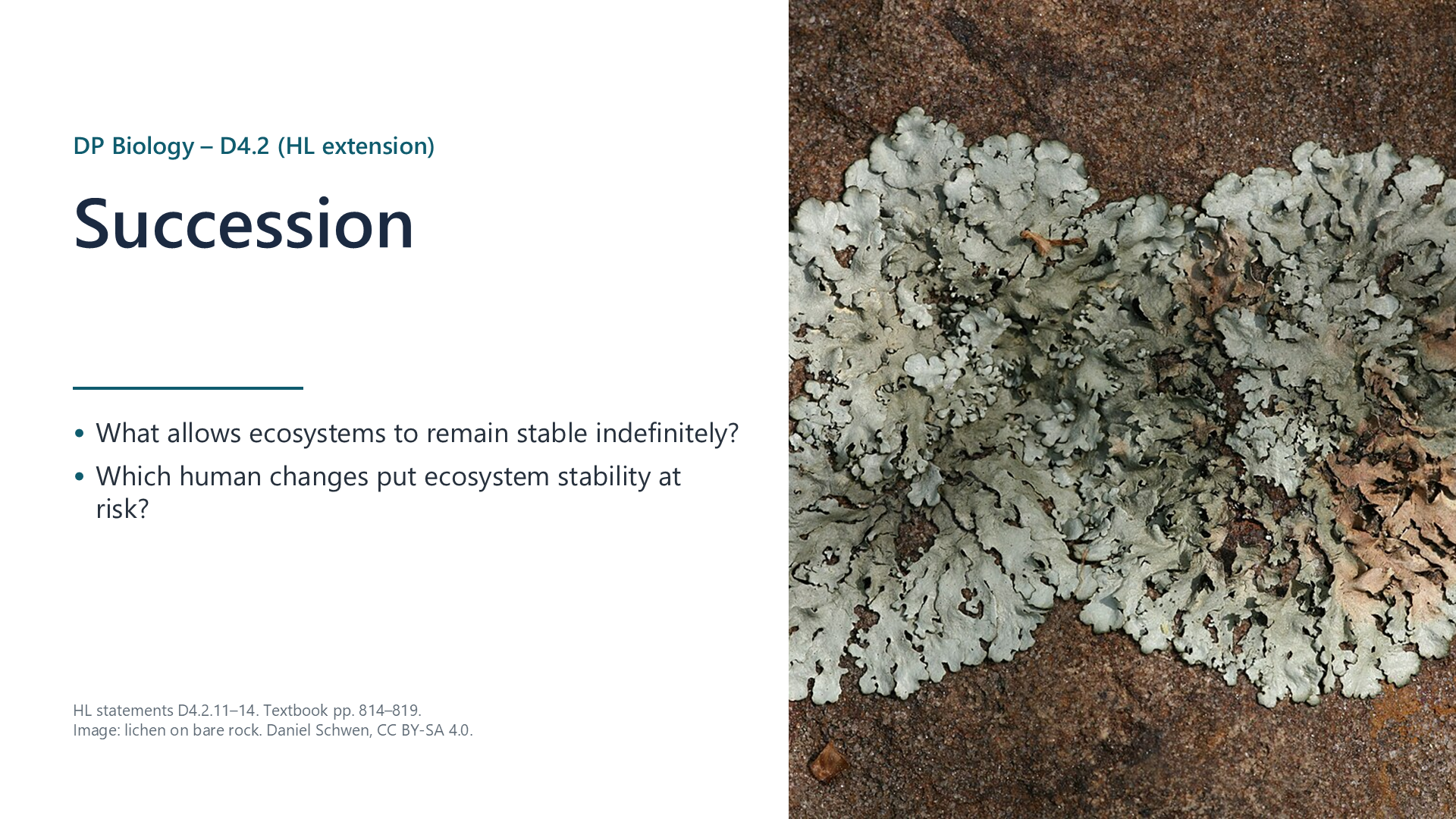
  1. What allows ecosystems to remain stable indefinitely?
  2. Which human changes put ecosystem stability at risk?

Slides

Slide 1 of 10

Notes

Written for this site from the class slides, with textbook page references for each statement. The chapter is on pages 814–819 of the course textbook. Image credits are on slide 10.

Succession

D4.2.11

What drives succession

p. 814

Succession is a directional change in the species of a community over time, driven by abiotic changes such as water, temperature and soil, and by biotic changes such as competition. Primary succession starts without soil; secondary succession starts where soil remains.
D4.2.12

Primary succession

pp. 815–816
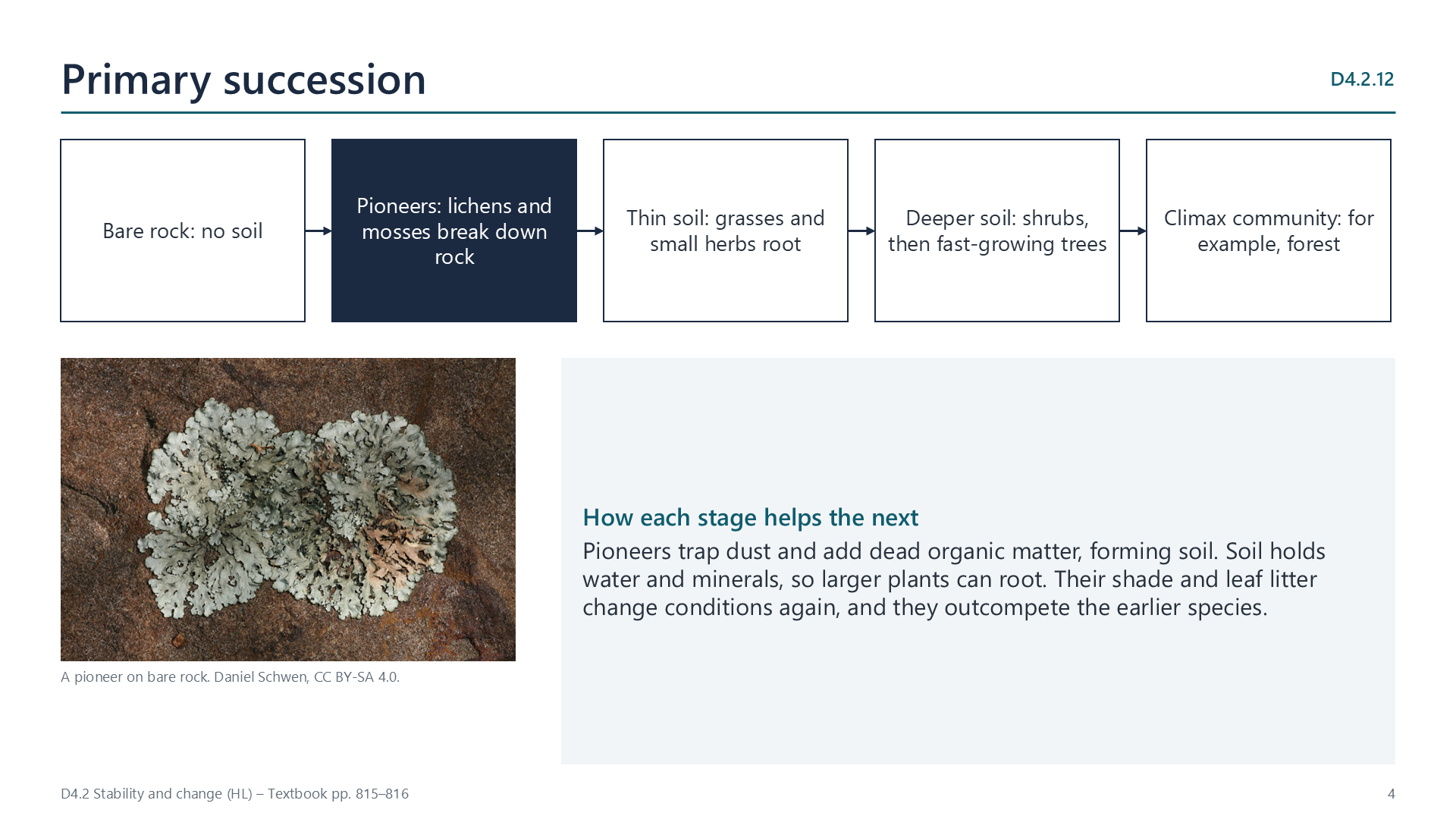
Slide: stages from bare rock through pioneers to a climax community

Pioneers such as lichens begin to form soil, which lets larger plants root. Plant size, primary production, species diversity, food-web complexity and nutrient cycling all increase.

D4.2.13

Cyclical succession

p. 817

Some ecosystems repeat a cycle of communities with no fixed climax. On some New Zealand rocky shores, barnacles, algae and then mussels settle in turn, and when the mussels detach the rock is bare again.

D4.2.14

Climax and arrested succession

pp. 818–819

A climax community is stable and in balance with its climate and soil. Human activity can arrest succession: livestock eat tree seedlings, and draining wetlands removes the waterlogged conditions their species need.

Videos

Select a video to play it here. Select it again to close it.

Note-taking sheet

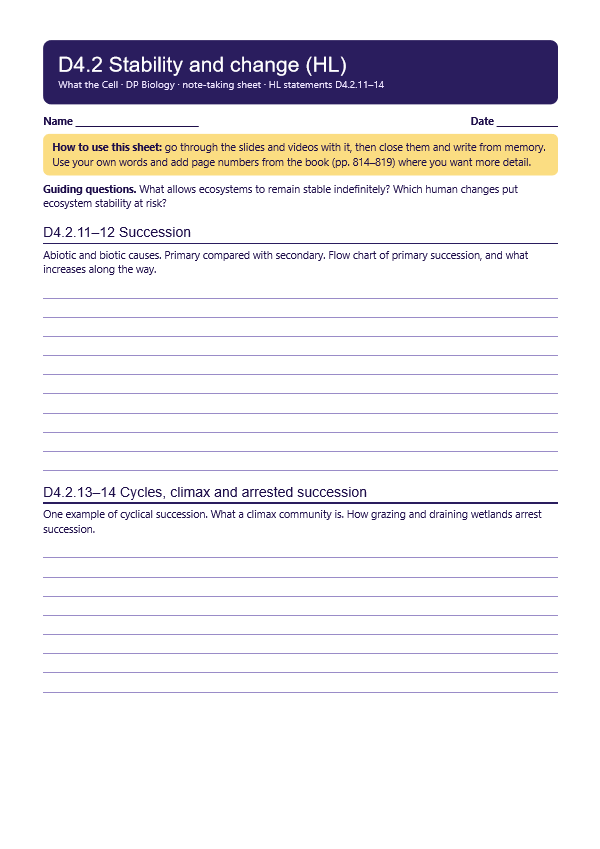
Print this guide and complete it as you work through the slides and videos. It asks for your own explanations, so close the notes while you try each section.

First page of the note-taking sheet

Quick self-check

The self-check needs JavaScript to run.

Practice questions

A printable worksheet covering all four statements, from quick recall to data questions and a longer answer. It has 30 marks and takes about 30 minutes, or you can do one section at a time.

Your teacher has the mark scheme.

First page of the worksheet

Practical

Succession in a jar

Lab20 min, then 2 weeksD4.2.11

You will need: Hay or dried grass, pond water, clear jars, microscope, slides

  1. Set up jars of hay and pond water, loosely covered
  2. Sample every few days and view under a microscope
  3. Record which types of organism appear and when
  4. Describe the changes, and relate them to succession

Safety: Wash hands after handling. Keep lids loose, and dispose of it all according to school procedures.

Carry this out with your teacher's supervision and follow your school's lab rules.

Nature of science and TOK

Syllabus statements

Summarised in our own words. Use each code to find the exact wording in your textbook or the IB subject guide.

  • D4.2.11Ecological succession and what drives itp. 814
  • D4.2.12What changes during primary successionp. 815
  • D4.2.13Cyclical successionp. 817
  • D4.2.14Climax communities and succession that has been arrestedp. 818

More of D4.2 in this course

© 2026 Akash Parthi Bendran. Please ask before using or sharing any resources from this site: see permission to use.