What the Cell
D3.3

Homeostasis

4 hours6 statementsTextbook pp. 760–767

Guiding questions

  1. How do humans keep internal conditions constant?
  2. Why is it useful for organisms to keep internal conditions constant?

Slides

Slide 1 of 18

Notes

Written for this site from the course textbook and class slides. Use the page numbers to read the book's fuller account. Image credits are on slide 18.

The principle

D3.3.1

Homeostasis: keeping the internal environment steady

p. 760

Homeostasis is maintaining the internal environment within preset limits, despite changes in the external environment. In humans, the controlled variables include body temperature, blood pH, blood glucose concentration and blood osmotic concentration.

Watch out: homeostasis is about the internal environment. It does not mean moving to somewhere more comfortable.
D3.3.2

How negative feedback loops work

p. 761
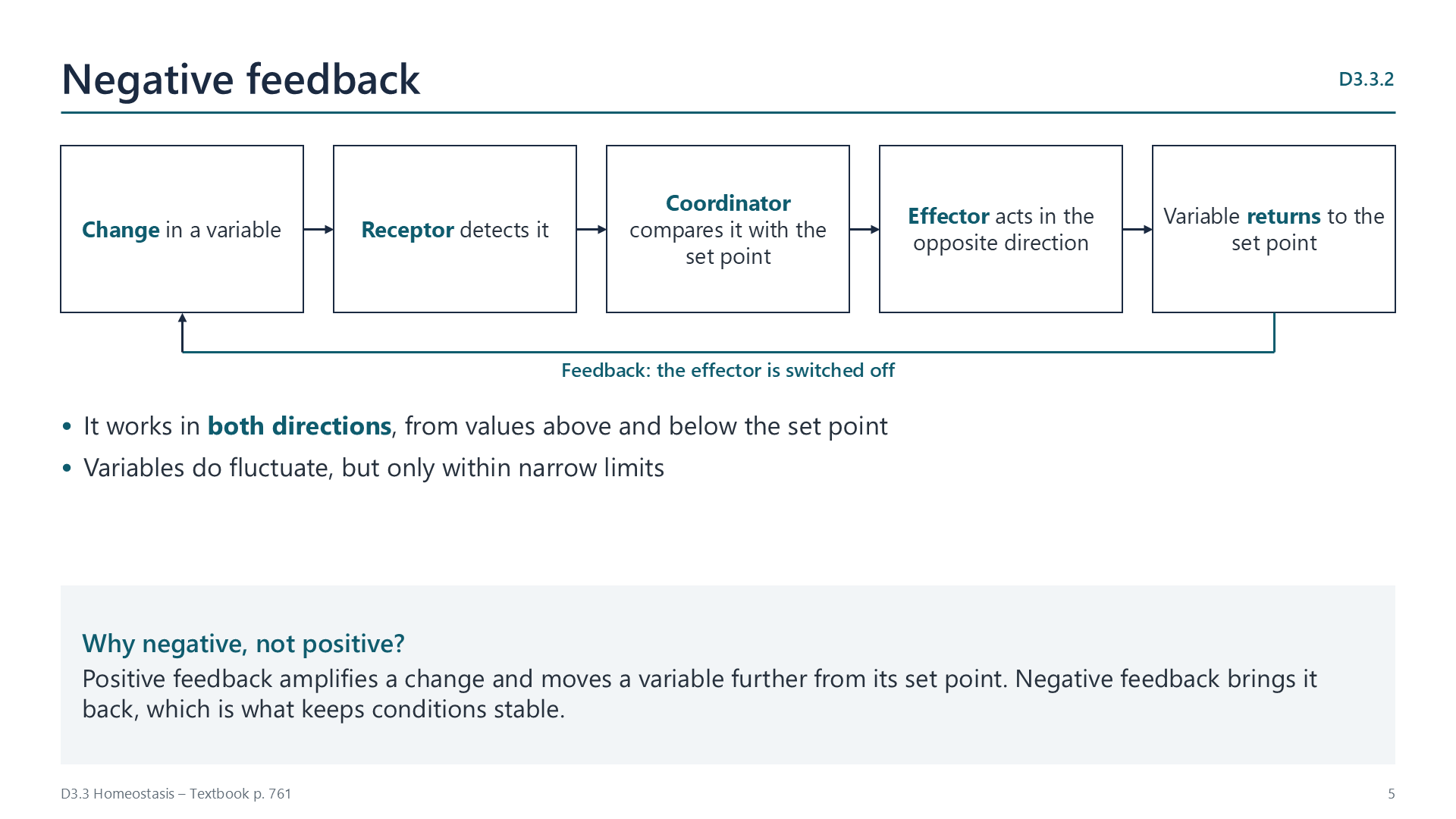
Slide: the negative feedback loop from a change in a variable back to the set point

A receptor detects a change, a coordinator compares it with the set point, and an effector acts in the opposite direction. Negative feedback returns a variable to the set point from above and from below. Positive feedback would move it further away, which is why homeostasis does not use it.

Blood glucose

D3.3.3

How hormones regulate blood glucose

pp. 761–763

Blood glucose is normally about 90 mg per 100 cm³. The brain has no glycogen store, so it depends on a steady supply from the blood.

Glucose too highGlucose too low
Detected byBeta cells in the islets of LangerhansAlpha cells in the islets of Langerhans
HormoneInsulinGlucagon
Target cellsLiver, muscle and other tissuesLiver
EffectGlucose uptake; storage as glycogen; more used in respirationGlycogen broken down; glucose released

Watch out: glucagon is a hormone, and glycogen is the storage product. The pancreas itself detects the change, so the hypothalamus is not involved.

D3.3.4

The changes behind type 1 and type 2 diabetes

pp. 764–765
Type 1Type 2
Physiological changeThe immune system destroys beta cells, so little or no insulin is producedInsulin is produced, but target cells do not respond well to it
Risk factorsGenes, and possibly exposure to some virusesOverweight, inactivity, age, family history
PreventionNone known at presentHealthy diet, regular exercise, healthy weight
TreatmentInsulin, with regular monitoring of blood glucoseDiet and exercise, sometimes medicine

In either type, blood glucose stays raised and glucose may appear in urine. Long-term effects can include damage to the kidneys, eyes, nerves and blood vessels.

Watch out: do not say that type 2 is simply caused by a high-sugar diet. Such a diet is linked with it, and is one of several risk factors.

Body temperature

D3.3.5

Temperature control as negative feedback

p. 766

Peripheral thermoreceptors in the skin detect temperature changes. The hypothalamus compares these with the set point and signals to effectors, including muscle and adipose tissue.

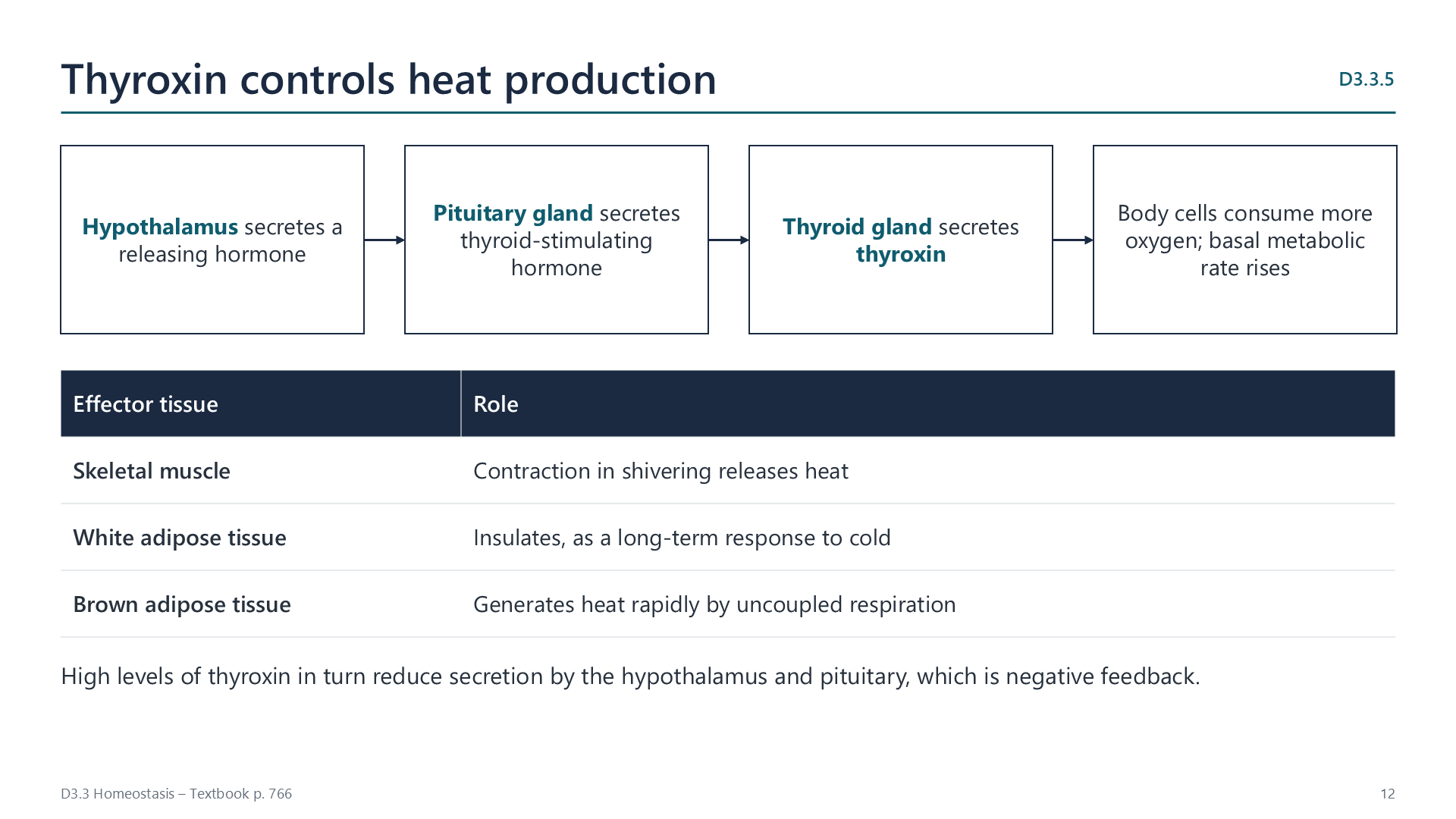
Hormones are involved too. The hypothalamus secretes a releasing hormone, the pituitary gland secretes thyroid-stimulating hormone, and the thyroid gland secretes thyroxin. Thyroxin raises oxygen consumption and metabolic rate, which generates heat.

Slide: steps from the hypothalamus to thyroxin, with a table of effector tissues
D3.3.6

How humans regulate body temperature

pp. 766–767
Too hotToo cold
Skin arteriolesVasodilation: more blood to the skinVasoconstriction: less blood to the skin
Sweat glandsMore sweat, which evaporatesLess sweat
HairMuscles relax; hairs lie flatMuscles contract; hair erection traps air
MuscleNo shiveringShivering generates heat
Brown adipose tissueLittle activityUncoupled respiration releases heat

Sweat cools the skin because evaporation breaks hydrogen bonds, which takes heat energy. Uncoupled respiration in brown adipose tissue releases energy as heat rather than storing it in ATP, which is important for newborn babies. Birds and mammals also use behaviour to regulate temperature.

Watch out: blood vessels do not move up or down in the skin. Arterioles widen or narrow, which changes how much blood flows through the surface capillaries.

Videos

Select a video to play it here. Select it again to close it.

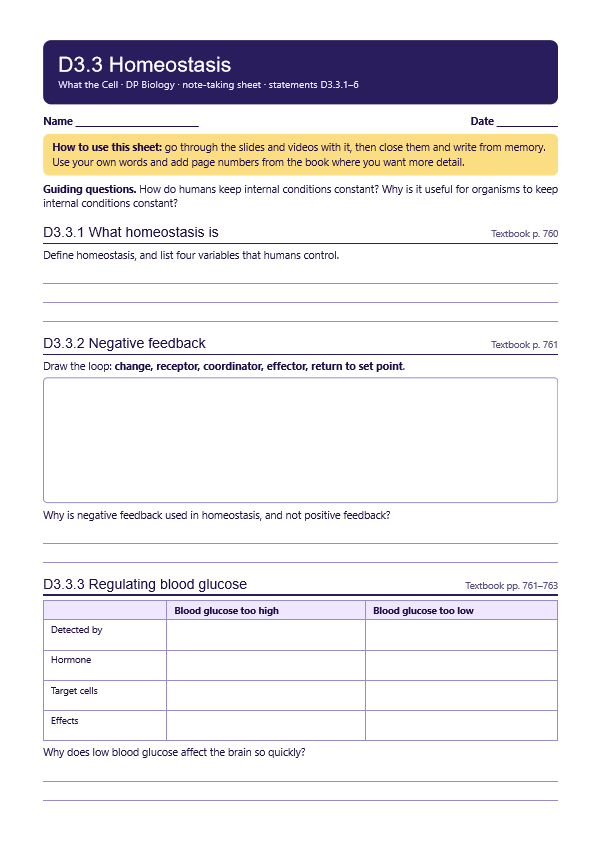
Note-taking sheet

Print this guide and complete it as you work through the slides and videos. It asks for your own explanations, so close the notes while you try each section.

First page of the note-taking sheet

Quick self-check

The self-check needs JavaScript to run.

Practice questions

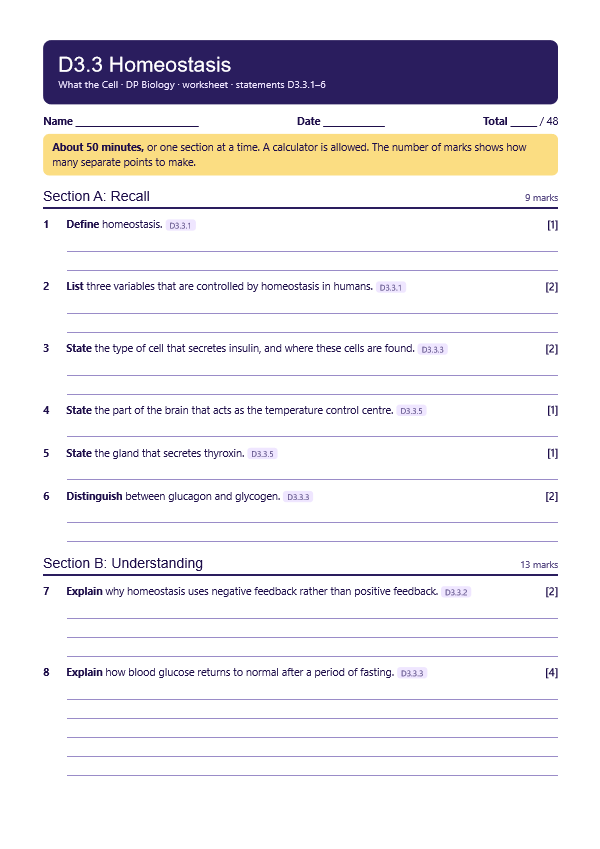
A printable worksheet covering all six statements, from quick recall to data questions and longer answers. It has 48 marks and takes about 50 minutes, or you can do one section at a time.

Your teacher has the mark scheme.

First page of the worksheet

Data-based questions

Questions built on realistic experimental data, in the style of Paper 1B and Paper 2. Work them on paper and show your working. 19 marks in total. Your teacher has the mark scheme.

A glucose tolerance test

7 marks
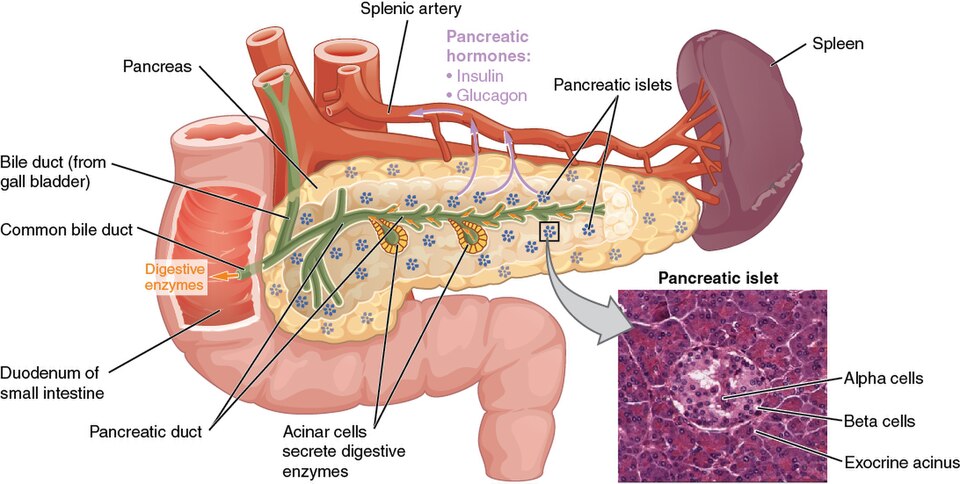
Pancreas tissue
Photo: OpenStax College, CC BY 3.0, Wikimedia Commons.

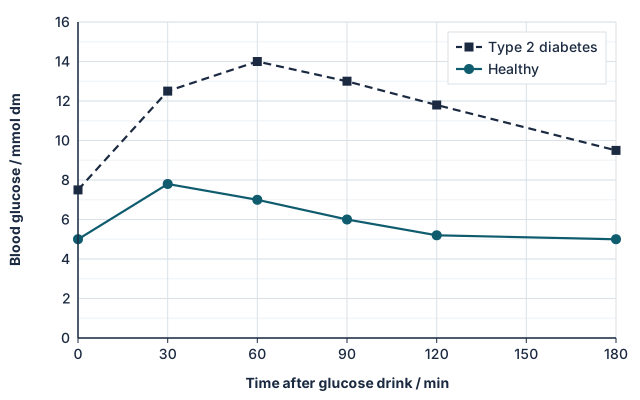
In an oral glucose tolerance test, a person who has not eaten overnight drinks a solution containing 75 g of glucose, and blood glucose is measured for three hours. The graph shows mean results for 20 healthy adults and 20 adults with type 2 diabetes.

Line graph of blood glucose. Healthy adults rise from 5.0 to 7.8 at 30 minutes and return to 5.0 by 180. Adults with type 2 diabetes rise from 7.5 to 14.0 at 60 minutes and are still 9.5 at 180.
  1. State the blood glucose of healthy adults 60 minutes after the drink. [1]
  2. Compare the results of the two groups. [2]
  3. A value of 11.1 mmol dm−3 or more at 120 minutes indicates diabetes. Deduce whether the test identifies the diabetic group. [1]
  4. Explain how blood glucose returns to normal in the healthy adults. [3]

Heat illness in marathon runners

6 marks

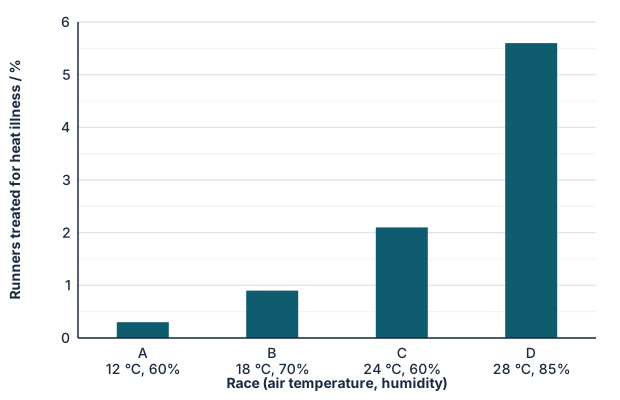
Organisers of four city marathons recorded the percentage of runners treated for heat illness. Weather at the start of each race is shown.

Bar chart of runners treated for heat illness: race A, 12 degrees and 60% humidity, 0.3%; race B, 18 degrees and 70%, 0.9%; race C, 24 degrees and 60%, 2.1%; race D, 28 degrees and 85%, 5.6%.
  1. Describe the relationship between air temperature and heat illness. [1]
  2. One organiser claimed that humidity, not temperature, causes most heat illness. Evaluate this claim using the data. [2]
  3. Explain why high humidity increases the risk of overheating. [1]
  4. Suggest two ways runners can reduce the risk of heat illness. [2]

Body temperature in a sloth

6 marks

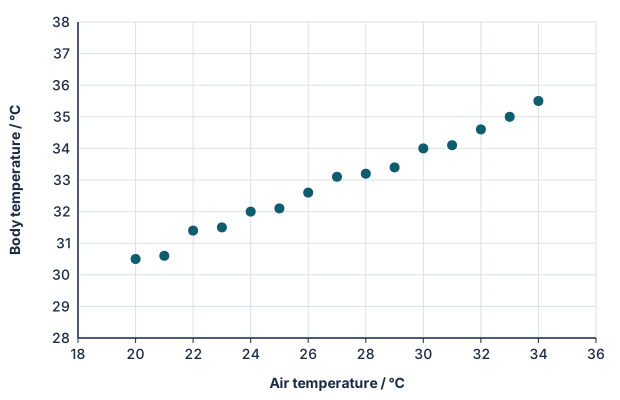
Brown-throated three-toed sloths (Bradypus variegatus) live in trees in Central and South America and eat leaves, which give little energy. The body temperature of sloths was measured at different air temperatures.

Scatter graph of body temperature against air temperature. Body temperature rises from about 30.5 at 20 degrees to about 35.5 at 34 degrees.
  1. Describe the relationship between air temperature and body temperature. [1]
  2. Calculate the mean change in body temperature for each 1 °C rise in air temperature between 20 and 34 °C. [1]
  3. Compare the sloths with a human in the same conditions. [1]
  4. Suggest two reasons why it is an advantage for sloths not to keep a constant body temperature. [2]
  5. Suggest why sloths eat more on warm days. [1]

Practical

Evaporative cooling and body temperature

Lab40 minD3.3.5, D3.3.6

You will need: Two boiling tubes, paper towel, thermometers or probes, warm water at about 40 C

  1. Wrap one tube in wet paper towel and the other in dry paper towel
  2. Fill both with the same volume of warm water
  3. Record temperature every minute for 15 minutes
  4. Relate the difference in cooling to sweating

Safety: Water no hotter than 45 C. Wipe up spills.

Carry this out with your teacher's supervision and follow your school's lab rules.

Nature of science and TOK

Syllabus statements

Summarised in our own words. Use each code to find the exact wording in your textbook or the IB subject guide.

  • D3.3.1Homeostasis: keeping an organism's internal environment steadyp. 760
  • D3.3.2How negative feedback loops work in homeostasisp. 761
  • D3.3.3How hormones regulate blood glucosep. 761
  • D3.3.4The changes in the body behind type 1 and type 2 diabetesp. 764
  • D3.3.5Temperature control as a case of negative feedbackp. 766
  • D3.3.6How humans regulate body temperaturep. 766

HL extension

© 2026 Akash Parthi Bendran. Please ask before using or sharing any resources from this site: see permission to use.