What the Cell
D3.3

Homeostasis

HL extension
3 hours5 statementsTextbook pp. 768–778

Guiding questions

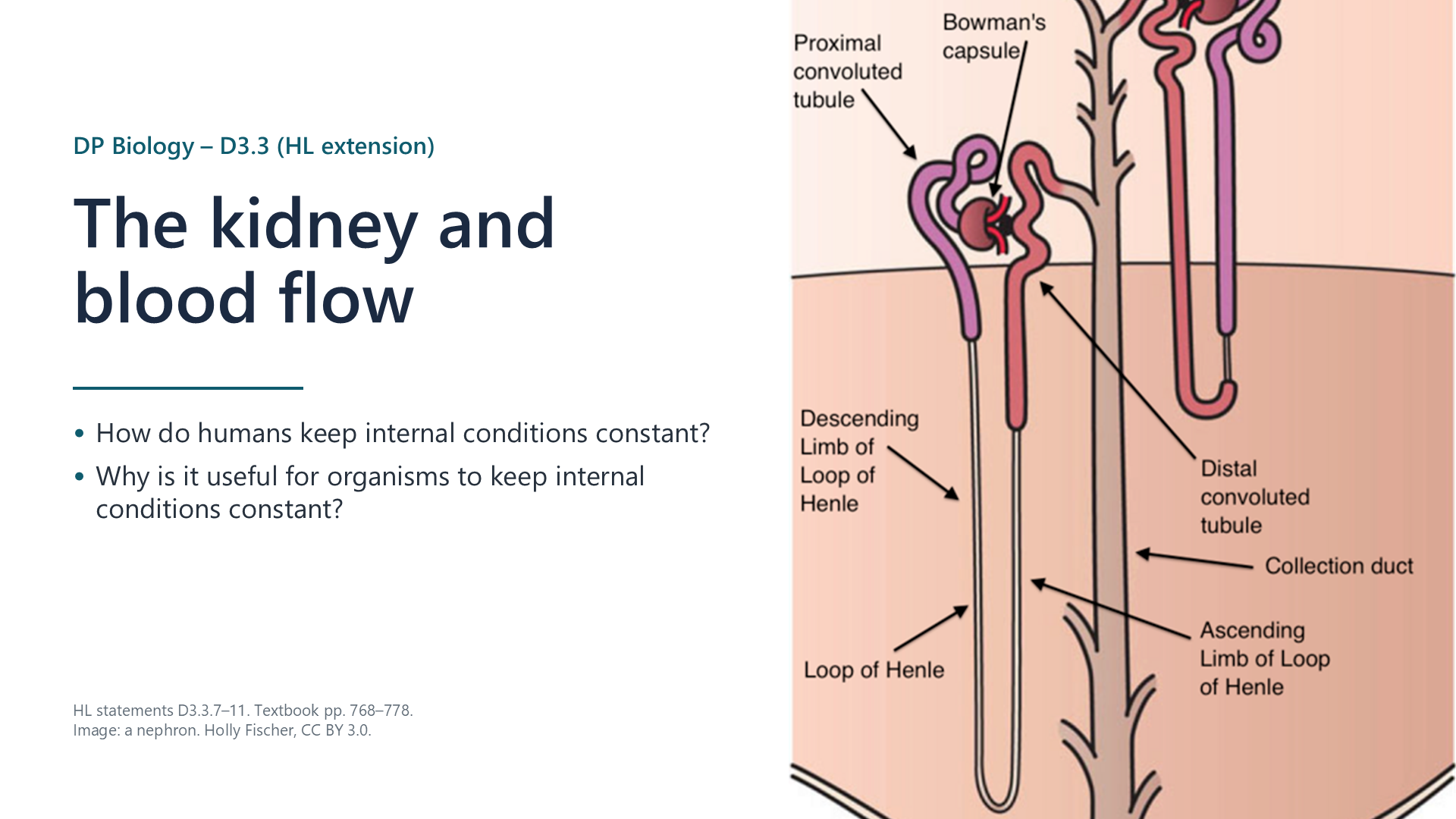
  1. How do humans keep internal conditions constant?
  2. Why is it useful for organisms to keep internal conditions constant?

Slides

Slide 1 of 16

Notes

Written for this site from the class slides, with textbook page references for each statement. The chapter is on pages 768–778 of the course textbook. Image credits are on slide 16.

The kidney

D3.3.7

Excretion and osmoregulation

pp. 768–770

Excretion removes waste products of metabolism, such as urea. Osmoregulation controls the osmotic concentration of body fluids, measured in osmol L−1. The kidney does both: it leaves wastes in the urine and varies how much water it reabsorbs.
D3.3.8

Ultrafiltration and reabsorption

pp. 771–772
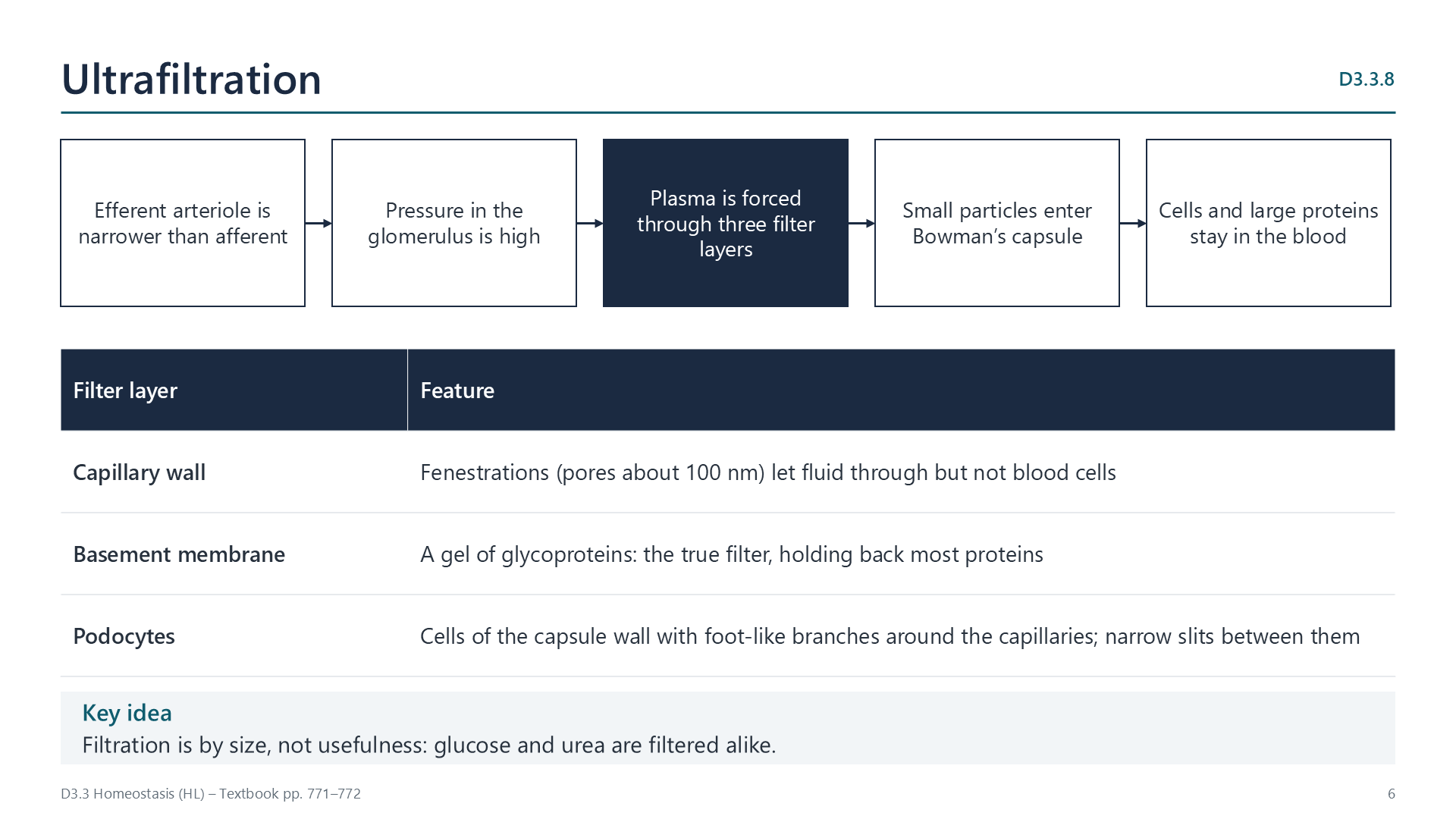
Slide: the steps of ultrafiltration and the three filter layers

High pressure in the glomerulus forces plasma through fenestrated capillaries, the basement membrane and slits between podocytes into Bowman’s capsule. Cells and proteins stay behind. In the proximal convoluted tubule, cells with microvilli and many mitochondria reabsorb all the glucose, amino acids and most salt and water, leaving urea and toxins in the filtrate.

D3.3.9

Loop of Henle

pp. 773–774
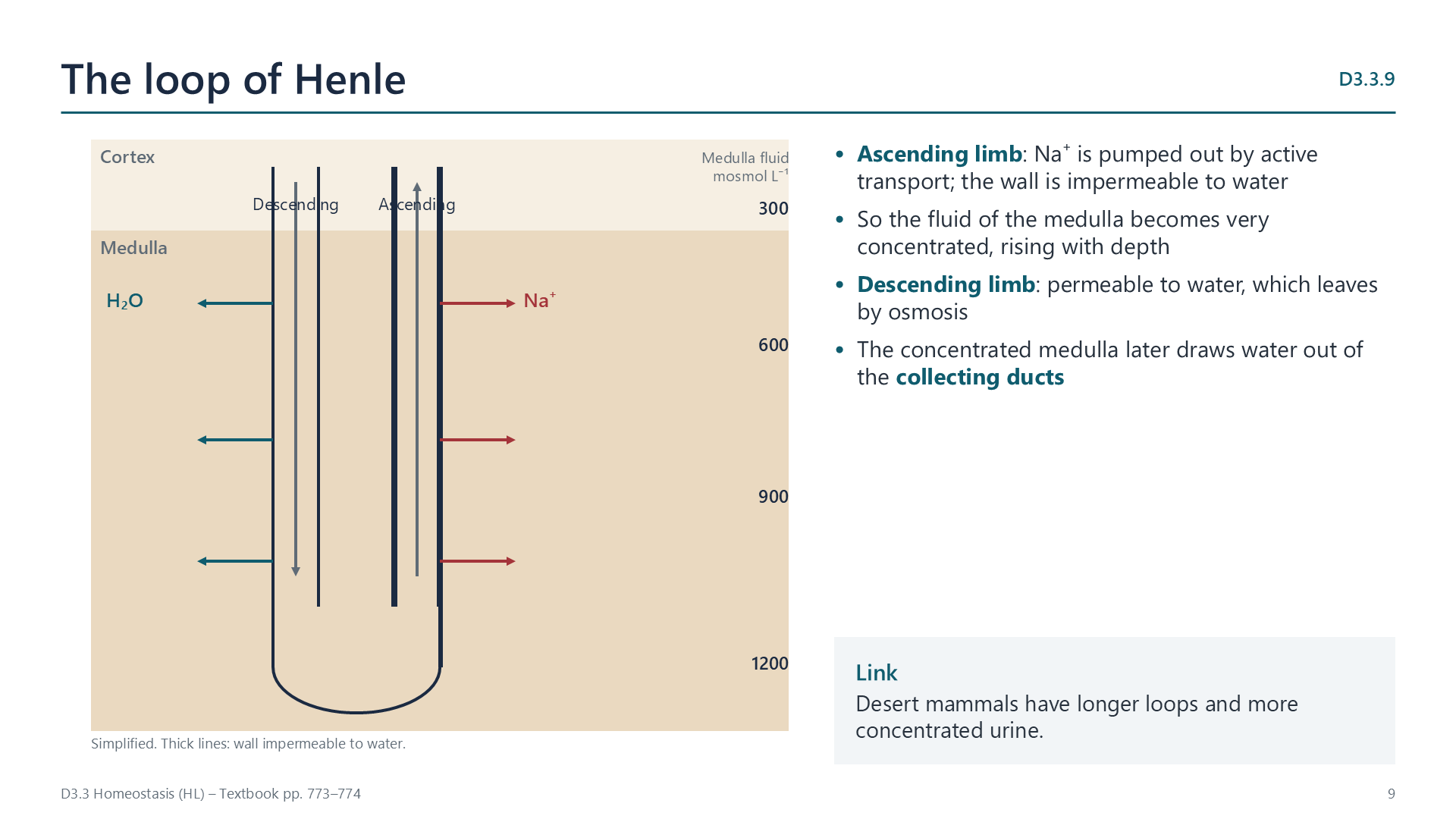
Slide: loop of Henle with sodium pumped out of the ascending limb and water leaving the descending limb

The ascending limb actively pumps Na+ into the medulla but does not let water out, so the medulla becomes very concentrated. This lets water be drawn out of the collecting ducts later.

D3.3.10

ADH and the collecting duct

pp. 775–776

Osmoreceptors in the hypothalamus detect concentrated blood, and the pituitary secretes more ADH. ADH causes vesicles carrying aquaporins to fuse with the membrane of collecting duct cells, so more water is reabsorbed. When blood is dilute, ADH falls and aquaporins are taken back into vesicles.

Blood supply

D3.3.11

Blood supply and activity

pp. 777–778

Arterioles dilate or constrict to send blood where it is needed. In vigorous exercise flow to skeletal muscle rises about twentyfold while flow to the gut and kidneys falls; brain flow stays nearly constant. In sleep, flow to muscle falls.

Videos

Select a video to play it here. Select it again to close it.

Note-taking sheet

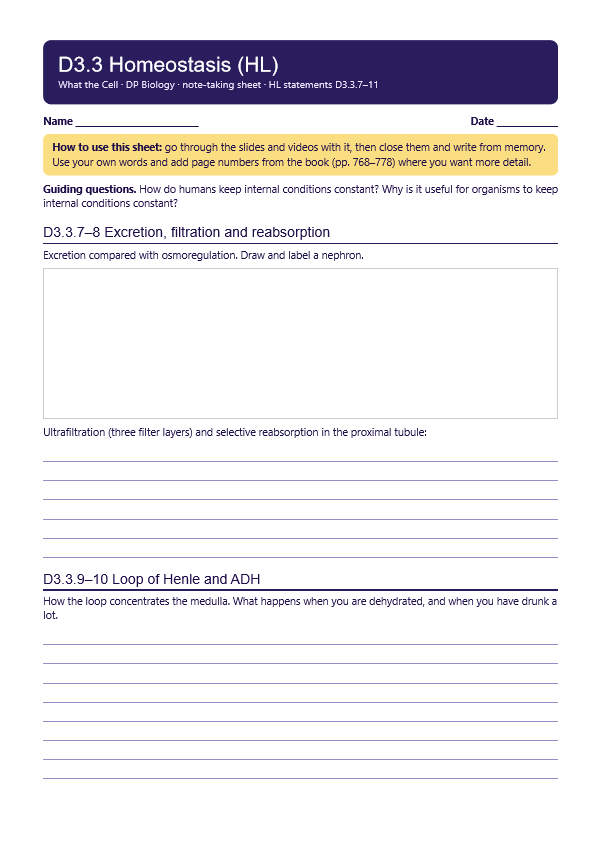
Print this guide and complete it as you work through the slides and videos. It asks for your own explanations, so close the notes while you try each section.

First page of the note-taking sheet

Quick self-check

The self-check needs JavaScript to run.

Practice questions

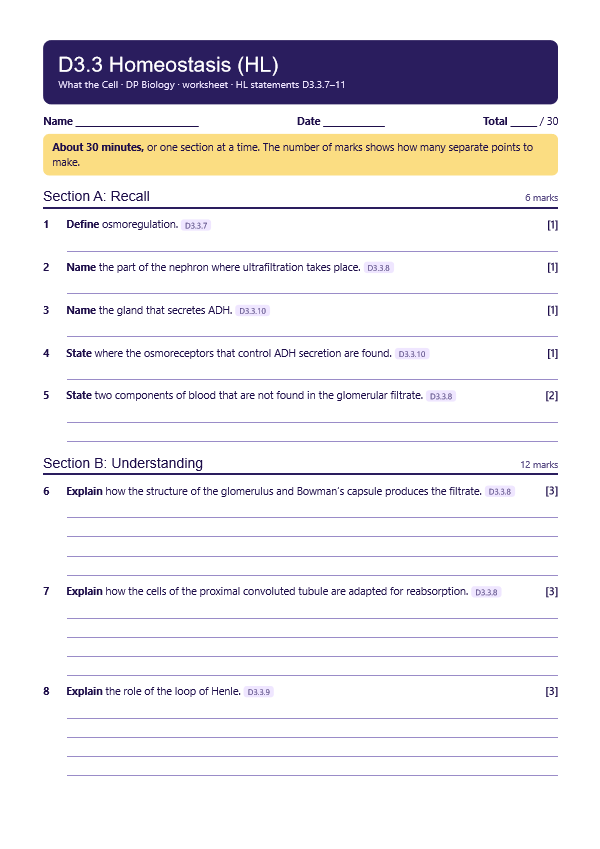
A printable worksheet covering all five statements, from quick recall to data questions and a longer answer. It has 30 marks and takes about 30 minutes, or you can do one section at a time.

Your teacher has the mark scheme.

First page of the worksheet

Practical

Modelling filtration in the kidney

Model40 minD3.3.8

You will need: Dialysis tubing, mix of starch and glucose, water, beaker, iodine solution, glucose test strips

  1. Fill knotted tubing with the mix, to represent blood in the glomerulus
  2. Stand it in water for 15 minutes
  3. Test the water for each substance
  4. Compare this model with ultrafiltration and identify what it leaves out

Safety: Eye protection when using iodine. Wipe up spills.

Carry this out with your teacher's supervision and follow your school's lab rules.

Nature of science and TOK

Syllabus statements

Summarised in our own words. Use each code to find the exact wording in your textbook or the IB subject guide.

  • D3.3.7What the kidney does in osmoregulation and excretionp. 768
  • D3.3.8How the glomerulus, Bowman's capsule and proximal convoluted tubule contribute to excretionp. 771
  • D3.3.9What the loop of Henle doesp. 773
  • D3.3.10How water reabsorption in collecting ducts achieves osmoregulationp. 775
  • D3.3.11How blood supply to organs changes with activityp. 777

More of D3.3 in this course

© 2026 Akash Parthi Bendran. Please ask before using or sharing any resources from this site: see permission to use.