What the Cell
A1.2

Nucleic acids

HL extension
3 hours5 statementsTextbook pp. 25–33

Guiding questions

  1. How do nucleic acids store information that can be inherited?
  2. Which features of DNA allow it to be copied accurately?

Slides

Slide 1 of 14

Notes

Written for this site from the class slides, with textbook page references for each statement. The chapter is on pages 25–33 of the course textbook. Image credits are on slide 14.

Structure

A1.2.11

Direction in DNA and RNA

pp. 25–26

Phosphodiester bonds link carbon 3′ of one sugar to carbon 5′ of the next, so each strand has a 5′ end (phosphate) and a 3′ end (free -OH). The two strands of DNA are antiparallel. New nucleotides join only the 3′ end, so DNA and RNA are always built 5′ to 3′. In replication, the two strands are copied in opposite directions; in transcription, RNA polymerase reads the template strand 3′ to 5′; in translation, ribosomes read mRNA from 5′ to 3′.
A1.2.12

Purine-pyrimidine pairs

pp. 26–27

Purines (adenine, guanine) have two rings; pyrimidines (cytosine, thymine) have one. Each base pair is one of each, so A-T and C-G pairs are the same width and the helix keeps the same shape whatever the sequence. Hydrogen bonds (two in A-T, three in C-G) hold the pairs together.

A1.2.13

Nucleosomes

pp. 27–29
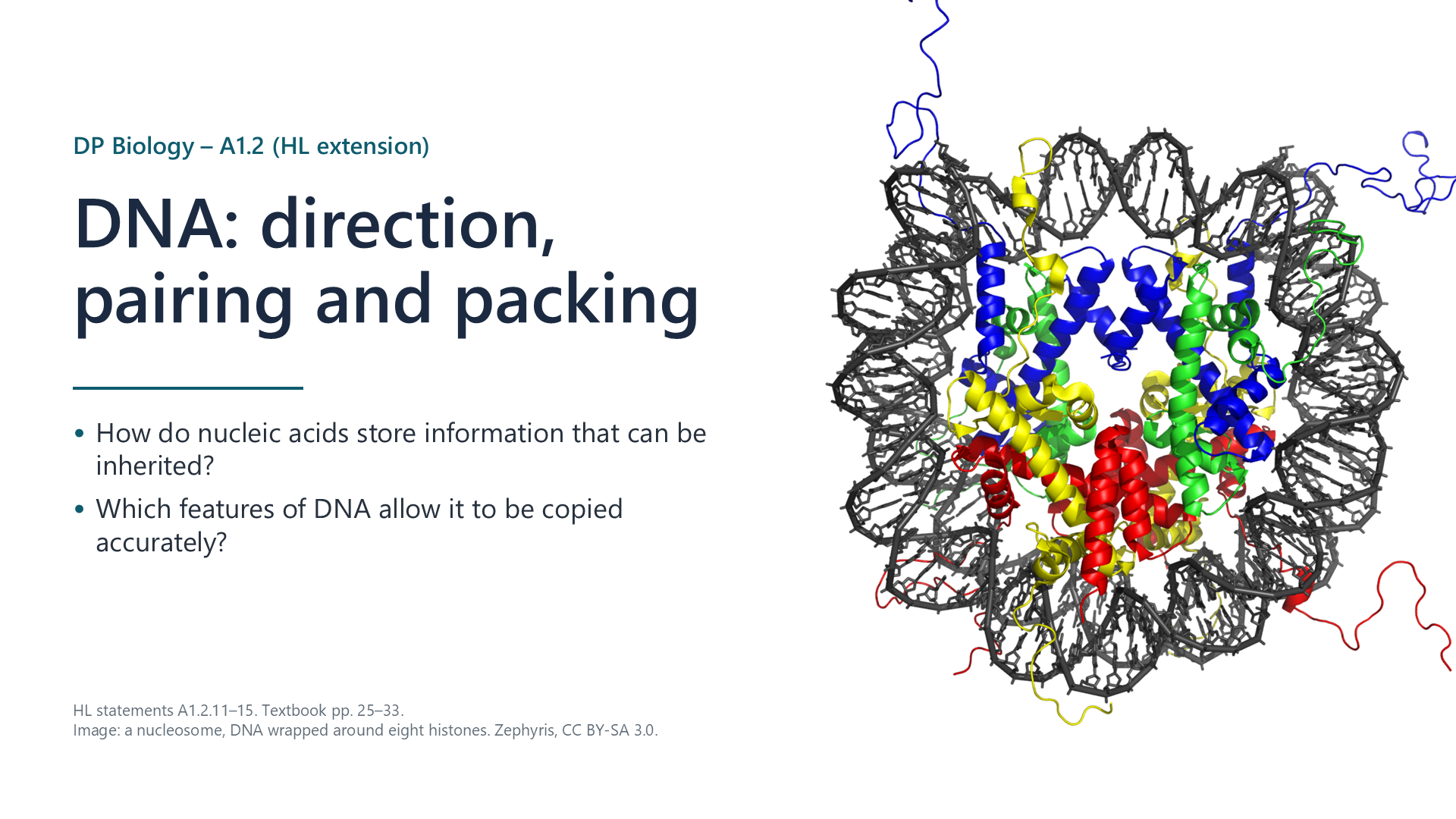
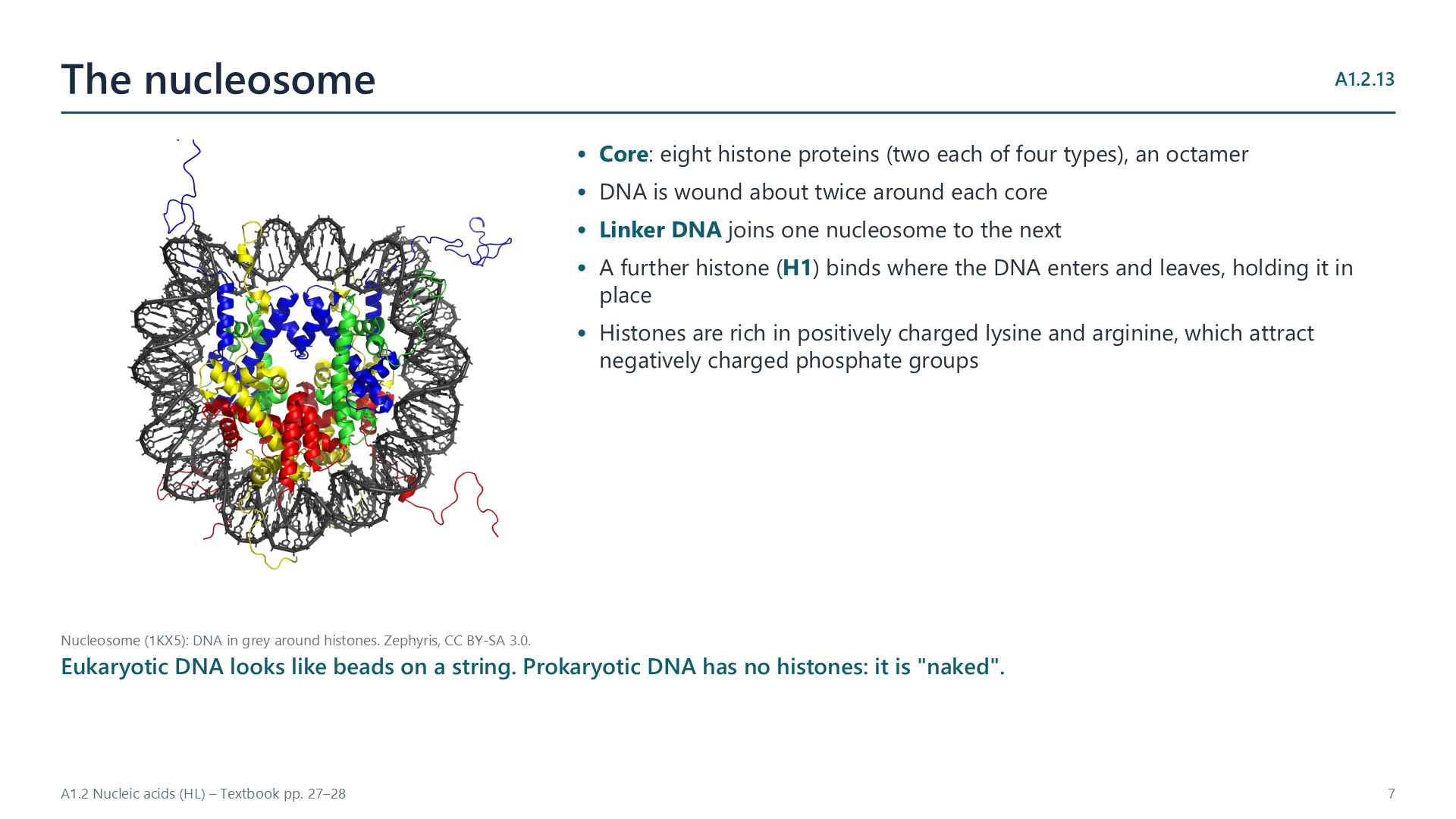
Slide: a nucleosome structure with DNA around a core of histones, and notes on its parts

In eukaryotes, DNA is wound about twice around a core of eight histone proteins. Linker DNA runs to the next nucleosome, and an H1 histone holds the DNA in place. Positively charged lysine and arginine in histones attract the negative phosphates of DNA. Packing fits about 2 m of DNA into each nucleus, lets chromosomes condense for division, and helps control which genes can be transcribed.

Evidence

A1.2.14

Hershey and Chase

pp. 29–30

In 1952, phages were labelled with 35S (in protein) or 32P (in DNA) and allowed to infect E. coli. Blending removed the phage coats and centrifuging separated them from the cells. Most 32P went into the bacteria and some appeared in new phages; most 35S stayed outside. So DNA, not protein, carries the genetic information.

A1.2.15

Chargaff’s data

pp. 31–32

Chargaff measured base proportions in DNA from many species. In every species A = T and G = C, so purines equal pyrimidines; but the proportions differ between species. This falsified the tetranucleotide hypothesis, which said DNA was a simple repeat of the four bases and could not carry information, and it supported complementary base pairing.

Videos

Select a video to play it here. Select it again to close it.

Note-taking sheet

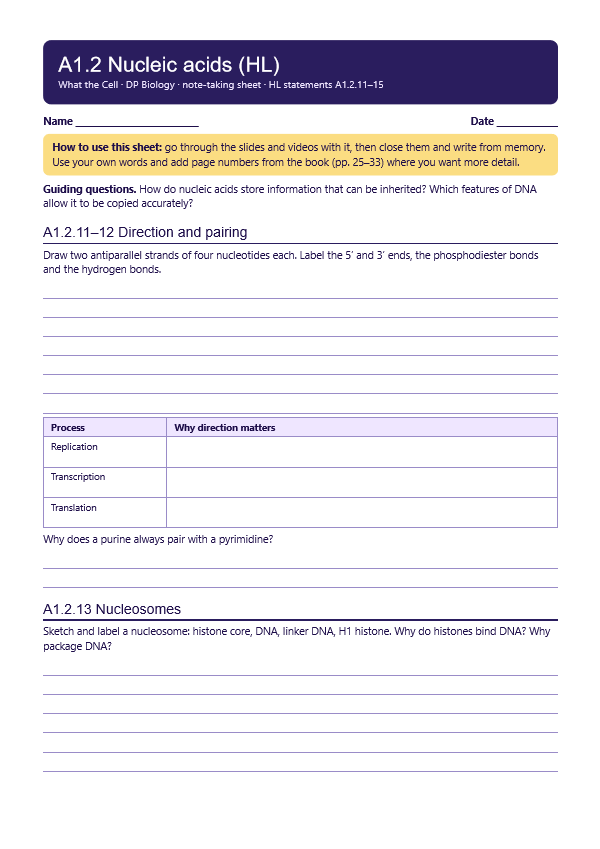
Print this guide and complete it as you work through the slides and videos. It asks for your own explanations, so close the notes while you try each section.

First page of the note-taking sheet

Quick self-check

The self-check needs JavaScript to run.

Practice questions

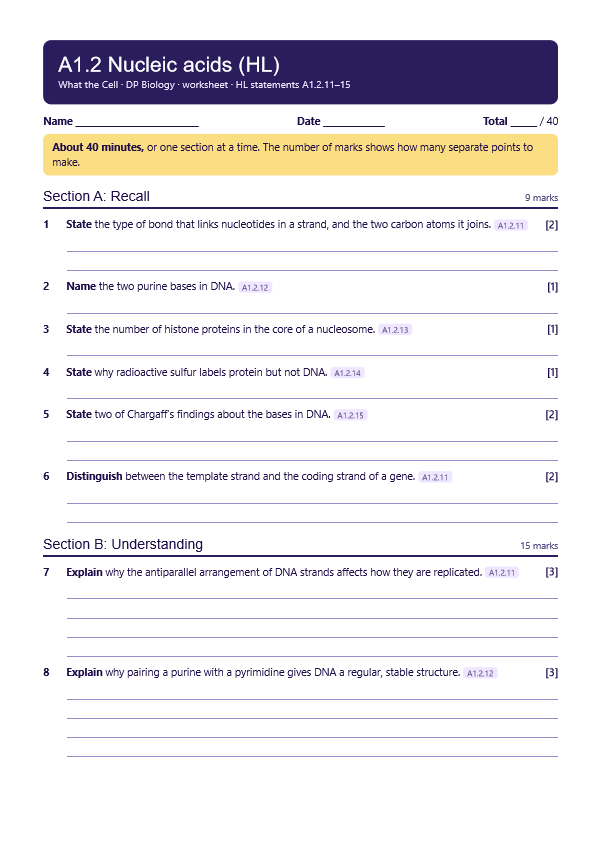
A printable worksheet covering all five statements, from quick recall to data questions and a longer answer. It has 40 marks and takes about 40 minutes, or you can do one section at a time.

Your teacher has the mark scheme.

First page of the worksheet

Practical

Testing Chargaff's rules

Data30 minA1.2.15

You will need: Published base composition data for several species, spreadsheet or calculator

  1. Tabulate the percentage of each base for each species
  2. Calculate the ratios A:T and G:C, and the total of purines to pyrimidines
  3. Compare the ratios across species
  4. Explain the results using complementary base pairing

Safety: No practical hazards.

Carry this out with your teacher's supervision and follow your school's lab rules.

Nature of science and TOK

Syllabus statements

Summarised in our own words. Use each code to find the exact wording in your textbook or the IB subject guide.

  • A1.2.11The 5' to 3' direction of DNA and RNA strandsp. 25
  • A1.2.12How pairing a purine with a pyrimidine keeps the helix stablep. 25
  • A1.2.13What a nucleosome is made of and how it is arrangedp. 26
  • A1.2.14How the Hershey and Chase experiment showed that DNA is the genetic materialp. 29
  • A1.2.15What Chargaff's measurements of purines and pyrimidines revealed across different speciesp. 31

More of A1.2 in this course

© 2026 Akash Parthi Bendran. Please ask before using or sharing any resources from this site: see permission to use.