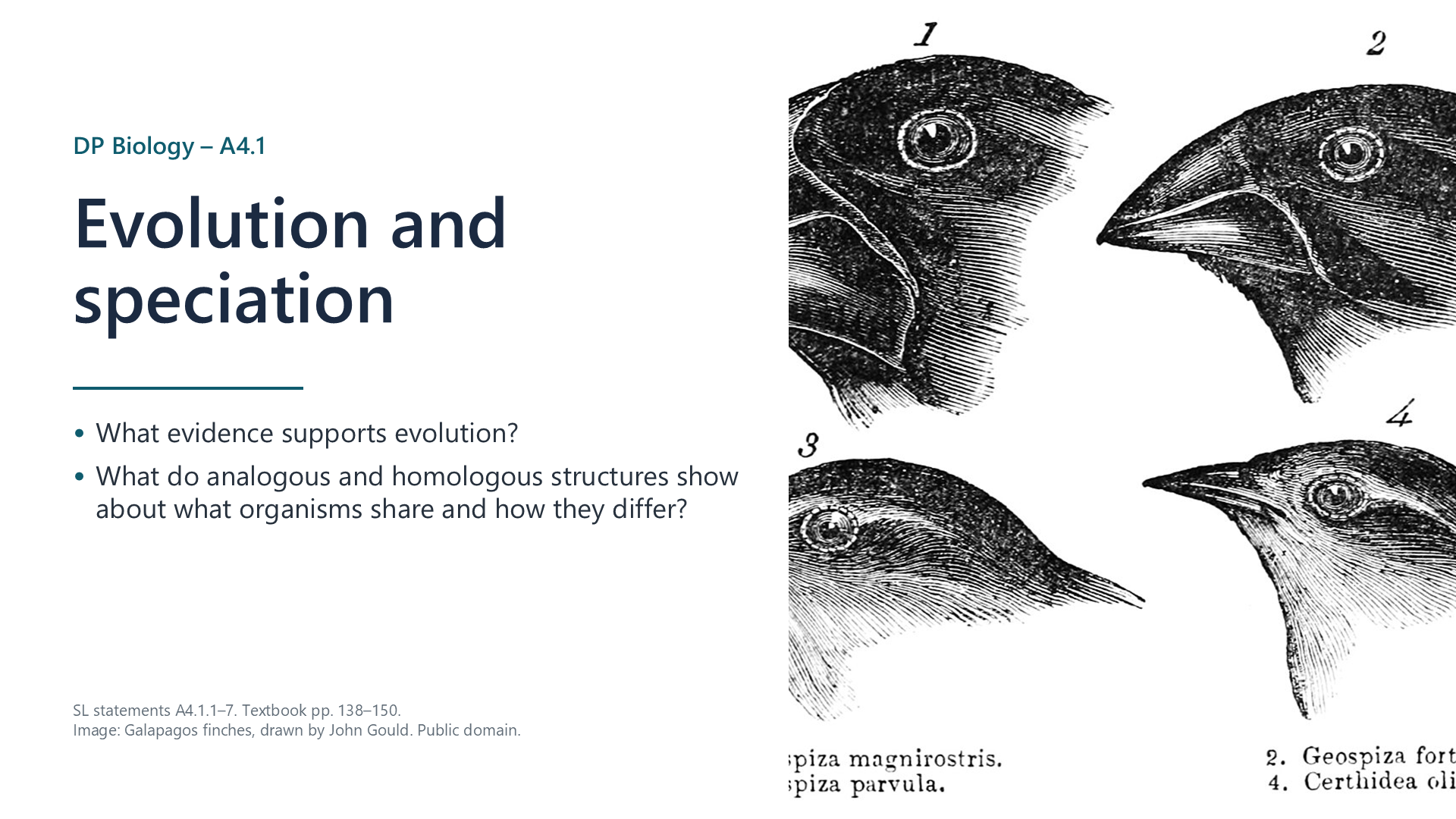
What the Cell
A4.1

Evolution and speciation

4 hours7 statementsTextbook pp. 138–150

Guiding questions

  1. What evidence supports evolution?
  2. What do analogous and homologous structures show about what organisms share and how they differ?

Slides

Slide 1 of 16

Notes

Written for this site from the class slides, with textbook page references for each statement. The chapter is on pages 138–150 of the course textbook. Image credits are on slide 16.

Evidence for evolution

A4.1.1

Evolution is a change in heritable characteristics

pp. 138–140

Evolution is a change in the inherited characteristics of a population. Changes acquired during a lifetime are not genetic, so they are not evolution. This is what separates Darwin's theory from Lamarck's idea that acquired traits pass to offspring.
A4.1.2

Evidence from sequences

p. 141

Base sequences in DNA or RNA, and amino acid sequences in proteins, can be compared. Mutations accumulate over time, so closer relatives have more similar sequences. This is powerful evidence of common ancestry.

A4.1.3

Evidence from selective breeding

pp. 141–144

Humans have chosen which animals and crops breed. Domesticated breeds now differ greatly from one another and from wild species. This shows how rapidly heritable characteristics can change under selection.

A4.1.4

Evidence from homologous structures

pp. 144–145
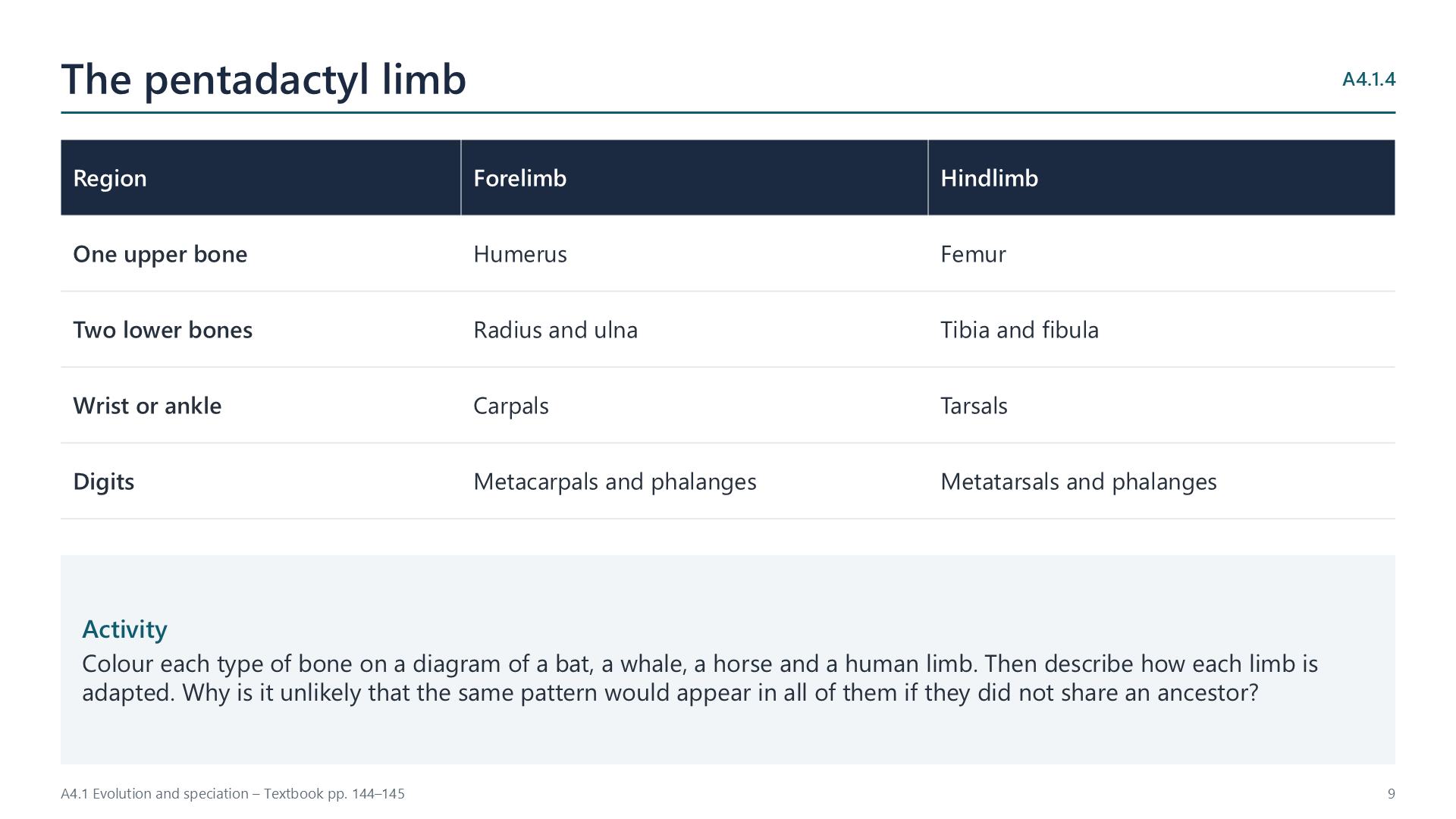
Slide: a table of the bones of a pentadactyl limb

Homologous structures have a similar basic structure, but they may have different functions. Pentadactyl limbs are the classic example: bones follow one pattern, whether used for flying, swimming or walking.

A4.1.5

Convergent evolution and analogous structures

pp. 145–147

Analogous structures have the same function, but different evolutionary origins. They arise by convergent evolution, as with the wings of birds and insects.

New species

A4.1.6

Speciation splits existing species

pp. 147–148

This is the only way in which new species have appeared. Speciation adds to the total of species alive, and extinction takes away from it.

A4.1.7

Reproductive isolation and differential selection

pp. 149–150

Speciation requires both reproductive isolation, which stops gene flow, and differential selection, which makes traits diverge. A geographical barrier can isolate populations. The Congo River separates bonobos from chimpanzees, which have diverged because of different conditions on each side.

Videos

Select a video to play it here. Select it again to close it.

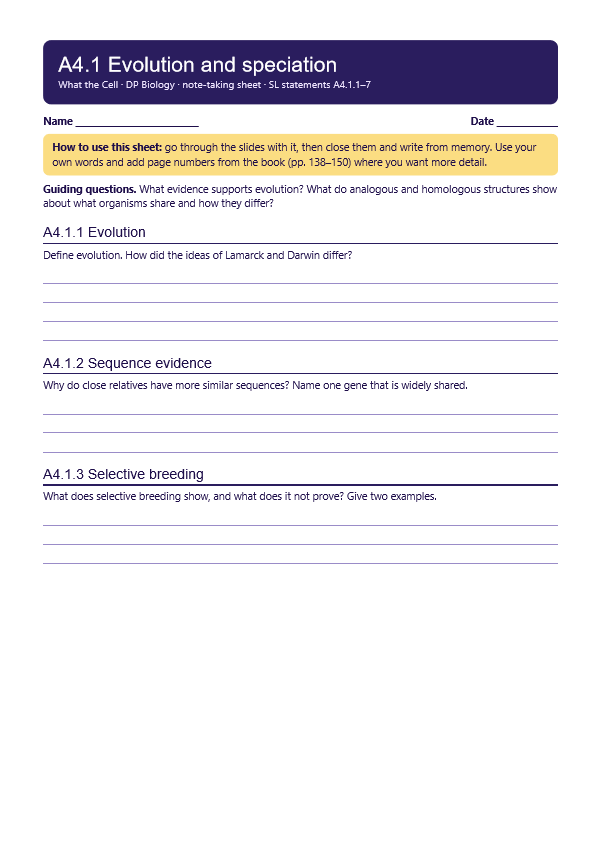
Note-taking sheet

Print this guide and complete it as you work through the slides and videos. It asks for your own explanations, so close the notes while you try each section.

First page of the note-taking sheet

Quick self-check

The self-check needs JavaScript to run.

Practice questions

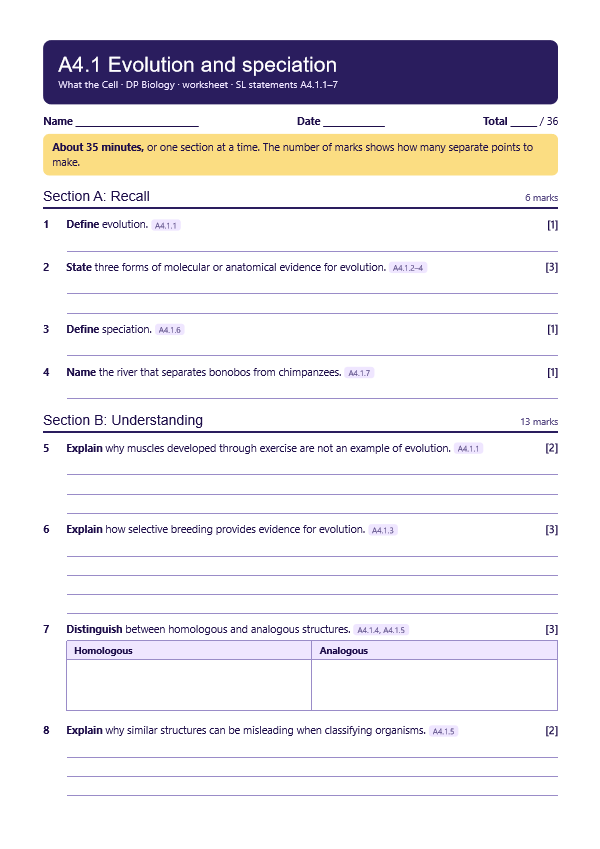
A printable worksheet covering all seven statements, from quick recall to data questions and a longer answer. It has 36 marks and takes about 35 minutes, or you can do one section at a time.

Your teacher has the mark scheme.

First page of the worksheet

Data-based questions

Questions built on realistic experimental data, in the style of Paper 1B and Paper 2. Work them on paper and show your working. 19 marks in total. Your teacher has the mark scheme.

Speciation in ferns

7 marks

Two groups of closely related fern species were studied. Group A (three species) grows on rocks in temperate forests of North America; its species look almost identical but cannot interbreed. Group B (four species) grows on trees in tropical forests; its species look clearly different. The table shows the percentage difference in a DNA sequence between each pair of species in a group.

GroupSequence difference between pairs of species / %
A (temperate, 3 species)0.81.11.3
B (tropical, 4 species)3.24.55.12.83.94.4
  1. Calculate the mean sequence difference between species in group B. [2]
  2. Identify, giving a reason, which group is more genetically diverse. [1]
  3. Suggest how the species in group A can look identical yet be separate species. [2]
  4. Outline how geographical isolation could lead to new species forming. [2]

Beetles in neighbouring valleys

6 marks

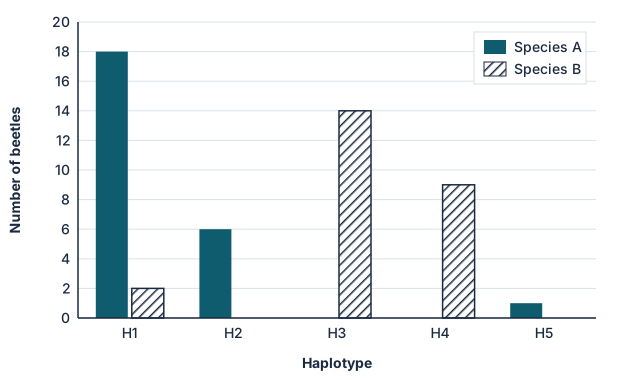
Two species of ground beetle live in neighbouring valleys in the mountains of Japan. A section of mitochondrial DNA was sequenced in 25 beetles of each species. Each different sequence is called a haplotype.

Bar chart of numbers of beetles with each haplotype. Species A: H1 18, H2 6, H3 0, H4 0, H5 1. Species B: H1 2, H2 0, H3 14, H4 9, H5 0.
  1. State the most common haplotype in species B. [1]
  2. Compare the haplotypes of the two species. [2]
  3. Suggest two reasons why haplotype H1 is found in both species. [2]
  4. Mitochondrial DNA is inherited only from the mother. State one reason this makes it useful for tracing ancestry. [1]

Feathers and flight

6 marks

Each main flight feather has a vane on each side of the central shaft. In flying birds the front vane is much narrower than the back vane, so the feather is asymmetric. Asymmetry was measured as the width of the back vane divided by the width of the front vane.

Flying birdsAsymmetryFlightless birdsAsymmetry
Pigeon2.9Ostrich1.0
Golden eagle3.2Emu1.1
Herring gull2.7Kiwi1.2
House sparrow3.0Flightless cormorant1.3
  1. Calculate the mean asymmetry of the flightless birds. Show your working. [2]
  2. Explain why asymmetric feathers help a bird to fly. [1]
  3. A fossil bird has feathers with a mean asymmetry of 2.4. Predict, with a reason, whether it could fly. [2]
  4. The flightless cormorant evolved from flying ancestors. Suggest why its feathers became nearly symmetric. [1]

Practical

Comparing protein sequences between species

Data40 minA4.1.2

You will need: Haemoglobin beta sequences for human and several other species from UniProt, spreadsheet

  1. Line up short sections of the sequence from each species
  2. Count the amino acid differences from the human sequence
  3. Rank the species by number of differences
  4. Discuss what the ranking suggests about common ancestry

Safety: No practical hazards.

Carry this out with your teacher's supervision and follow your school's lab rules.

Nature of science and TOK

Syllabus statements

Summarised in our own words. Use each code to find the exact wording in your textbook or the IB subject guide.

  • A4.1.1Evolution: change in the inherited characteristics of a populationp. 138
  • A4.1.2DNA, RNA and protein sequences as evidence for evolutionp. 141
  • A4.1.3Selective breeding of domesticated animals and crops as evidence for evolutionp. 141
  • A4.1.4What homologous structures tell us about evolutionp. 144
  • A4.1.5How convergent evolution produces analogous structuresp. 145
  • A4.1.6Speciation: an existing species splitting into new onesp. 147
  • A4.1.7How reproductive isolation and different selection pressures lead to speciationp. 149

HL extension

© 2026 Akash Parthi Bendran. Please ask before using or sharing any resources from this site: see permission to use.