What the Cell
B2.3

Cell specialization

HL extension
2 hours4 statementsTextbook pp. 265–272

Guiding questions

  1. What do stem cells do in multicellular organisms?
  2. How do differentiated cells suit their specialized roles?

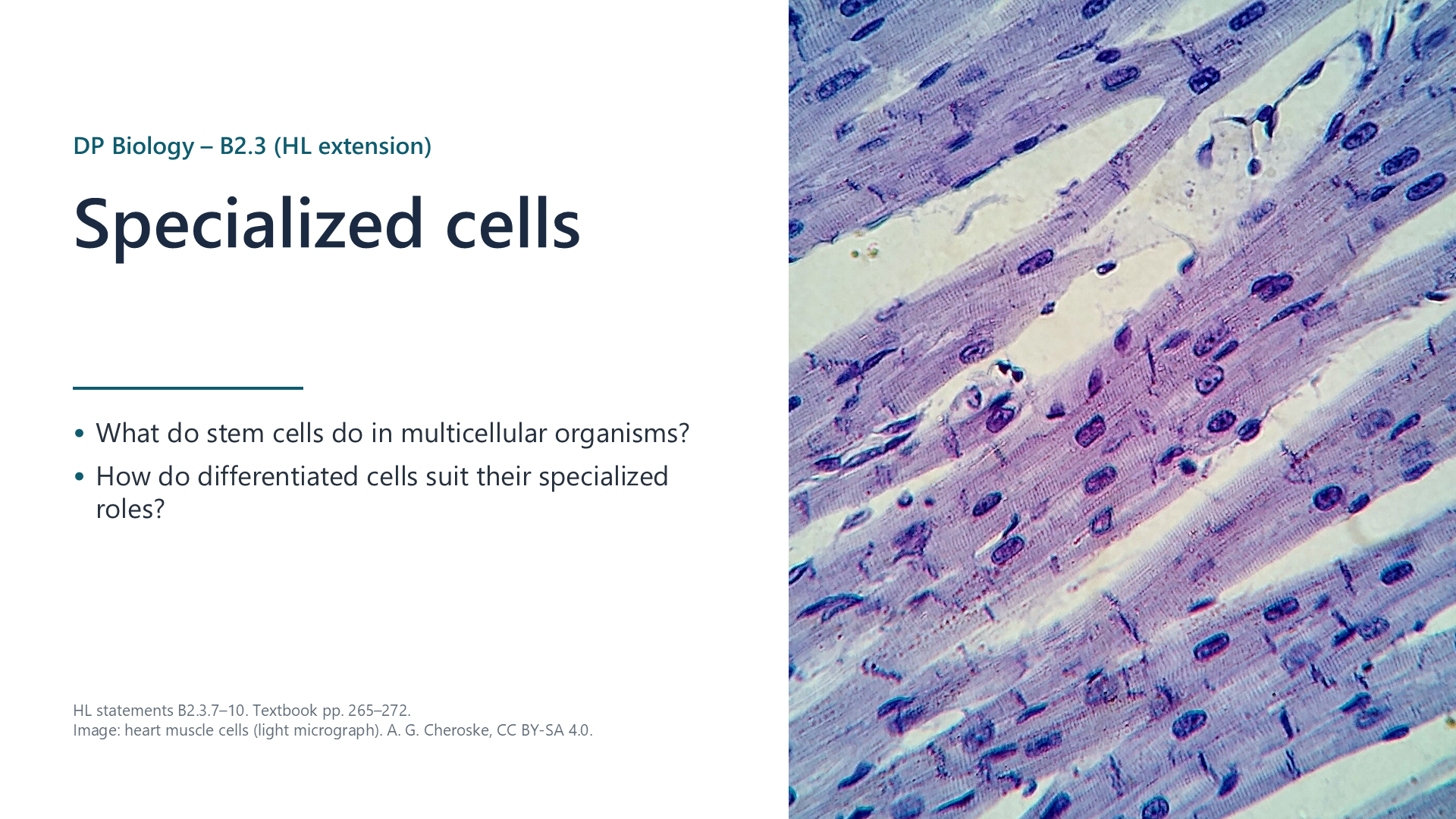
Slides

Slide 1 of 13

Notes

Written for this site from the class slides, with textbook page references for each statement. The chapter is on pages 265–272 of the course textbook. Image credits are on slide 13.

Exchange surfaces

B2.3.7

Raising the surface area-to-volume ratio

pp. 265–266

Cells increase their surface area-to-volume ratio by flattening, by microvilli (finger-like projections of the plasma membrane) and by invaginations (infoldings). Red blood cells are about 8 µm across, biconcave and have no nucleus, so oxygen diffuses only a short way to any haemoglobin, and the cells bend through capillaries. Cells of the proximal convoluted tubule have microvilli facing the filtrate, invaginations facing the blood and many mitochondria, for fast active reabsorption.
B2.3.8

Two kinds of pneumocyte

pp. 266–268
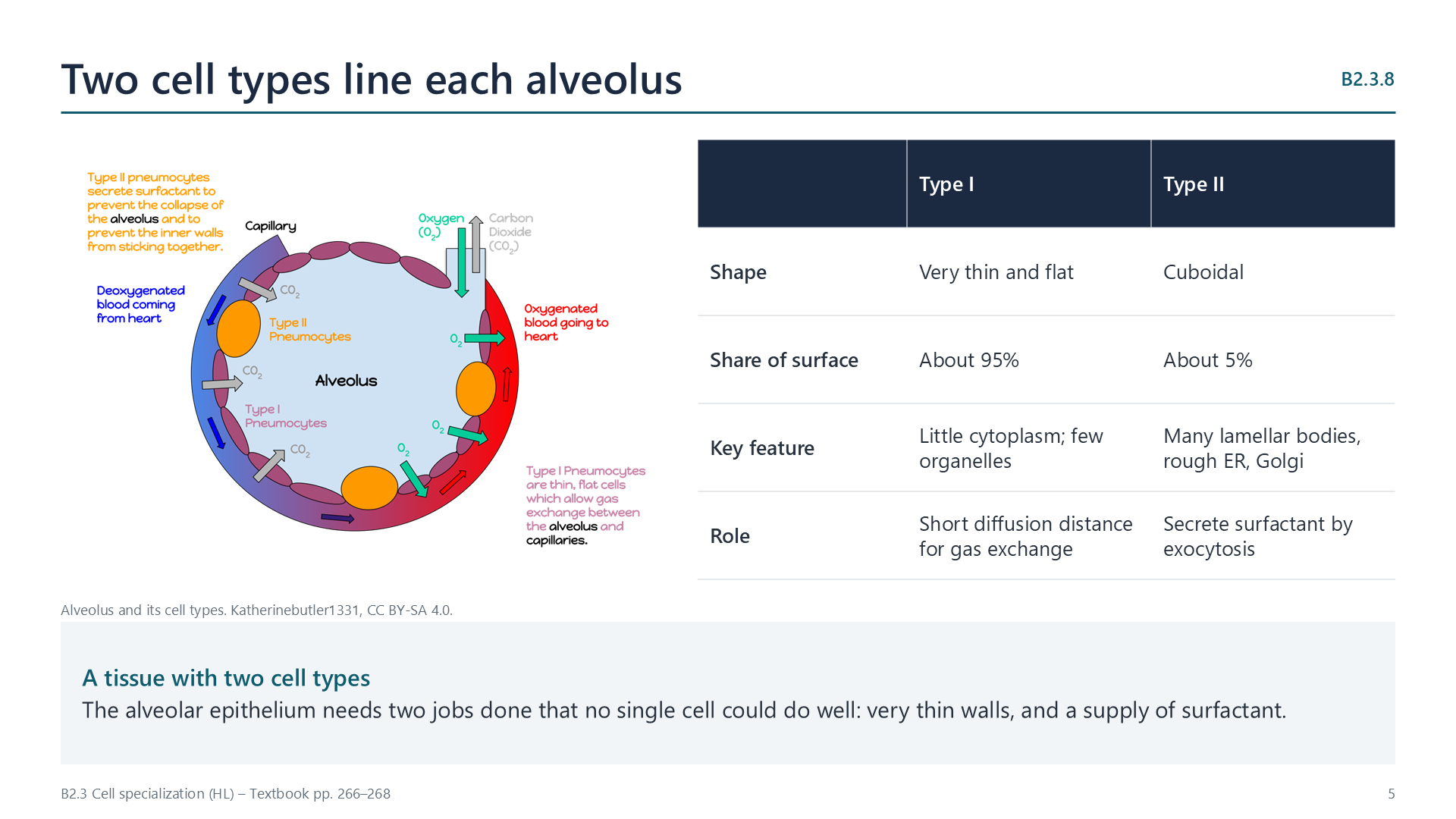
Slide: diagram of an alveolus beside a table comparing the two kinds of pneumocyte

Type I pneumocytes are extremely thin and cover most of the alveolar surface, so the diffusion distance for gases is very short. Type II pneumocytes are cuboidal and full of organelles; their lamellar bodies release surfactant by exocytosis. Surfactant lowers the surface tension of the water lining the alveoli, so they do not collapse when we breathe out. The alveolar epithelium is a tissue with more than one cell type, because no single cell could do both jobs.

Muscle and gametes

B2.3.9

Cardiac muscle and striated muscle

pp. 268–270
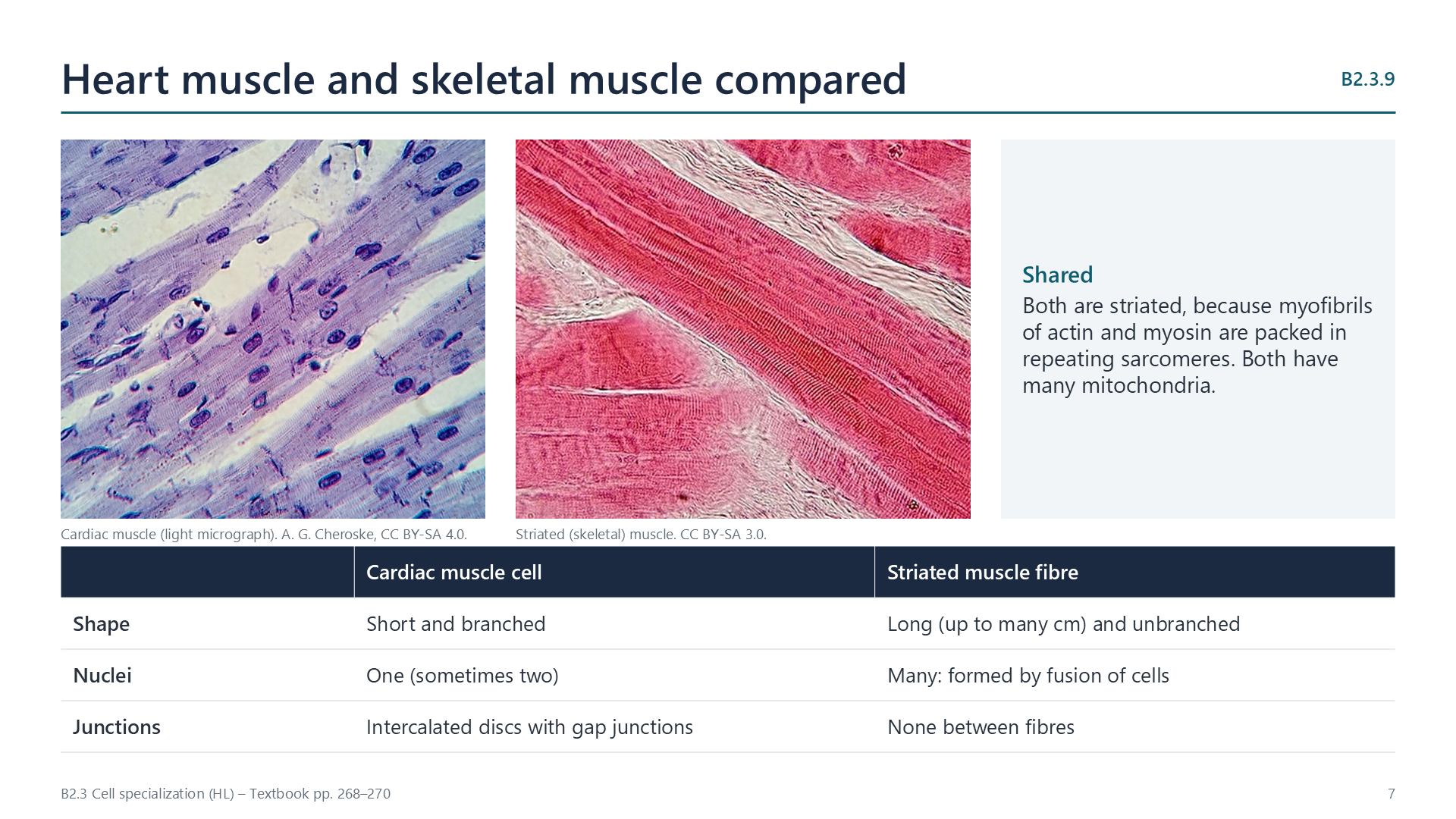
Slide: micrographs of cardiac and striated muscle above a comparison table

Both are striated, because myofibrils of actin and myosin are arranged in repeating sarcomeres, and both have many mitochondria. Cardiac muscle cells are short, branched, have one nucleus and are joined by intercalated discs, so the signal to contract spreads quickly through the heart. Striated muscle fibres are long, unbranched and have many nuclei, because they form by fusion of many cells. A fibre has one plasma membrane and normal organelles, but its size and many nuclei make it an unusual cell.

B2.3.10

Sperm and egg cells

pp. 271–272

A sperm is small and streamlined: an acrosome with enzymes to digest the zona pellucida, a haploid nucleus, a mid-piece packed with mitochondria and a flagellum. An egg is much larger: its cytoplasm holds nutrients, organelles and mRNA for early development. It is surrounded by the zona pellucida and follicle cells, and its cortical granules harden the zona after one sperm enters, preventing polyspermy.

Videos

Select a video to play it here. Select it again to close it.

Note-taking sheet

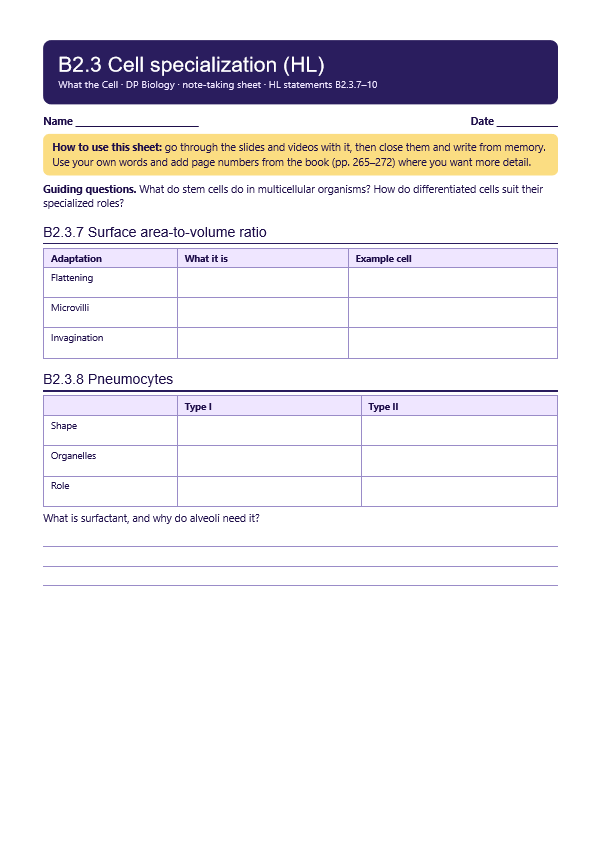
Print this guide and complete it as you work through the slides and videos. It asks for your own explanations, so close the notes while you try each section.

First page of the note-taking sheet

Quick self-check

The self-check needs JavaScript to run.

Practice questions

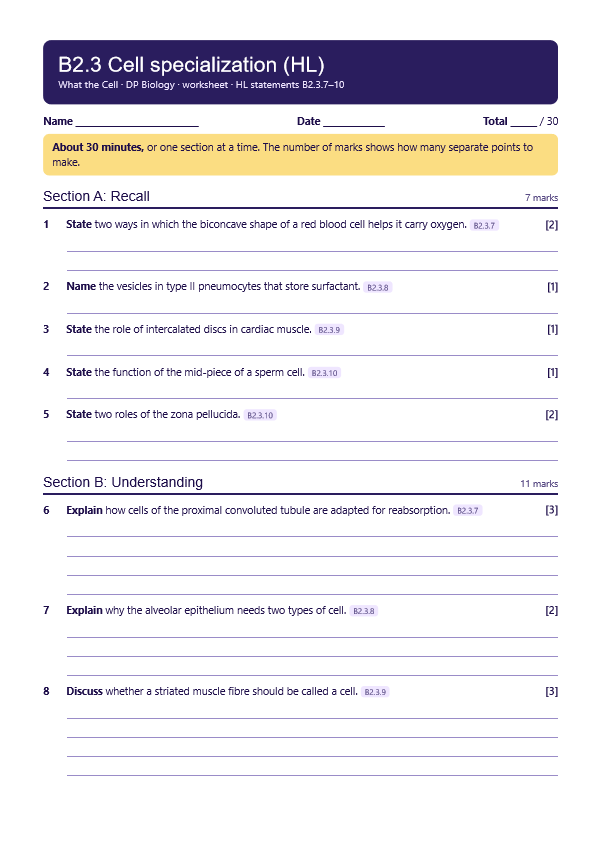
A printable worksheet covering all four statements, from quick recall to data questions and a longer answer. It has 30 marks and takes about 30 minutes, or you can do one section at a time.

Your teacher has the mark scheme.

First page of the worksheet

Practical

Specialized cells under the microscope

Lab40 minB2.3.8, B2.3.9

You will need: Prepared slides or micrographs of lung tissue and of cardiac and striated muscle

  1. Find alveoli and identify the thin cells of their walls
  2. Observe the striped appearance of muscle tissue
  3. Draw one example of each with labels
  4. Link two visible features of each to its function

Safety: Carry microscopes with two hands. Take care with glass slides.

Carry this out with your teacher's supervision and follow your school's lab rules.

Nature of science and TOK

Syllabus statements

Summarised in our own words. Use each code to find the exact wording in your textbook or the IB subject guide.

  • B2.3.7How cells are adapted to raise their surface area-to-volume ratiop. 265
  • B2.3.8How type I and type II pneumocytes in alveoli are adaptedp. 266
  • B2.3.9How cardiac muscle cells and striated muscle fibres are adaptedp. 268
  • B2.3.10How sperm and egg cells are adaptedp. 271

More of B2.3 in this course

© 2026 Akash Parthi Bendran. Please ask before using or sharing any resources from this site: see permission to use.