What the Cell
B2.3

Cell specialization

2 hours6 statementsTextbook pp. 256–264

Guiding questions

  1. What do stem cells do in multicellular organisms?
  2. How do differentiated cells suit their specialized roles?

Slides

Slide 1 of 13

Notes

Written for this site from the class slides, with textbook page references for each statement. The chapter is on pages 256–264 of the course textbook. Image credits are on slide 13.

Becoming specialized

B2.3.1

From unspecialized cells to specialized cells

pp. 256–257

After fertilization, repeated division forms unspecialized, genetically identical cells. These then differentiate, as different genes are expressed in each cell type. In an early embryo, gradients of signalling chemicals called morphogens show a cell its position and so affect gene expression.
B2.3.2

Properties of stem cells

p. 257

Stem cells can divide endlessly, and can differentiate along different pathways.

B2.3.3

Stem cell niches in the adult body

pp. 258–259

A niche is a location that can maintain stem cells, or can promote their division and differentiation. Bone marrow produces all types of blood cell, and hair follicles produce new hair and help to repair skin.

B2.3.4

Totipotent, pluripotent and multipotent

pp. 259–260
TypeCan becomeFound in
TotipotentAny cell type, including support tissuesZygote and earliest embryo
PluripotentAny cell type of the bodyEarly embryo
MultipotentA limited range of related cellsAdult tissue, such as bone marrow

Size and shape

B2.3.5

Cell size as part of specialization

pp. 260–262

Red blood cells are small enough to pass through capillaries. Eggs are large because they store food, whereas sperm are small and able to swim. White blood cells are larger than red ones, while neurons and striated muscle fibres can be very long.

B2.3.6

Surface area-to-volume ratio limits cell size

pp. 262–264
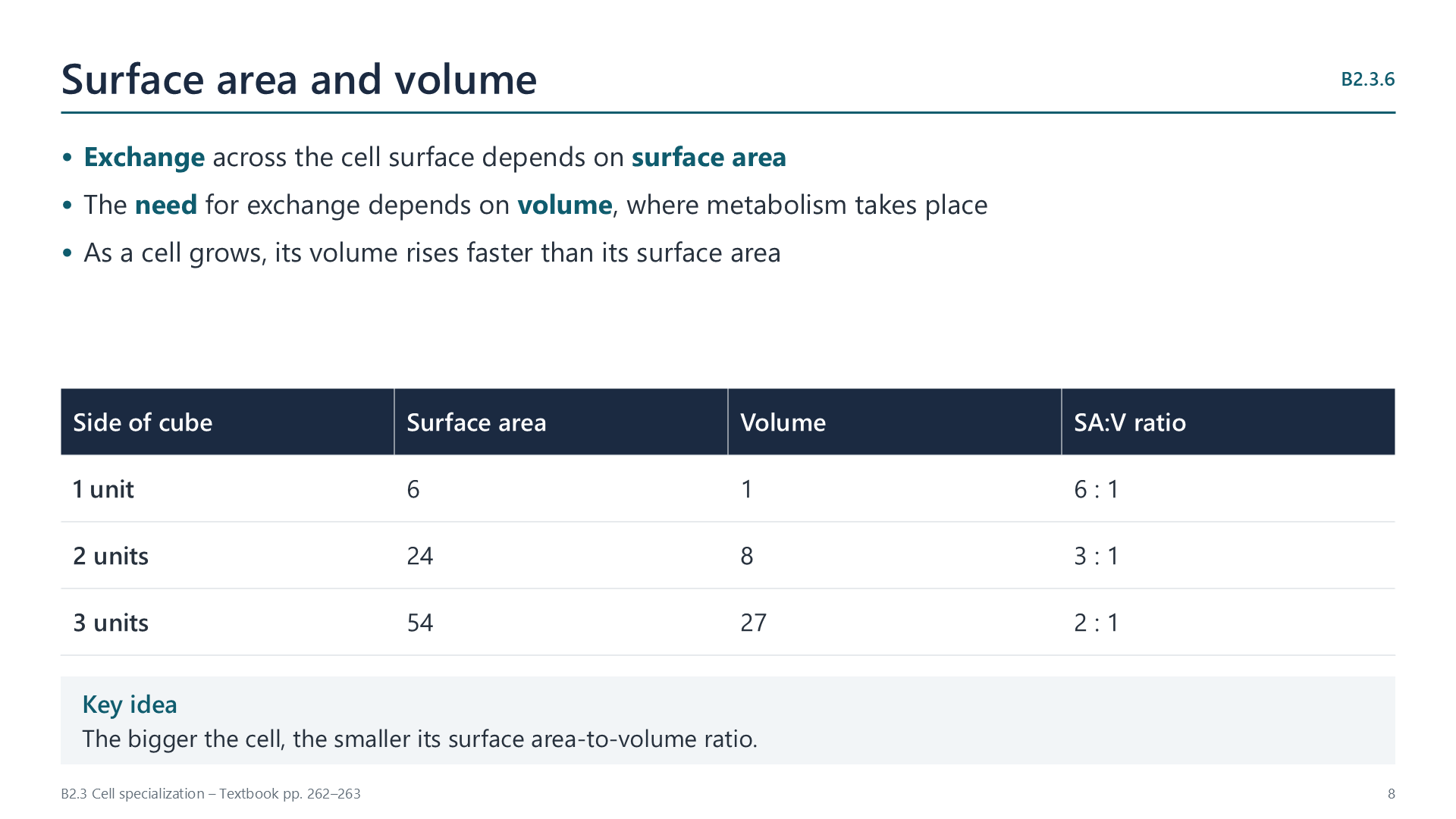
Slide: a table of surface area, volume and ratio for three cubes

Exchange across the surface depends on area, whereas the need for exchange depends on volume. As a cell grows, volume rises faster than area, so the ratio falls. Materials then cannot enter or leave quickly enough, and the cell must stop growing or divide.

Videos

Select a video to play it here. Select it again to close it.

Note-taking sheet

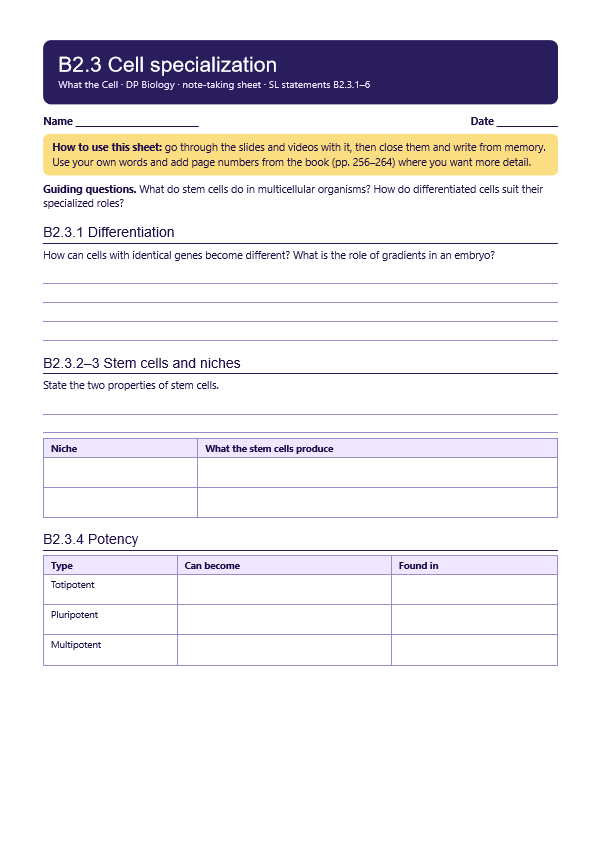
Print this guide and complete it as you work through the slides and videos. It asks for your own explanations, so close the notes while you try each section.

First page of the note-taking sheet

Quick self-check

The self-check needs JavaScript to run.

Practice questions

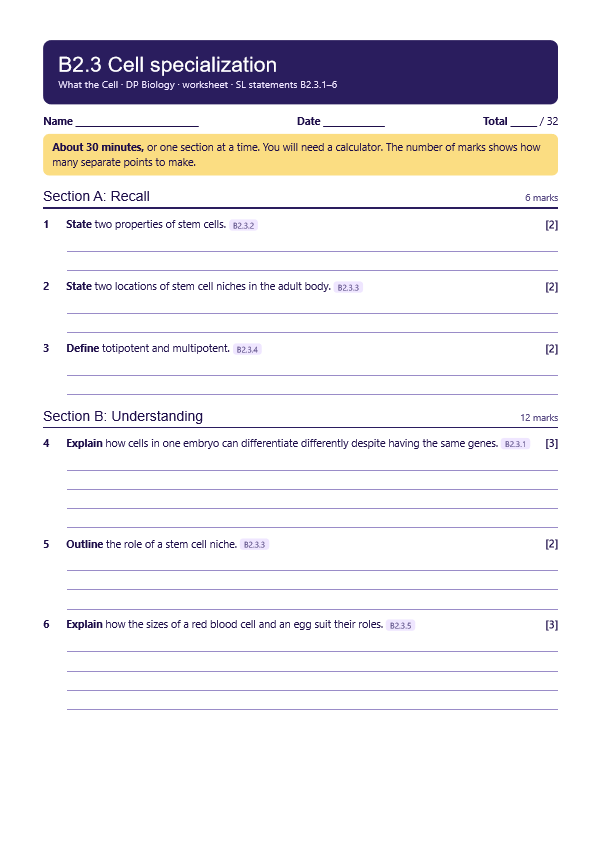
A printable worksheet covering all six statements, from quick recall to data questions and a longer answer. It has 32 marks and takes about 30 minutes, or you can do one section at a time.

Your teacher has the mark scheme.

First page of the worksheet

Practical

Surface area, volume and diffusion

Lab40 minB2.3.6

You will need: Agar cubes of three sizes containing a pH indicator, dilute hydrochloric acid, ruler, timer

  1. Calculate the surface area-to-volume ratio of each cube
  2. Place the cubes in dilute acid
  3. Time how long each takes to change colour all the way through
  4. Plot time against ratio, and relate this to limits on cell size

Safety: Eye protection. Use acid no stronger than 0.1 M.

Carry this out with your teacher's supervision and follow your school's lab rules.

Nature of science and TOK

Syllabus statements

Summarised in our own words. Use each code to find the exact wording in your textbook or the IB subject guide.

  • B2.3.1How fertilization leads to unspecialized cells that then differentiatep. 256
  • B2.3.2What makes a cell a stem cellp. 257
  • B2.3.3Where stem cell niches are found in adults and what they dop. 258
  • B2.3.4How totipotent, pluripotent and multipotent stem cells differp. 259
  • B2.3.5Cell size as part of being specializedp. 260
  • B2.3.6How the surface area-to-volume ratio limits cell sizep. 262

HL extension

© 2026 Akash Parthi Bendran. Please ask before using or sharing any resources from this site: see permission to use.