What the Cell
C3.1

Integration of body systems

HL extension
5 hours7 statementsTextbook pp. 509–516

Guiding questions

  1. What do nerves and hormones each do to coordinate body systems?
  2. How does feedback help to control body systems?

Slides

Slide 1 of 14

Notes

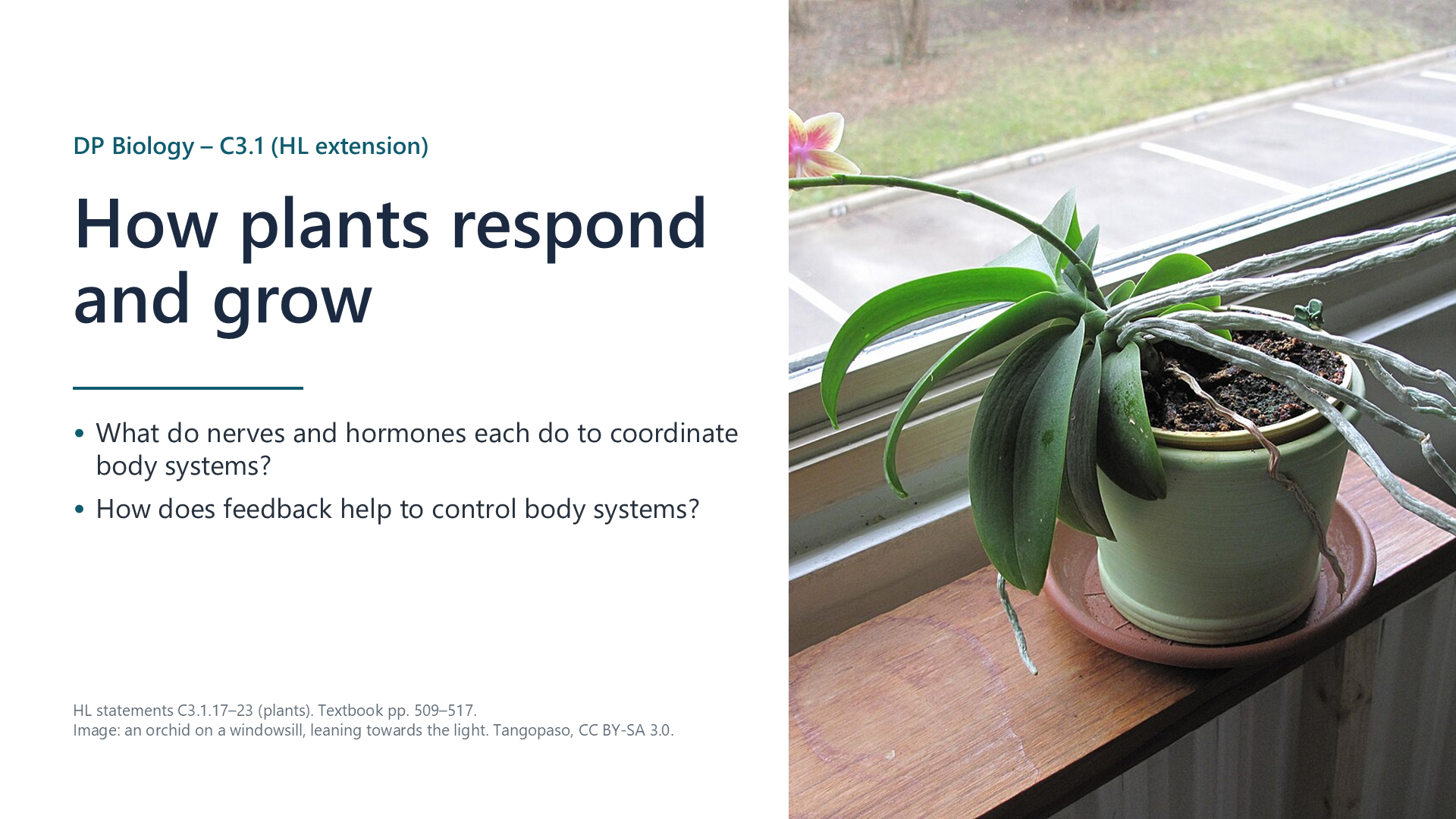
Written for this site from the class slides, with textbook page references for each statement. The chapter is on pages 509–517 of the course textbook. Image credits are on slide 14.

Tropisms

C3.1.17

Observing tropic responses

pp. 509–510

Grow seedlings in the dark, then light them from one side. Record drawings at intervals and measure the angle of curvature with a protractor. Use seedlings lit from above and seedlings kept in the dark as controls, and find the mean of many seedlings.
C3.1.18

Positive phototropism

pp. 510–511
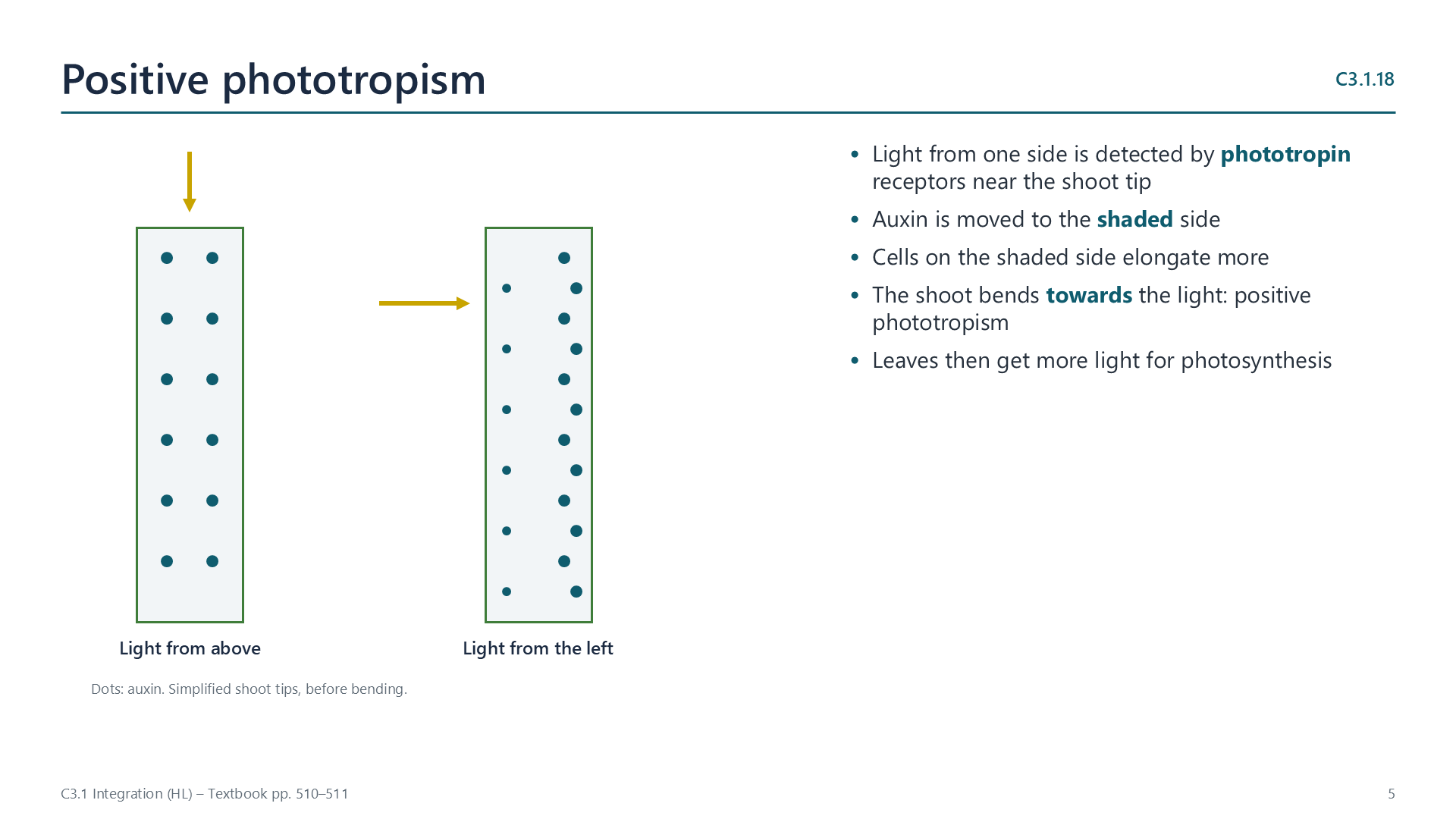
Slide: auxin evenly spread with light from above, and moved to the shaded side with light from the left

Phototropins in the shoot tip detect light from one side. Auxin is moved to the shaded side, where cells elongate more, so the shoot bends towards the light.

Phytohormones

C3.1.19

Phytohormones

pp. 512–513

Plants use many signalling chemicals: auxin (elongation, apical dominance), cytokinin (cell division, side buds), gibberellin (stem growth, germination), ethylene (ripening), abscisic acid (stomatal closure) and jasmonic acid (defence).

C3.1.20

Auxin efflux carriers

pp. 514–515

Auxin diffuses into cells but cannot diffuse out. It leaves through efflux carriers placed on one side of each cell. When neighbouring cells use the same side, auxin is pumped through the tissue in one direction and builds up a concentration gradient.

C3.1.21

Auxin and cell growth

p. 515

Auxin makes cells pump H+ into their walls. The acid loosens cross-links between cellulose molecules, so turgor stretches the cell. Unequal auxin causes unequal growth, which bends the shoot.

C3.1.22

Auxin and cytokinin

p. 516

Shoot tips make auxin, which moves to the roots; root tips make cytokinin, which moves to the shoots. Their interaction keeps root and shoot growth in proportion, for example in apical dominance.

C3.1.23

Ethylene and ripening

pp. 516–517

Ethylene stimulates ripening, and ripening fruit makes more ethylene: positive feedback. Ripening is fast and synchronized, so many fruits are ready together to attract seed dispersers.

Videos

Select a video to play it here. Select it again to close it.

Note-taking sheet

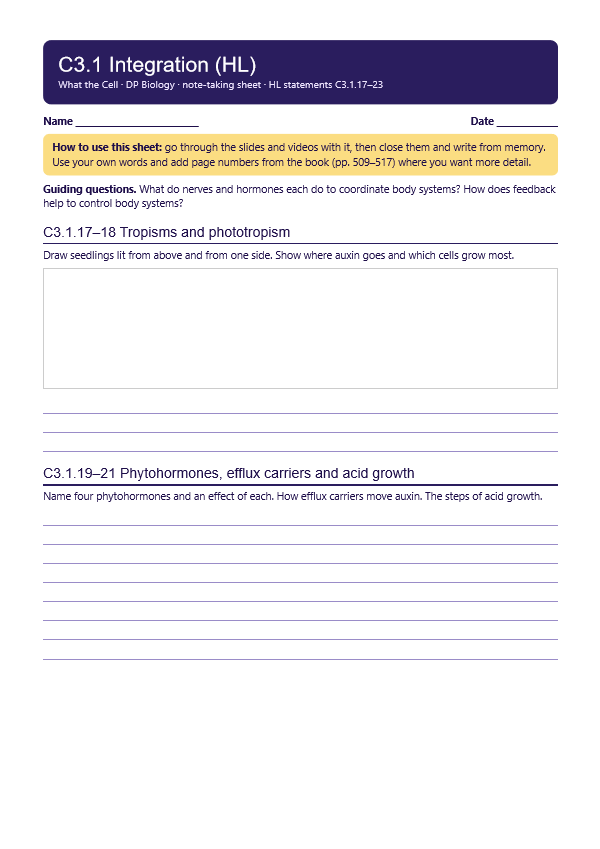
Print this guide and complete it as you work through the slides and videos. It asks for your own explanations, so close the notes while you try each section.

First page of the note-taking sheet

Quick self-check

The self-check needs JavaScript to run.

Practice questions

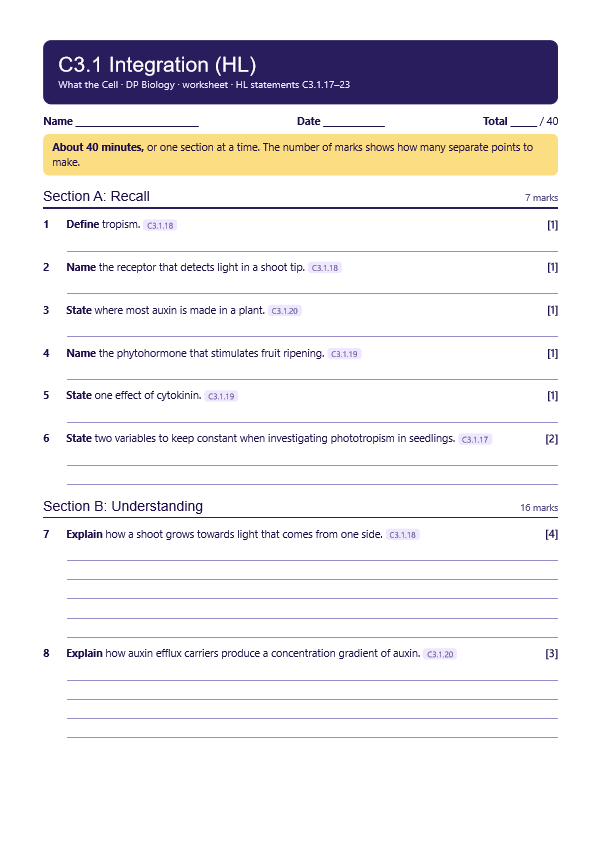
A printable worksheet covering all seven statements, from quick recall to data questions and a longer answer. It has 40 marks and takes about 40 minutes, or you can do one section at a time.

Your teacher has the mark scheme.

First page of the worksheet

Practical

Phototropism in seedlings

Lab20 min, then 5 daysC3.1.17, C3.1.18

You will need: Cress seeds, damp cotton wool, dishes, box with a side slit, ruler

  1. Grow seedlings until they are a few centimetres tall
  2. Put one dish in the box lit from one side, and keep another in even light
  3. Measure the angle of bending daily
  4. Explain the response using auxin distribution

Safety: Keep lamps away from water. Wash hands after handling seedlings.

Carry this out with your teacher's supervision and follow your school's lab rules.

Nature of science and TOK

Syllabus statements

Summarised in our own words. Use each code to find the exact wording in your textbook or the IB subject guide.

  • C3.1.17Observing tropic responses in seedlingsp. 509
  • C3.1.18Positive phototropism: plant shoots growing towards light from one sidep. 510
  • C3.1.19Phytohormones: chemicals that control growth, development and responses to stimuli in plantsp. 512
  • C3.1.20How auxin efflux carriers keep phytohormone concentration gradients in placep. 514
  • C3.1.21How auxin makes cells growp. 515
  • C3.1.22How auxin and cytokinin interact to regulate root and shoot growthp. 516
  • C3.1.23Ripening fruit and ethylene: a self-reinforcing loopp. 516

More of C3.1 in this course

© 2026 Akash Parthi Bendran. Please ask before using or sharing any resources from this site: see permission to use.