What the Cell
D3.1

Reproduction

HL extension
5 hours8 statementsTextbook pp. 709–724

Guiding questions

  1. What does sexual or asexual reproduction show about change and continuity?
  2. How must organisms change in order to reproduce?

Slides

Slide 1 of 16

Notes

Written for this site from the class slides, with textbook page references for each statement. The chapter is on pages 709–725 of the course textbook. Image credits are on slide 16.

Gametes

D3.1.13

Puberty

pp. 709–710

In late childhood the hypothalamus releases more GnRH, so the pituitary releases more LH and FSH. These make the testes secrete testosterone and the ovaries secrete oestradiol and progesterone, which bring about the changes of puberty.
D3.1.14

Spermatogenesis and oogenesis

pp. 710–715
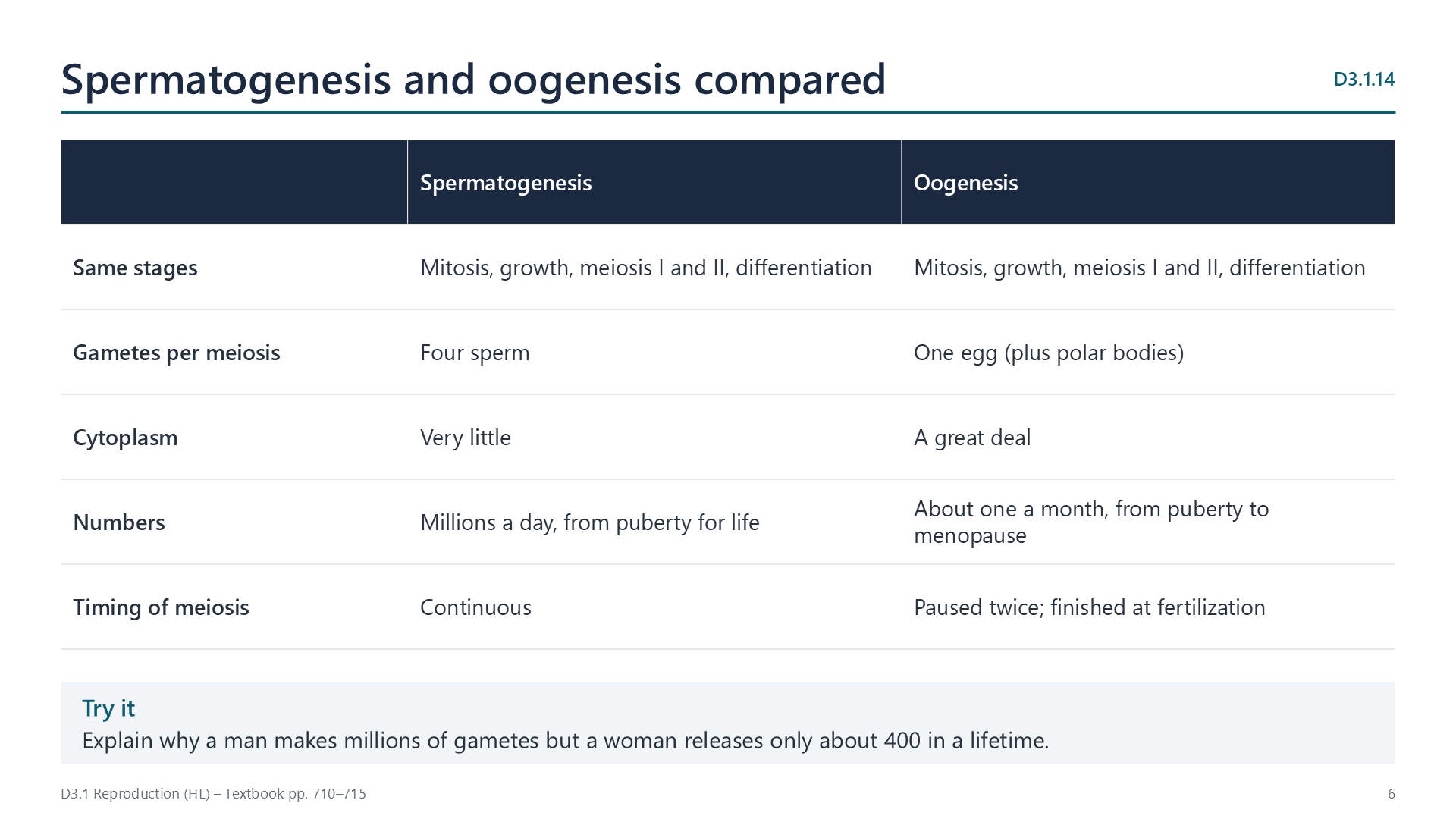
Slide: table comparing spermatogenesis and oogenesis

Both have mitosis, growth, two divisions of meiosis and differentiation. Each primary spermatocyte gives four small sperm, millions a day for life. Each primary oocyte gives one large egg, because the cytoplasm divides unequally and polar bodies break down; meiosis pauses twice and finishes only at fertilization.

Fertilization to birth

D3.1.15

Preventing polyspermy

pp. 716–717

In the acrosome reaction, enzymes from the sperm head digest a path through the zona pellucida. Once one sperm fuses with the egg, the cortical reaction releases enzymes that harden the zona pellucida, so no other sperm can enter.

D3.1.16

Blastocyst and implantation

p. 718

The zygote divides by mitosis as it travels down the oviduct and becomes a hollow blastocyst. About a week after fertilization it implants in the endometrium; its outer layer helps form the placenta and its inner cell mass becomes the embryo.

D3.1.17

Pregnancy tests

pp. 719–720
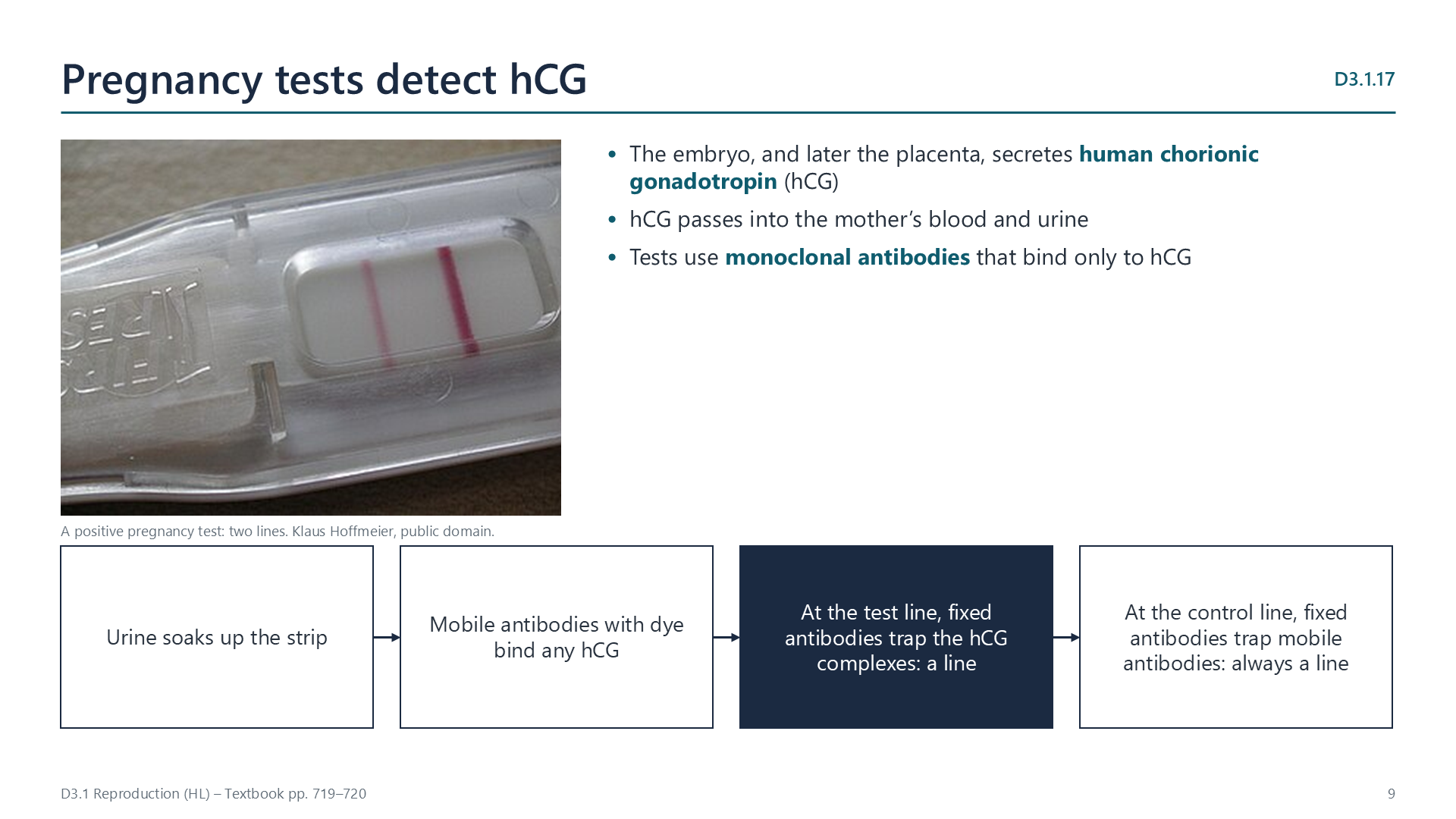
Slide: how a pregnancy test strip uses antibodies to hCG

The embryo and young placenta secrete hCG, which appears in urine. Monoclonal antibodies on the test strip bind hCG and are trapped at the test line, giving a coloured line; a control line shows the test worked.

D3.1.18

The placenta

p. 721

Placental villi give a large surface area for exchange: oxygen and nutrients pass to the foetus, carbon dioxide and urea to the mother, without the bloods mixing. The placenta lets the foetus stay in the uterus to a later stage of development.

D3.1.19

Pregnancy and childbirth

pp. 722–723

Progesterone keeps the pregnancy going, first from the corpus luteum (kept alive by hCG) and then from the placenta. Near term progesterone falls, oxytocin is released and causes contractions, which cause more oxytocin release: positive feedback until birth.

Evidence

D3.1.20

HRT and heart disease

pp. 724–725

Early observational studies found less coronary heart disease in women taking HRT. Randomized controlled trials later found a small increase. HRT users tended to have higher socioeconomic status, which itself lowers heart disease risk: the correlation was not cause and effect.

Videos

Select a video to play it here. Select it again to close it.

Note-taking sheet

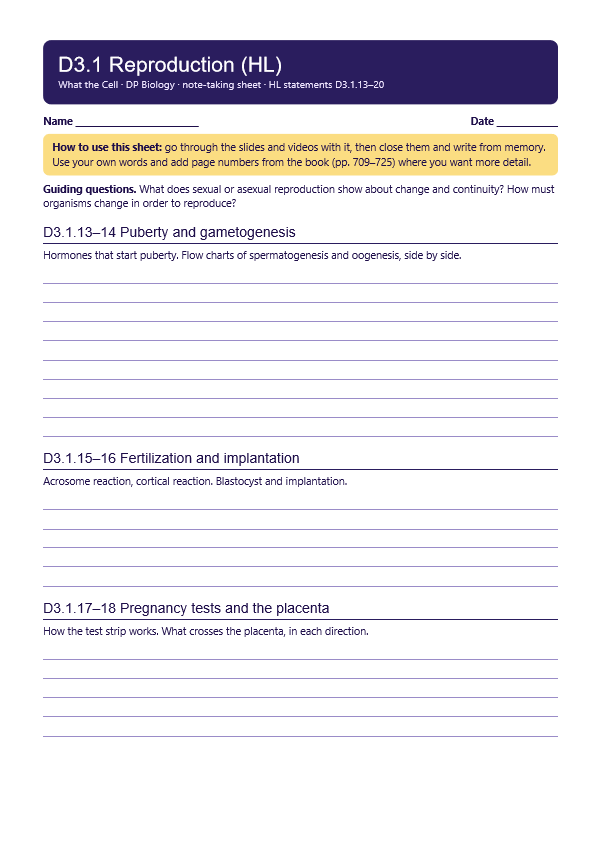
Print this guide and complete it as you work through the slides and videos. It asks for your own explanations, so close the notes while you try each section.

First page of the note-taking sheet

Quick self-check

The self-check needs JavaScript to run.

Practice questions

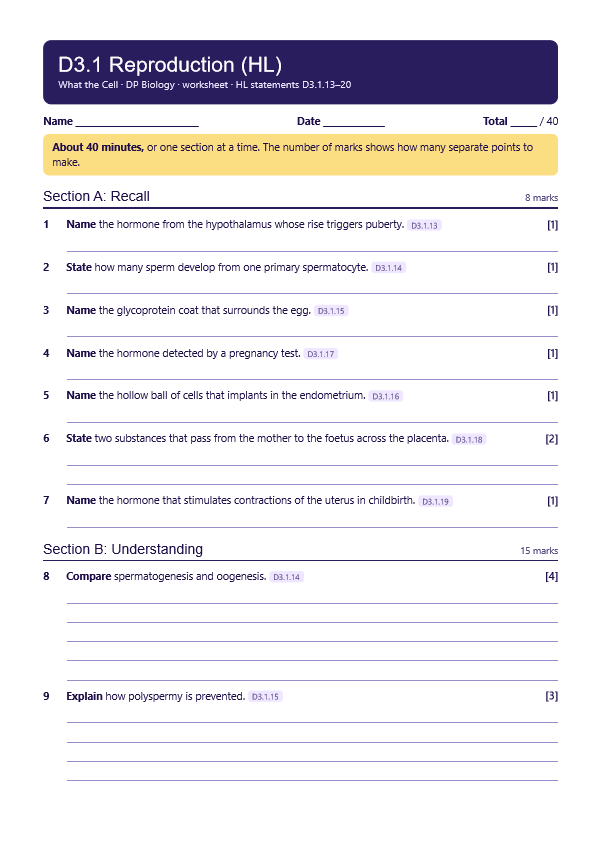
A printable worksheet covering all eight statements, from quick recall to data questions and a longer answer. It has 40 marks and takes about 40 minutes, or you can do one section at a time.

Your teacher has the mark scheme.

First page of the worksheet

Practical

Interpreting hormone data in pregnancy

Data30 minD3.1.19

You will need: Published hCG, oestradiol and progesterone values through pregnancy, spreadsheet

  1. Plot each hormone against week of pregnancy
  2. Identify when each rises and falls
  3. Annotate the switch from corpus luteum to placenta
  4. Explain why progesterone drops before birth

Safety: No practical hazards. Handle the topic sensitively.

Carry this out with your teacher's supervision and follow your school's lab rules.

Nature of science and TOK

Syllabus statements

Summarised in our own words. Use each code to find the exact wording in your textbook or the IB subject guide.

  • D3.1.13How GnRH and steroid sex hormones control the changes of pubertyp. 709
  • D3.1.14How sperm and eggs are produced in humansp. 710
  • D3.1.15How polyspermy is preventedp. 716
  • D3.1.16How a blastocyst develops and implants in the endometriump. 718
  • D3.1.17How pregnancy tests detect human chorionic gonadotropinp. 719
  • D3.1.18What the placenta does for a developing foetusp. 721
  • D3.1.19How hormones control pregnancy and birthp. 722
  • D3.1.20Does hormone replacement therapy raise the risk of coronary heart disease?p. 724

More of D3.1 in this course

© 2026 Akash Parthi Bendran. Please ask before using or sharing any resources from this site: see permission to use.