What the Cell
D2.3

Water potential

HL extension
2 hours4 statementsTextbook pp. 690–692

Guiding questions

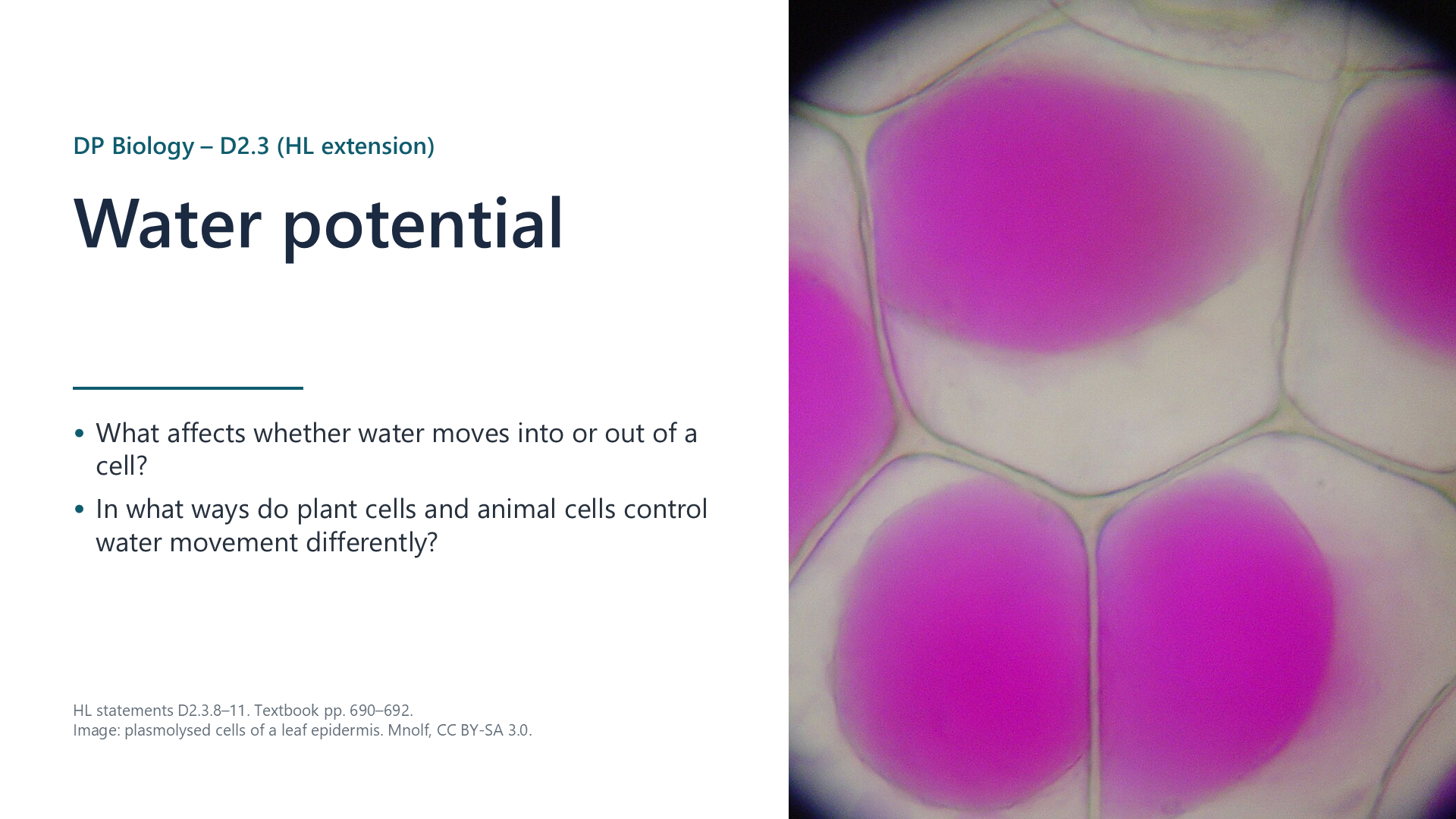
  1. What affects whether water moves into or out of a cell?
  2. In what ways do plant cells and animal cells control water movement differently?

Slides

Slide 1 of 12

Notes

Written for this site from the class slides, with textbook page references for each statement. The chapter is on pages 690–692 of the course textbook. Image credits are on slide 12.

Water potential

D2.3.8

What water potential is

p. 690

Water potential measures the stored energy held by a given volume of water, in kPa relative to pure water, which is set at 0 kPa. Solutes form hydrogen bonds with water molecules and lower their freedom to move, so solutions have negative water potentials.
D2.3.9

Direction of movement

p. 691

Water moves from higher (less negative) to lower (more negative) water potential, until the two are equal.

D2.3.10

Solute and pressure potential

pp. 691–692
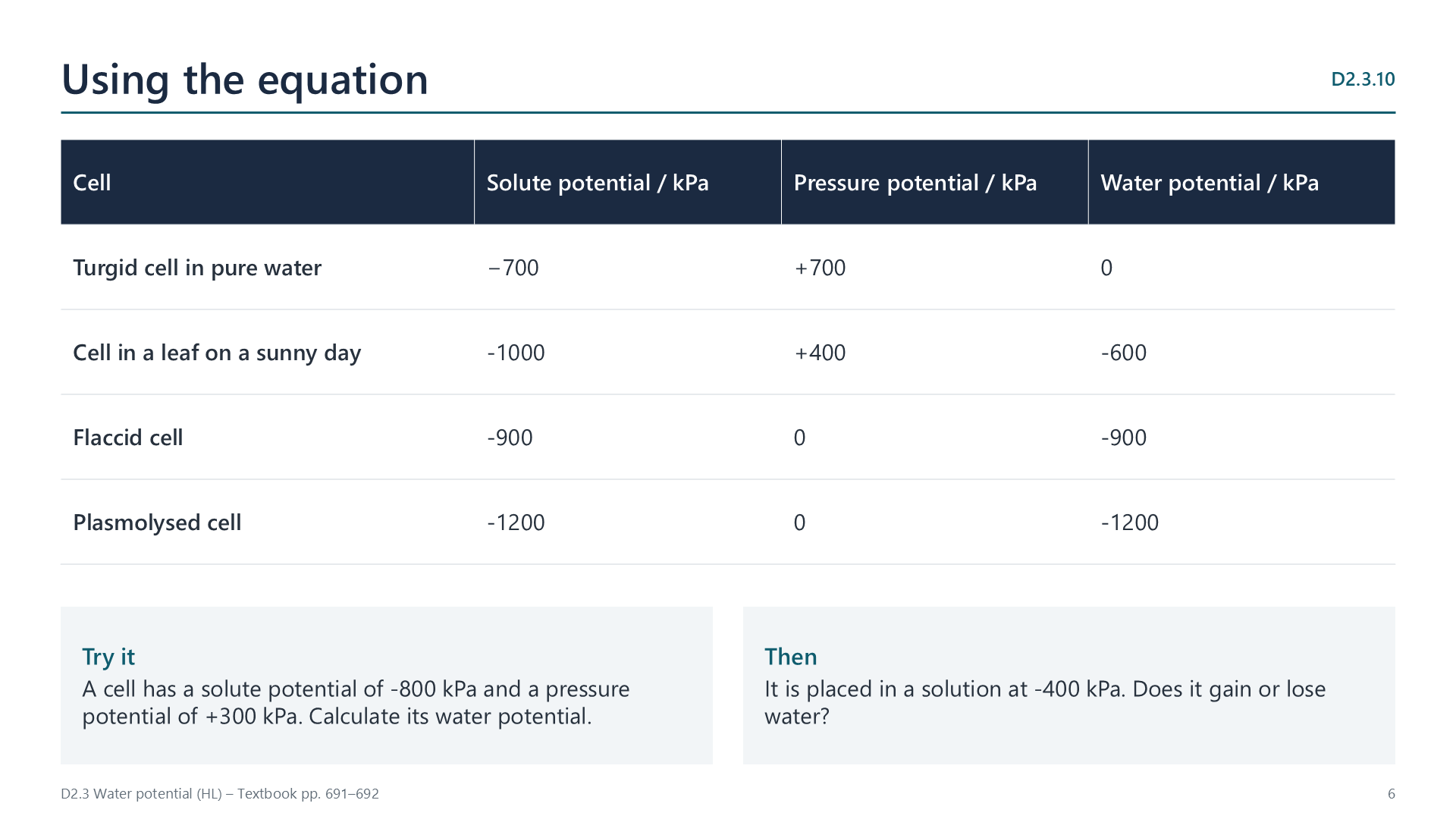
Slide: table of solute, pressure and water potentials for four cells

Water potential = solute potential + pressure potential. Solute potential is zero or negative. Pressure potential is usually positive in cells with walls, as the protoplast pushes on the wall, but negative in xylem under tension.

D2.3.11

Water movement in plant tissue

p. 692

In a hypotonic solution, water enters: solute potential becomes less negative and pressure potential rises until the cell is turgid. In a hypertonic solution, water leaves: solute potential becomes more negative and pressure potential falls to zero, and the cell may plasmolyse.

Videos

Select a video to play it here. Select it again to close it.

Note-taking sheet

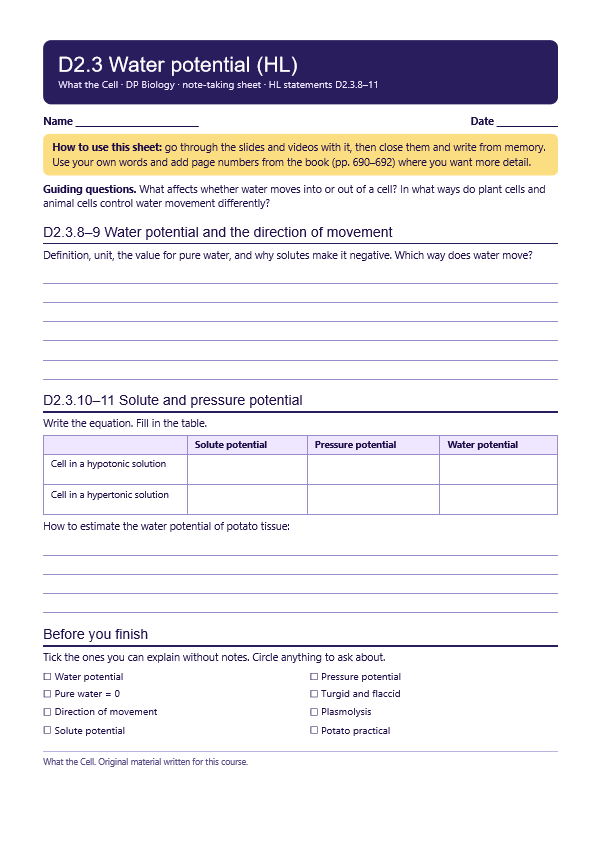
Print this guide and complete it as you work through the slides and videos. It asks for your own explanations, so close the notes while you try each section.

First page of the note-taking sheet

Quick self-check

The self-check needs JavaScript to run.

Practice questions

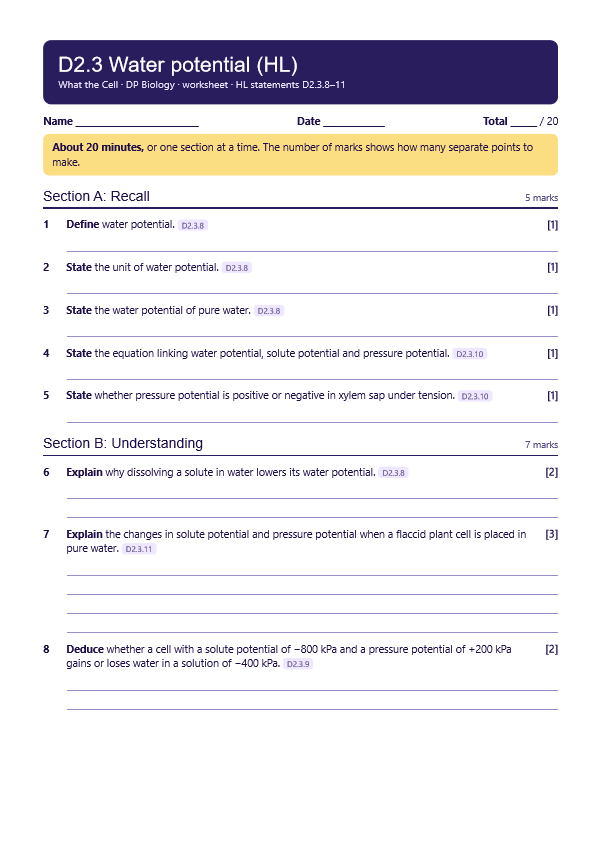
A printable worksheet covering all four statements, from quick recall to data questions and a longer answer. It has 20 marks and takes about 20 minutes, or you can do one section at a time.

Your teacher has the mark scheme.

First page of the worksheet

Practical

Finding the water potential of a tissue

Lab50 minD2.3.9, D2.3.11

You will need: Potato cylinders, sucrose solutions from 0 to 1.0 M, balance, table of solute potentials

  1. Measure the percentage change in mass of cylinders in each solution
  2. Plot change in mass against concentration
  3. Read off the concentration where there is no change
  4. Convert this to water potential using the table, and explain the result

Safety: Take care with cork borers and knives. Wipe up spills.

Carry this out with your teacher's supervision and follow your school's lab rules.

Nature of science and TOK

Syllabus statements

Summarised in our own words. Use each code to find the exact wording in your textbook or the IB subject guide.

  • D2.3.8What water potential measures: stored energy in a given volume of waterp. 690
  • D2.3.9Water moves from higher water potential to lower water potentialp. 691
  • D2.3.10How solute potential and pressure potential combine to give water potential in walled cellsp. 691
  • D2.3.11How water potential explains water movement in plant tissuep. 692

More of D2.3 in this course

© 2026 Akash Parthi Bendran. Please ask before using or sharing any resources from this site: see permission to use.