What the Cell
D1.1

DNA replication

HL extension
3 hours4 statementsTextbook pp. 604–614

Guiding questions

  1. How do cells make new DNA?
  2. What biotechnology has understanding DNA replication made possible?

Slides

Slide 1 of 11

Notes

Written for this site from the class slides, with textbook page references for each statement. The chapter is on pages 604–614 of the course textbook. Image credits are on slide 11.

How DNA is copied

D1.1.6

DNA polymerases work 5′ to 3′

pp. 608–609

DNA polymerase joins the 5′ phosphate of an incoming nucleotide to the free 3′ -OH at the end of the growing strand, using energy from the nucleotide’s extra phosphates. So new strands grow only 5′ to 3′, and the polymerase needs an existing 3′ end, a primer, to start.
D1.1.7

Leading and lagging strands

pp. 609–611
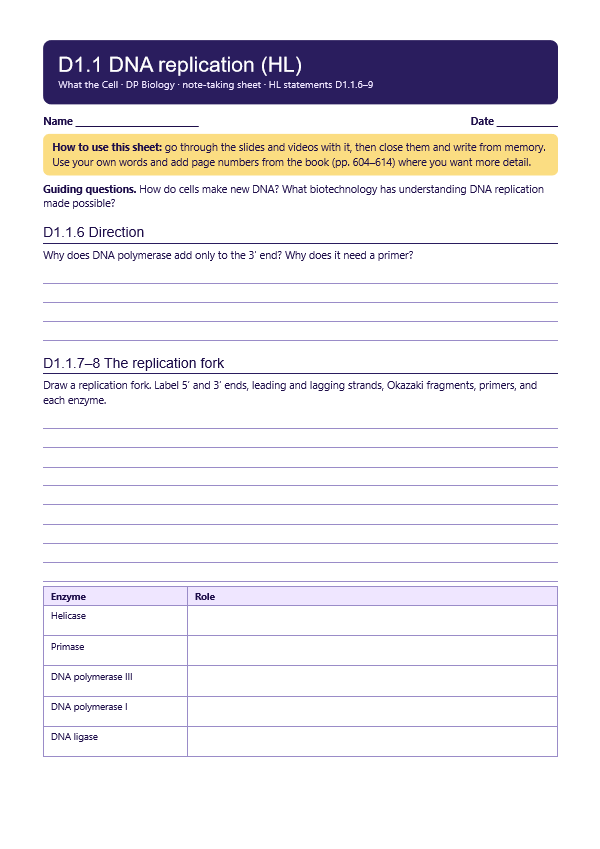
Slide: a replication fork beside a table comparing leading and lagging strands

Because the strands are antiparallel, one new strand, the leading strand, is made continuously towards the fork from a single primer. The other, the lagging strand, is made discontinuously away from the fork as short Okazaki fragments, each needing its own primer.

D1.1.8

The enzymes

pp. 610–612

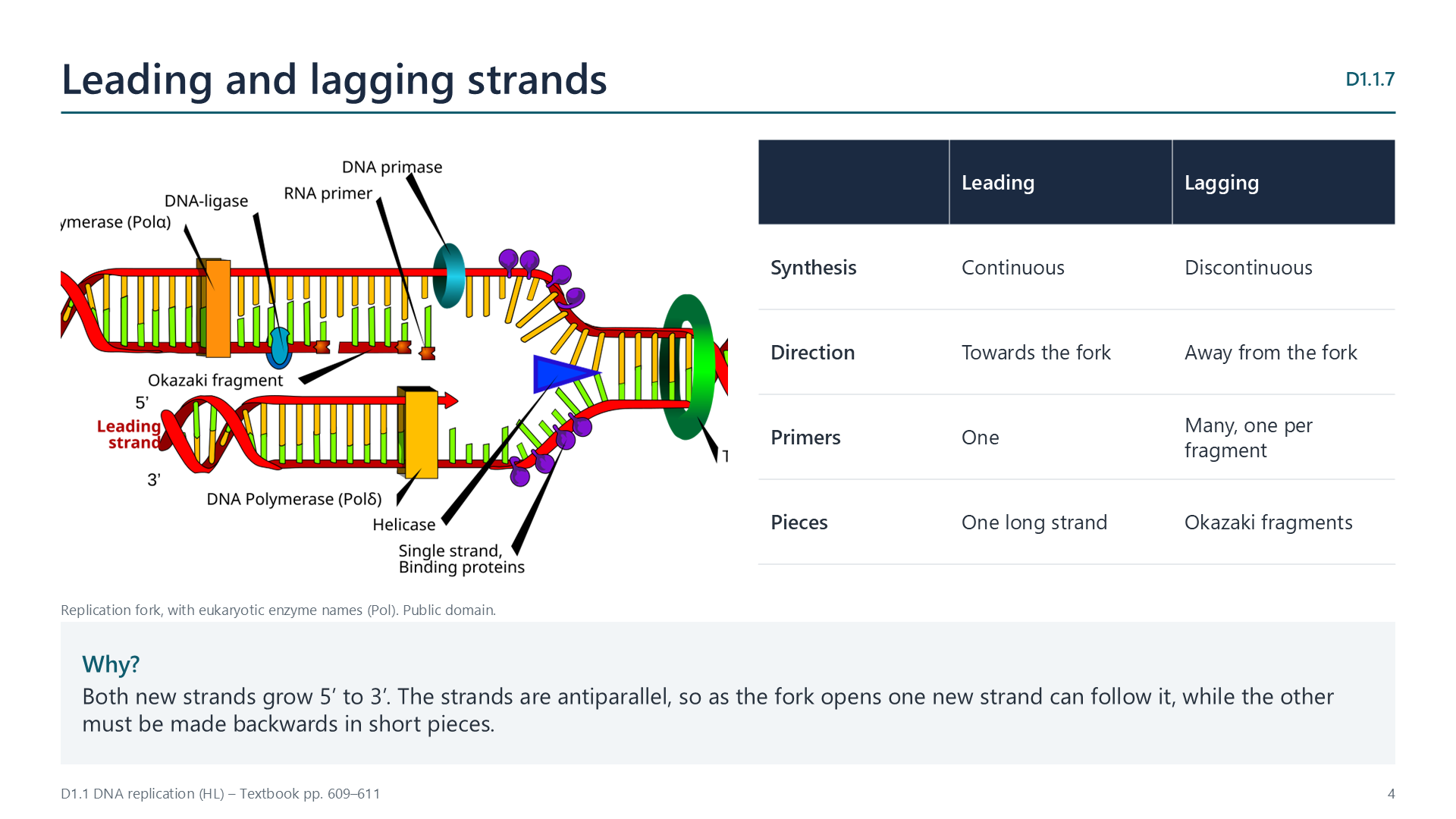
In prokaryotes, helicase separates the strands; DNA primase makes short RNA primers; DNA polymerase III extends them with DNA nucleotides; DNA polymerase I removes the RNA primers and replaces them with DNA; and DNA ligase joins the fragments into a continuous strand.

D1.1.9

Proofreading

pp. 613–614

If DNA polymerase III adds a nucleotide with a mismatched base, it removes it from the 3′ end and adds the correct one. Proofreading cuts the error rate about a hundredfold, keeping mutations rare. Taq polymerase, used in PCR, cannot proofread.

Videos

Select a video to play it here. Select it again to close it.

Note-taking sheet

Print this guide and complete it as you work through the slides and videos. It asks for your own explanations, so close the notes while you try each section.

First page of the note-taking sheet

Quick self-check

The self-check needs JavaScript to run.

Practice questions

A printable worksheet covering all four statements, from quick recall to data questions and a longer answer. It has 40 marks and takes about 40 minutes, or you can do one section at a time.

Your teacher has the mark scheme.

First page of the worksheet

Practical

Modelling leading and lagging strands

Model30 minD1.1.6, D1.1.7, D1.1.8

You will need: Long paper strips marked 5' and 3', short primer strips, cards for each enzyme

  1. Separate the strands at a moving replication fork
  2. Build the leading strand continuously in the 5' to 3' direction
  3. Build the lagging strand in short fragments, adding primers each time
  4. Use enzyme cards to show what each enzyme does

Safety: No practical hazards.

Carry this out with your teacher's supervision and follow your school's lab rules.

Nature of science and TOK

Syllabus statements

Summarised in our own words. Use each code to find the exact wording in your textbook or the IB subject guide.

  • D1.1.6The direction in which DNA polymerases workp. 611
  • D1.1.7How replication differs on the leading and lagging strandsp. 611
  • D1.1.8What primase, DNA polymerase I, DNA polymerase III and ligase each do in replicationp. 604
  • D1.1.9How DNA is proofreadp. 614

More of D1.1 in this course

© 2026 Akash Parthi Bendran. Please ask before using or sharing any resources from this site: see permission to use.