What the Cell
D1.1

DNA replication

3 hours5 statementsTextbook pp. 602–610

Guiding questions

  1. How do cells make new DNA?
  2. What biotechnology has understanding DNA replication made possible?

Slides

Slide 1 of 19

Notes

Written for this site from the course textbook and class slides, with page references for each statement. The chapter is on pages 602–610 of the course textbook. Image credits are on slide 19.

Copying DNA

D1.1.1

Replication makes exact copies of DNA

p. 602

Replication produces copies with identical base sequences. It happens in the S phase, before a cell divides. It is needed for reproduction, so that offspring inherit base sequences, and for growth and tissue replacement in multicellular organisms, so that every new cell has a full set of genes.

Watch out: replication and cell division are separate events. DNA is copied first, and the cell divides later.
D1.1.2

Semi-conservative replication and base pairing

pp. 602–604

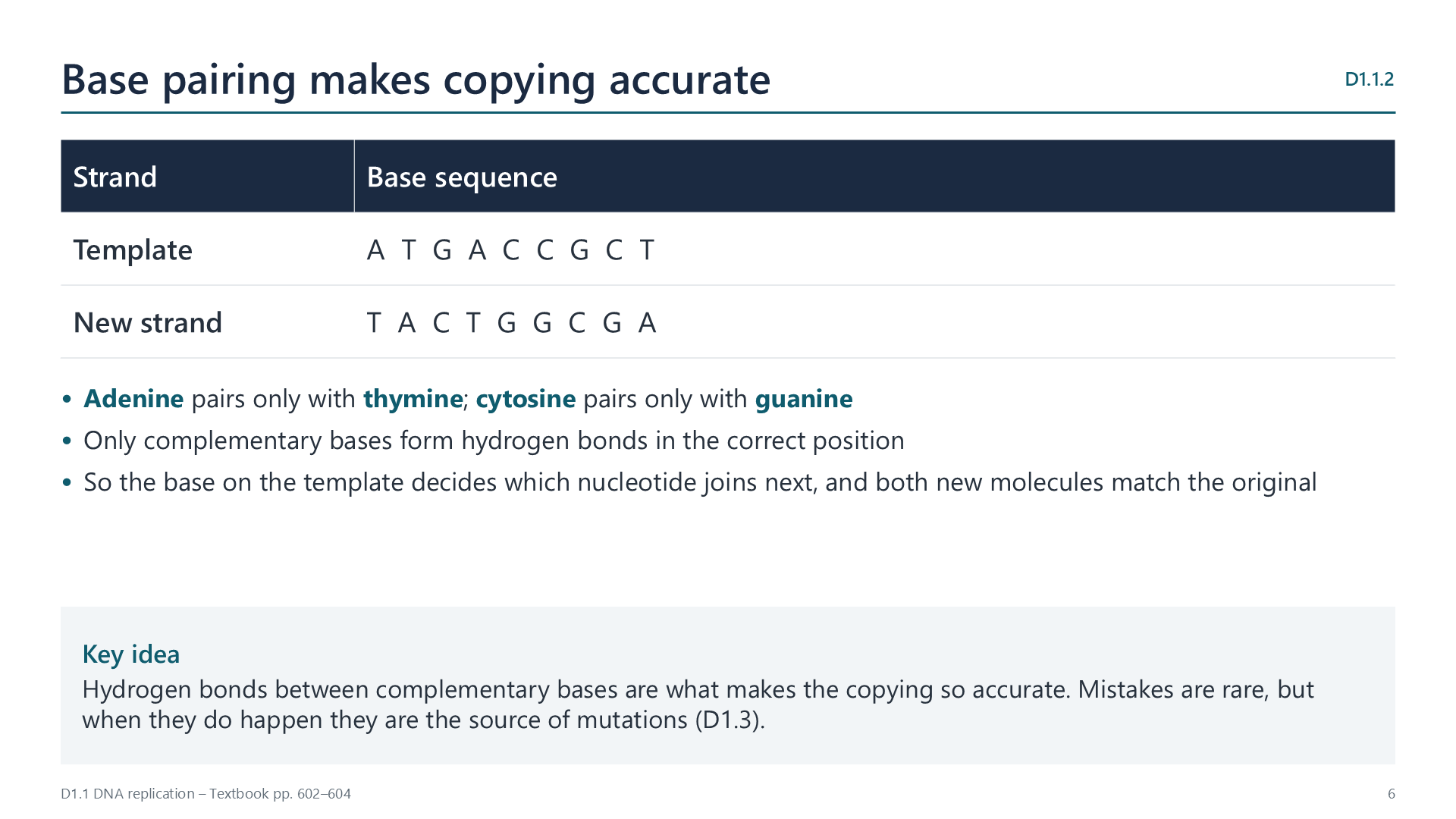
The two strands separate and each acts as a template. Each new molecule has one old strand and one new strand, so replication is semi-conservative.

Adenine pairs only with thymine, and cytosine only with guanine. Hydrogen bonds form only between complementary bases, so the template decides which nucleotide joins next. This is why copying is so accurate.

Slide: a template strand and its complementary new strand
D1.1.3

Helicase and DNA polymerase

p. 604
EnzymeRole
HelicaseUnwinds the double helix and separates the strands, by breaking hydrogen bonds between bases
DNA polymeraseLinks free nucleotides into a new strand, using the old strand as a template, by forming covalent bonds

Tools for working with DNA

D1.1.4

PCR and gel electrophoresis

pp. 605–608

The polymerase chain reaction copies a chosen section of DNA. Each cycle doubles the DNA, so 30 cycles give over a billion copies.

StepTemperatureWhat happens
DenaturationAbout 95°CStrands separate
AnnealingAbout 40°CPrimers, which are short single strands of DNA, attach to mark the section
ElongationAbout 72°CTaq polymerase builds new strands from the primers

Taq polymerase comes from a bacterium living in hot springs, so it is not denatured at 95°C.

In gel electrophoresis, DNA is placed in wells and an electric current is applied. Negatively charged phosphate groups make DNA move towards the positive electrode. The gel acts as a sieve, so short fragments travel furthest. A DNA ladder of known lengths allows comparison.

Watch out: charge makes DNA move, but length is what separates the fragments.

D1.1.5

What these tools are used for

pp. 608–610

Some non-coding regions contain short tandem repeats. The number of repeats varies between people, so fragment lengths vary too. Many loci are compared, as a match at all of them is very unlikely by chance.

  • Forensics: all bands from the crime scene sample must match the suspect. This is strong evidence that the DNA is theirs, but not in itself proof of guilt.
  • Paternity: every band in a child comes from the mother or the father. Bands not found in the mother must be in the father.
  • Other uses: diagnosing infections, and copying genes for research.

Videos

Select a video to play it here. Select it again to close it.

Note-taking sheet

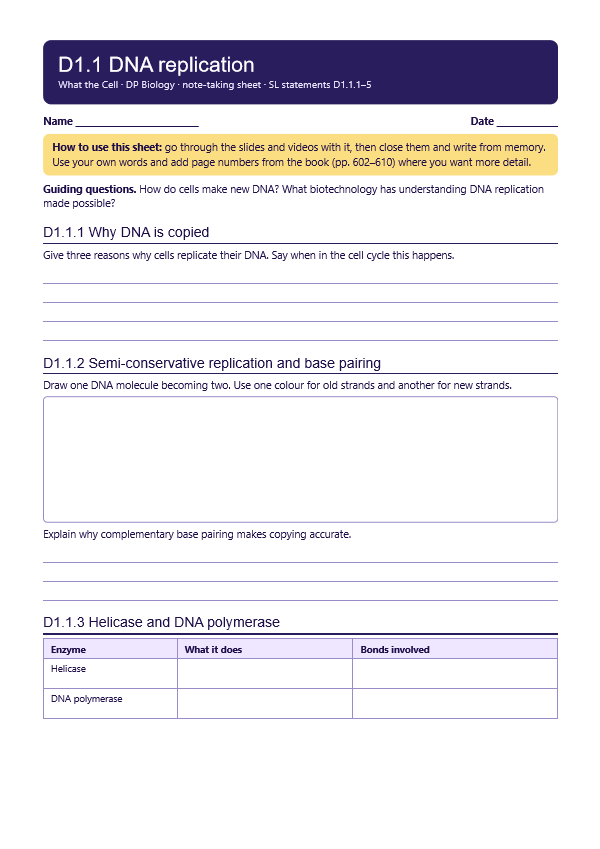
Print this guide and complete it as you work through the slides and videos. It asks for your own explanations, so close the notes while you try each section.

First page of the note-taking sheet

Quick self-check

The self-check needs JavaScript to run.

Practice questions

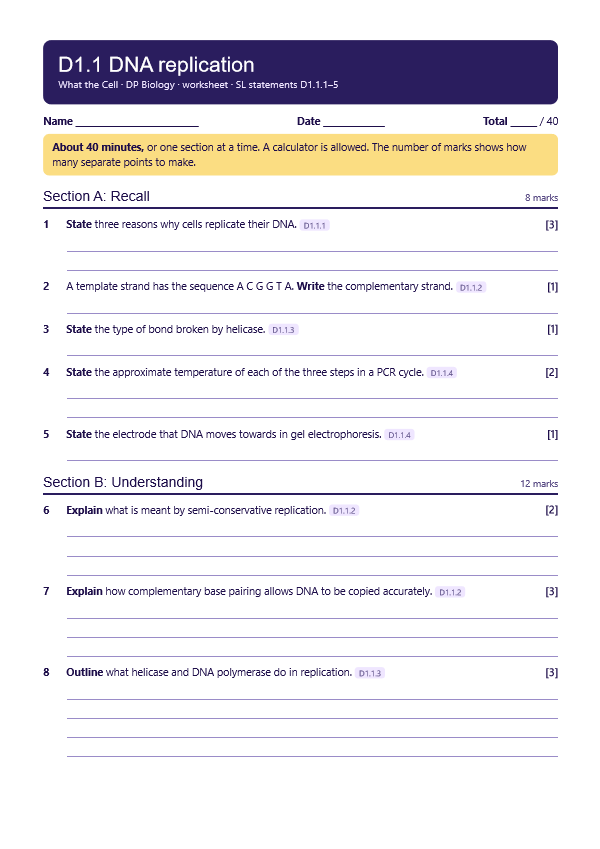
A printable worksheet covering all five statements, from quick recall to data questions and a longer answer. It has 40 marks and takes about 40 minutes, or you can do one section at a time.

Your teacher has the mark scheme.

First page of the worksheet

Practical

Modelling semi-conservative replication

Model30 minD1.1.1, D1.1.2, D1.1.3

You will need: Paper strips or sets of coloured beads for bases, two colours of backbone

  1. Build a short double strand in one colour
  2. Separate the strands, acting as helicase
  3. Add new complementary bases in the second colour, acting as DNA polymerase
  4. Explain why each new molecule keeps one original strand

Safety: No practical hazards.

Carry this out with your teacher's supervision and follow your school's lab rules.

Nature of science and TOK

Syllabus statements

Summarised in our own words. Use each code to find the exact wording in your textbook or the IB subject guide.

  • D1.1.1Replication: making exact copies of DNA with identical base sequencesp. 602
  • D1.1.2Why replication is semi-conservative, and how complementary base pairing makes it workp. 602
  • D1.1.3What helicase and DNA polymerase do in replicationp. 604
  • D1.1.4PCR and gel electrophoresis: tools for copying and separating DNAp. 605
  • D1.1.5What PCR and gel electrophoresis are used forp. 608

HL extension

© 2026 Akash Parthi Bendran. Please ask before using or sharing any resources from this site: see permission to use.