What the Cell
D3.2

Inheritance

HL extension
4 hours6 statementsTextbook pp. 747–759

Guiding questions

  1. What patterns of inheritance are seen in plants and animals?
  2. What happens at the molecular level to produce these patterns?

Slides

Slide 1 of 14

Notes

Written for this site from the class slides, with textbook page references for each statement. The chapter is on pages 747–759 of the course textbook. Image credits are on slide 14.

Two genes

D3.2.16

Segregation and independent assortment

pp. 747–748

In meiosis I, homologous chromosomes separate, so each gamete gets one allele of each gene (segregation). Each pair of homologues lines up at random in metaphase I, so genes on different chromosomes are inherited independently (independent assortment). A parent RrYy makes RY, Ry, rY and ry gametes in equal numbers.

D3.2.17

Dihybrid Punnett grids

pp. 748–750
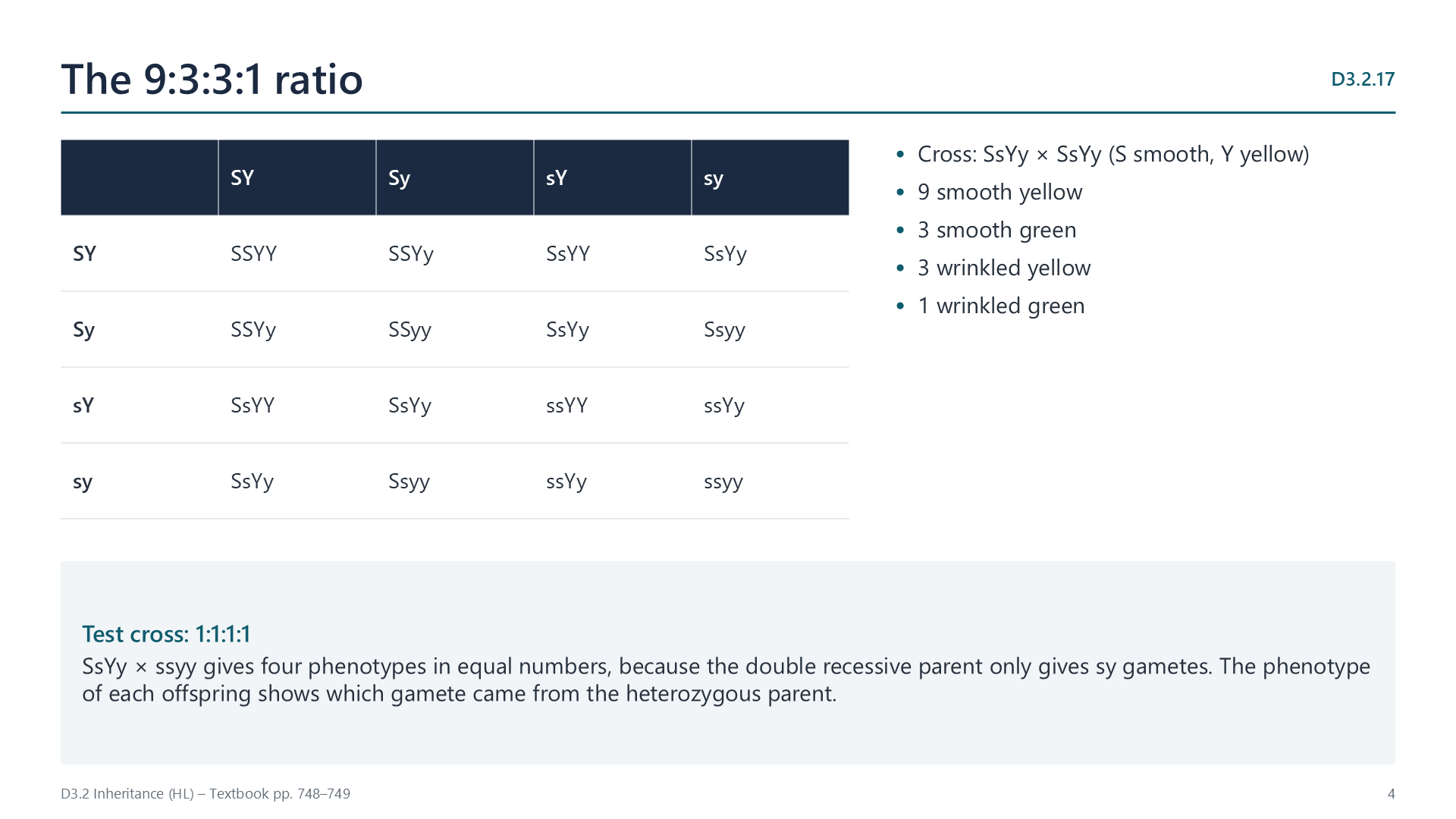
Slide: a 4 by 4 Punnett grid for a dihybrid cross giving 9:3:3:1

Crossing two double heterozygotes for unlinked genes gives a 9:3:3:1 phenotype ratio. A test cross of a double heterozygote with a double homozygous recessive gives 1:1:1:1.

D3.2.18

Gene loci

pp. 750–751

Databases give each human gene’s locus and product. HBB (beta globin) and HBD (delta globin) lie next to each other on chromosome 11; HBA1 (alpha globin) is on chromosome 16; CFTR is on chromosome 7.

Linkage and statistics

D3.2.19

Linkage

pp. 751–752

Genes on the same chromosome are linked and tend to be inherited together, so they do not assort independently. They are shown with alleles beside vertical lines, one line per homologous chromosome. The closer the loci, the stronger the linkage.

D3.2.20

Recombinants

pp. 752–754

A recombinant has a combination of alleles not found in either parent. With linked genes, recombinants come only from crossing over between the loci, so a test cross gives two large parental classes and two small recombinant classes.

D3.2.21

Chi-squared test

pp. 755–757

The null hypothesis is that observed numbers do not differ significantly from those expected (for example 9:3:3:1). Calculate χ2 = Σ(O − E)2/E, with degrees of freedom = classes − 1. If χ2 is greater than the critical value at p = 0.05 (7.81 for 3 degrees of freedom), reject the null hypothesis; the genes may be linked.

Videos

Select a video to play it here. Select it again to close it.

Note-taking sheet

Print this guide and complete it as you work through the slides and videos. It asks for your own explanations, so close the notes while you try each section.

First page of the note-taking sheet

Quick self-check

The self-check needs JavaScript to run.

Practice questions

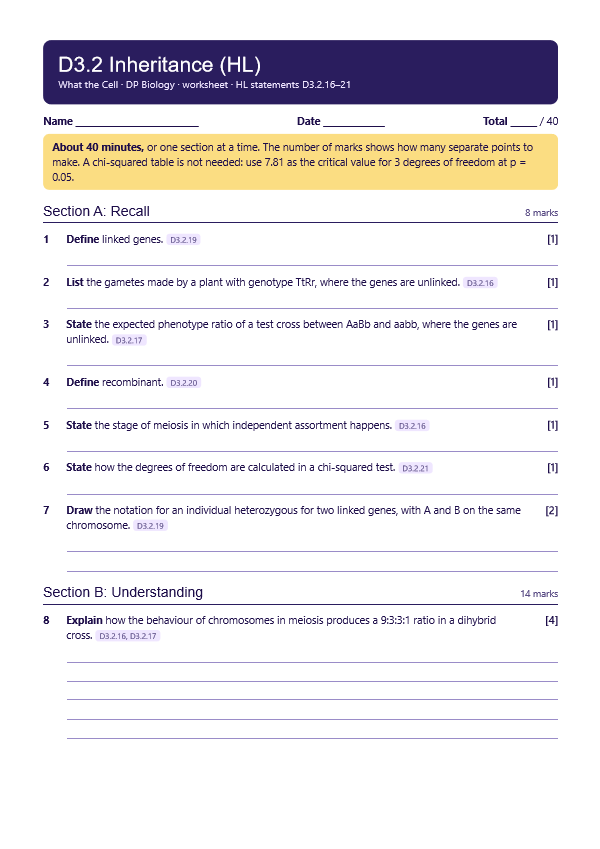
A printable worksheet covering all six statements, from quick recall to data questions and a longer answer. It has 40 marks and takes about 40 minutes, or you can do one section at a time.

Your teacher has the mark scheme.

First page of the worksheet

Practical

Dihybrid crosses and chi-squared

Model45 minD3.2.17, D3.2.21

You will need: Two coins per student, Punnett grid template, chi-squared table

  1. Treat each coin as a heterozygous gene, and toss both coins for each parent
  2. Record 80 offspring from a cross of two heterozygotes
  3. Compare the results to the expected 9:3:3:1 ratio
  4. Calculate chi-squared and decide whether the difference is significant

Safety: No practical hazards.

Carry this out with your teacher's supervision and follow your school's lab rules.

Nature of science and TOK

Syllabus statements

Summarised in our own words. Use each code to find the exact wording in your textbook or the IB subject guide.

  • D3.2.16How unlinked genes segregate and assort independently in meiosisp. 747
  • D3.2.17Using Punnett grids to predict ratios in dihybrid crosses of unlinked autosomal genesp. 748
  • D3.2.18The loci of human genes and the polypeptides they code forp. 751
  • D3.2.19Linkage of genes on autosomesp. 751
  • D3.2.20Recombinant offspring when two genes are crossed, whether linked or notp. 753
  • D3.2.21Applying a chi-squared test to dihybrid cross resultsp. 757

More of D3.2 in this course

© 2026 Akash Parthi Bendran. Please ask before using or sharing any resources from this site: see permission to use.