What the Cell
A4.2

Conservation of biodiversity

3 hours8 statementsTextbook pp. 156–180

Guiding questions

  1. What is driving the sixth mass extinction?
  2. What can conservationists do to reduce the loss of biodiversity?

Slides

Slide 1 of 18

Notes

Written for this site from the class slides, with textbook page references for each statement. The chapter is on pages 156–180 of the course textbook. Image credits are on slide 18.

Biodiversity, past and present

A4.2.1

Biodiversity in all its forms and levels

pp. 156–159

Biodiversity includes ecosystem diversity, species diversity and genetic diversity. Species diversity depends on richness, the number of species, and evenness, how similar their numbers are. Simpson's reciprocal index compares communities: D = N(N − 1) / Σn(n − 1), and a higher value means higher diversity.
A4.2.2

Today compared with the past

pp. 160–161

Millions of species have been named, and many more remain to be discovered. Fossils suggest that more species are alive now than at any time in the past, although past levels are hard to estimate.

What is being lost, and why

A4.2.3

Human-caused extinction

pp. 162–164
SpeciesCauses
Moa, New ZealandHunted, and their forest burnt and cleared, after people arrived around 1280; giant moa were gone by about 1500
Caribbean monk sealHunted for oil and meat, and last confirmed in 1952

Add a third brief case study from your own region.

A4.2.4

Causes of ecosystem loss

pp. 164–167

Causes include farming, logging, mining, dams, draining water, pollution and climate change. Mixed dipterocarp forest in South East Asia is being lost to timber and plantations such as oil palm. Your local example could be Swiss moorland or river floodplains.

A4.2.5

Evidence of a biodiversity crisis

p. 168

Reports from IPBES and other sources draw on surveys of many habitats and groups. They include population sizes, species ranges, richness and evenness, and how degraded ecosystems are. Citizen scientists can add data too.

A4.2.6

Causes of the current crisis

pp. 169–173

Human population growth is the overarching cause. Specific causes are hunting and over-exploitation, urbanization, deforestation and land clearance, pollution, and invasive species.

What can be done

A4.2.7

Why several approaches are needed

pp. 174–178
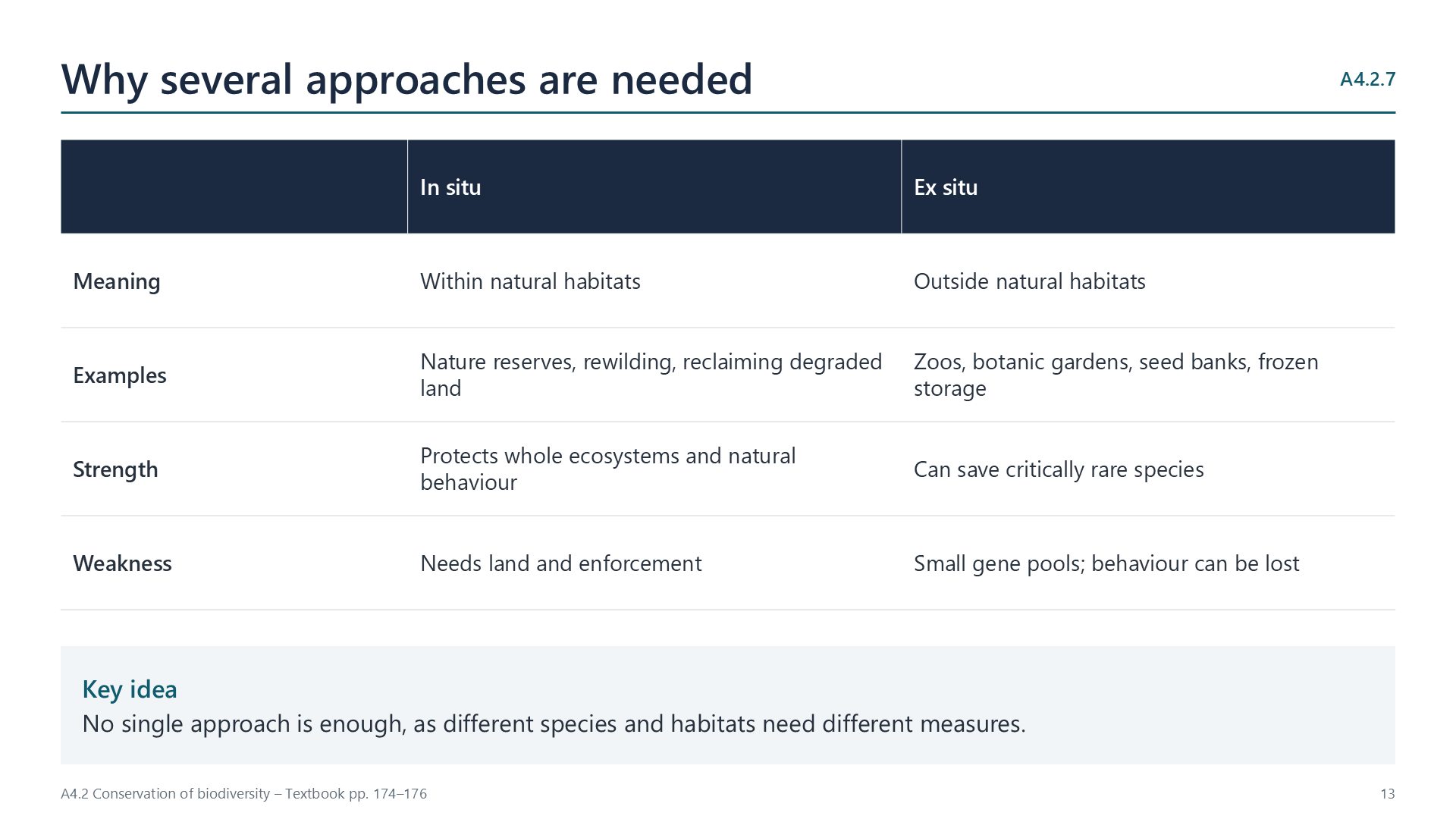
Slide: a table comparing in situ and ex situ conservation

No single approach is enough. In situ methods include nature reserves, rewilding and reclaiming degraded land. Ex situ methods include zoos, botanic gardens and seed banks.

A4.2.8

The EDGE of Existence programme

pp. 178–179

EDGE gives priority to species that are Evolutionarily Distinct and Globally Endangered. With limited funds, saving a species with few close relatives protects more unique evolutionary history.

Videos

Select a video to play it here. Select it again to close it.

Note-taking sheet

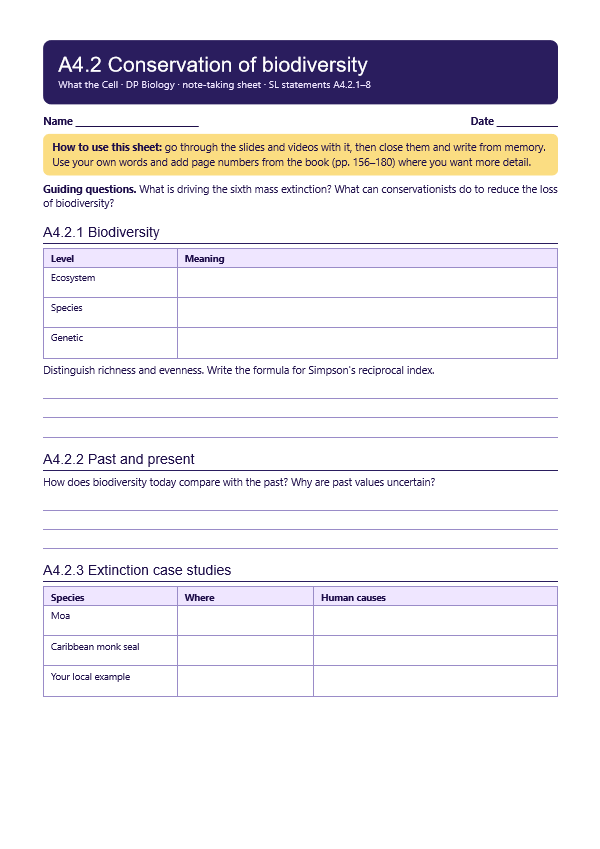
Print this guide and complete it as you work through the slides and videos. It asks for your own explanations, so close the notes while you try each section.

First page of the note-taking sheet

Quick self-check

The self-check needs JavaScript to run.

Practice questions

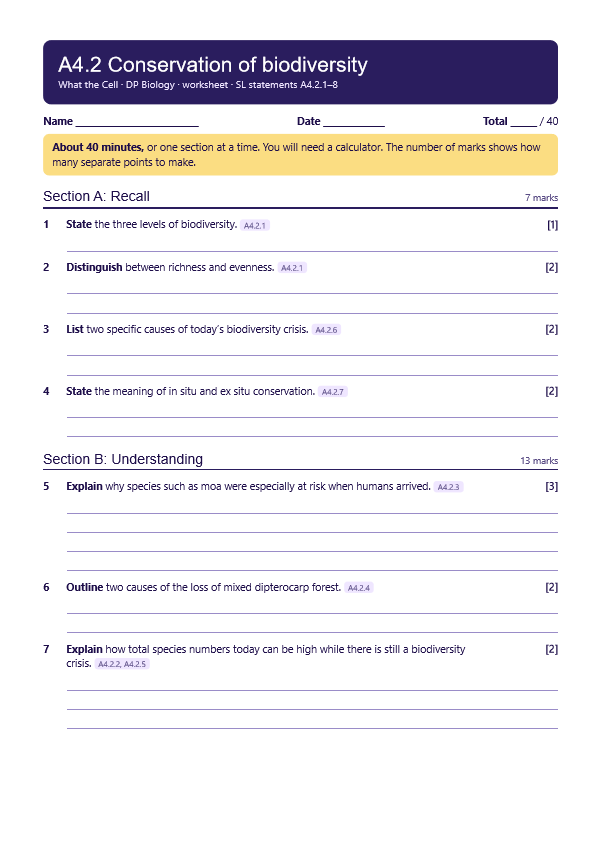
A printable worksheet covering all eight statements, from quick recall to data questions and a longer answer. It has 40 marks and takes about 40 minutes, or you can do one section at a time.

Your teacher has the mark scheme.

First page of the worksheet

Data-based questions

Questions built on realistic experimental data, in the style of Paper 1B and Paper 2. Work them on paper and show your working. 13 marks in total. Your teacher has the mark scheme.

Insect decline and bee food

7 marks
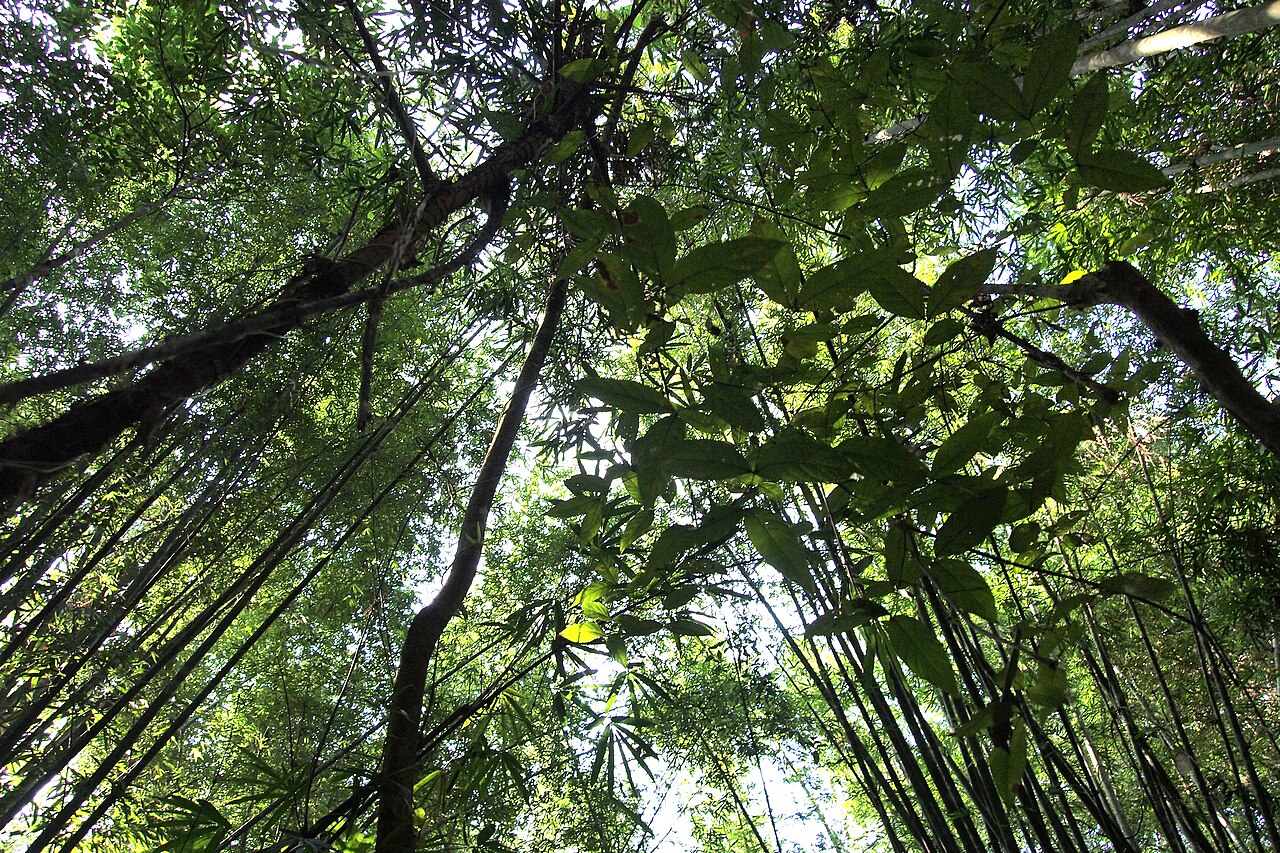
A forest
Image: Vyacheslav Argenberg, CC BY 4.0, Wikimedia Commons.

A review of 70 long-term studies estimated how fast insect biomass is falling each year in different orders of insects.

Insect orderMean decline in biomass / % per year
Lepidoptera (butterflies and moths)3.1
Coleoptera (beetles)2.4
Hymenoptera (bees, wasps and ants)1.9
All insects2.5
  1. State the mean annual decline in biomass for all insects. [1]
  2. A region has 400 000 insect species. Calculate how many would remain after one year if the number of species fell at the same rate. [1]
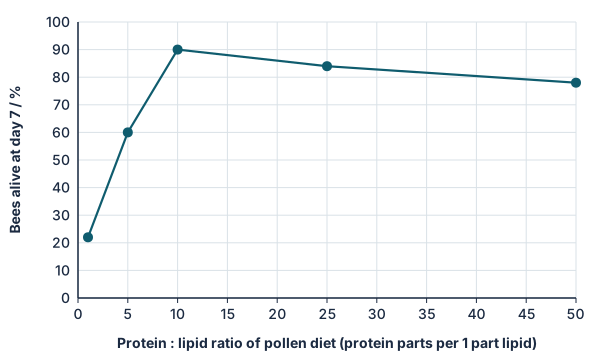
  3. Bumblebees were fed artificial pollen with different ratios of protein to lipid, and survival was recorded after 7 days.

    Line graph of bumblebee survival at day 7 against protein to lipid ratio of food: 22% at 1 to 1, 60% at 5 to 1, 90% at 10 to 1, 84% at 25 to 1 and 78% at 50 to 1.
    Describe the effect of a high lipid content on survival. [1]
  4. Identify, with a reason, the best ratio of protein to lipid for bumblebees. [1]
  5. Discuss how the loss of wildflower habitats could contribute to the decline of bumblebees, using the data. [3]

Threats to wilderness

6 marks

Large wilderness areas have very few people and are mostly undisturbed. Conservationists recorded which human activities threaten wilderness areas in five biomes. A tick means the activity threatens that biome.

ActivityTropical forestBoreal forestTundraDesertGrassland
Climate change✓✓✓✓✓
Hunting✓✓✓✓✓
Mining✓✓✓✓
Fire✓✓✓
Logging✓✓
Agriculture✓✓
Pollution✓✓
  1. State how many of the activities threaten all five biomes. [1]
  2. Identify one activity that threatens deserts but not grasslands. [1]
  3. Compare the threats from pollution and climate change. [2]
  4. Suggest how fire could reduce biodiversity in a tropical forest. [2]

Practical

Comparing species in two habitats

Field50 minA4.2.1

You will need: Quadrats, identification guide or app, clipboard

  1. Choose two contrasting areas, such as mown and unmown grass
  2. Place five random quadrats in each
  3. Record the types of plant and how common each is
  4. Compare the two sites, and suggest reasons for any difference

Safety: Check the site first. Watch for stinging plants, wash hands afterwards and consider allergies.

Carry this out with your teacher's supervision and follow your school's lab rules.

Nature of science and TOK

Syllabus statements

Summarised in our own words. Use each code to find the exact wording in your textbook or the IB subject guide.

  • A4.2.1What biodiversity means, across all forms and levels of lifep. 156
  • A4.2.2How today's species numbers compare with biodiversity in the pastp. 160
  • A4.2.3How human activity causes species to become extinctp. 162
  • A4.2.4What causes ecosystems to be lostp. 164
  • A4.2.5Evidence that biodiversity is in crisisp. 168
  • A4.2.6What is causing the present biodiversity crisisp. 169
  • A4.2.7Why conserving biodiversity needs more than one approachp. 174
  • A4.2.8How the EDGE of Existence programme picks species that are evolutionarily distinct and globally endangeredp. 178

HL extension

A4.2 has no HL-only content. SL and HL students learn the same material here.

© 2026 Akash Parthi Bendran. Please ask before using or sharing any resources from this site: see permission to use.