What the Cell
D4.1

Natural selection

3 hours8 statementsTextbook pp. 779–789

Guiding questions

  1. What can change allele frequencies in a population?
  2. What part does reproduction play in natural selection?

Slides

Slide 1 of 15

Notes

Written for this site from the class slides, with textbook page references for each statement. The chapter is on pages 779–789 of the course textbook. Image credits are on slide 15.

How selection works

D4.1.1

Natural selection drives evolution

pp. 779–781

Natural selection operates all the time and has done so for billions of years, producing the biodiversity of life on Earth. Individuals vary, more are born than can survive, and those better adapted leave more offspring.
D4.1.2

Mutation and sexual reproduction create variation

p. 782

Mutation makes new alleles, and sexual reproduction makes new combinations of alleles, through crossing over, random orientation and random fertilization.

D4.1.3

Overproduction and competition

pp. 782–783

More offspring are produced than resources can support, so members of a species compete. Food, water, space and nesting sites can limit a population's carrying capacity.

D4.1.4

Abiotic factors as selection pressures

p. 783

Density-independent factors, such as high or low temperatures, reduce survival at any population density. Individuals with heritable traits suited to the conditions are more likely to survive.

D4.1.5

Differences in adaptation, survival and reproduction

pp. 783–785

This is the basis of selection. Fitness is how likely a genotype is to survive and leave offspring, and it depends on the environment. Competition within a species favours those with higher fitness.

D4.1.6

Traits must be heritable

p. 784

Characteristics acquired in life because of the environment are not encoded in base sequences, so they are not inherited and cannot evolve.

Sexual selection

D4.1.7

Sexual selection

pp. 786–788

Physical and behavioural differences can affect success in attracting a mate, and they can signal fitness. Birds-of-paradise are well-known examples, in which males have exaggerated plumage and displays.

D4.1.8

Modelling selection: Endler's guppies

pp. 788–789
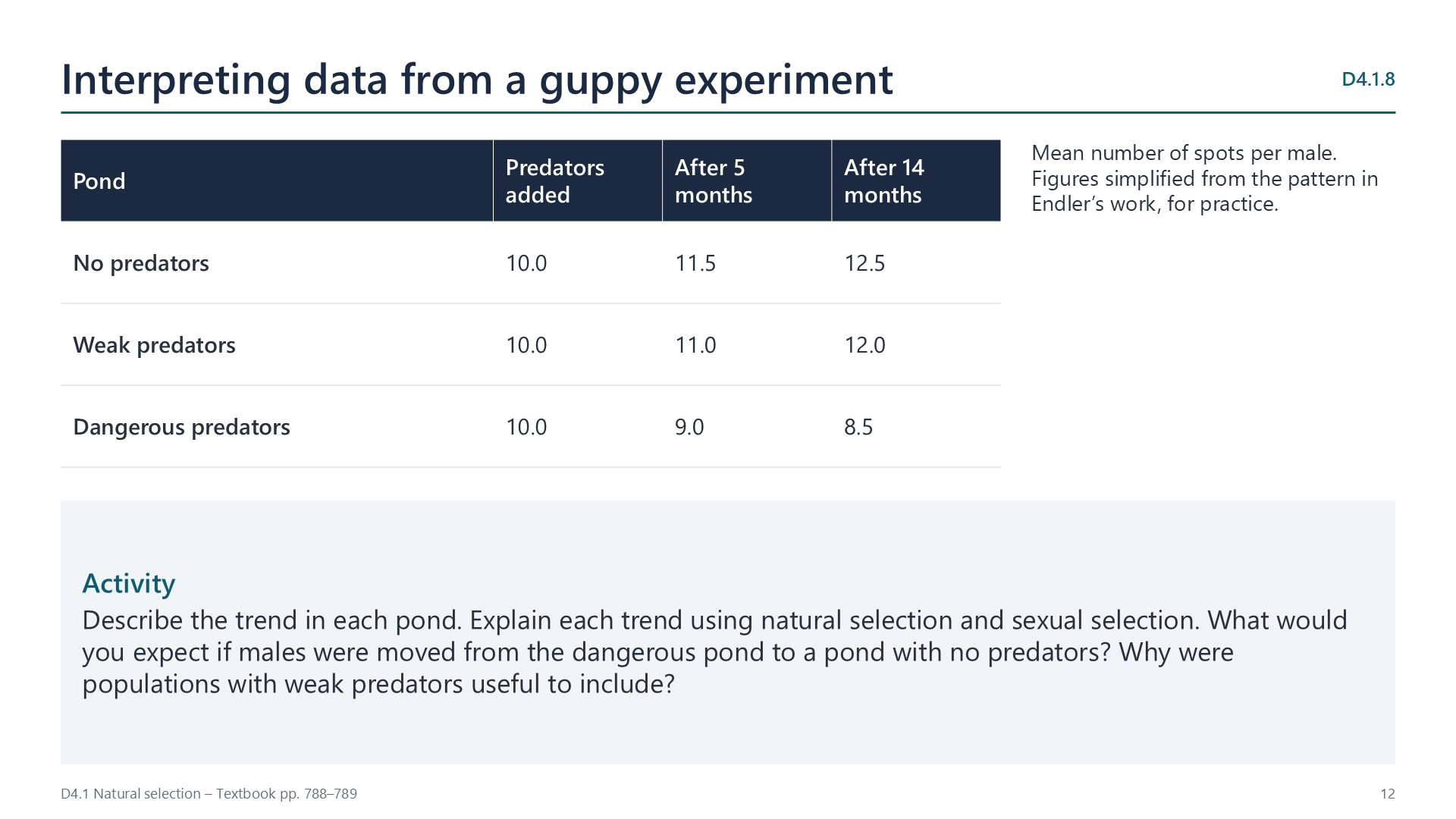
Slide: a table of guppy spot numbers in three ponds

Bright spots attract females, as well as predators. Endler kept guppies under different levels of predation. Spots increased without predators, through sexual selection, and fell with dangerous predators, through natural selection. Selection pressures in the experiment were controlled.

Videos

Select a video to play it here. Select it again to close it.

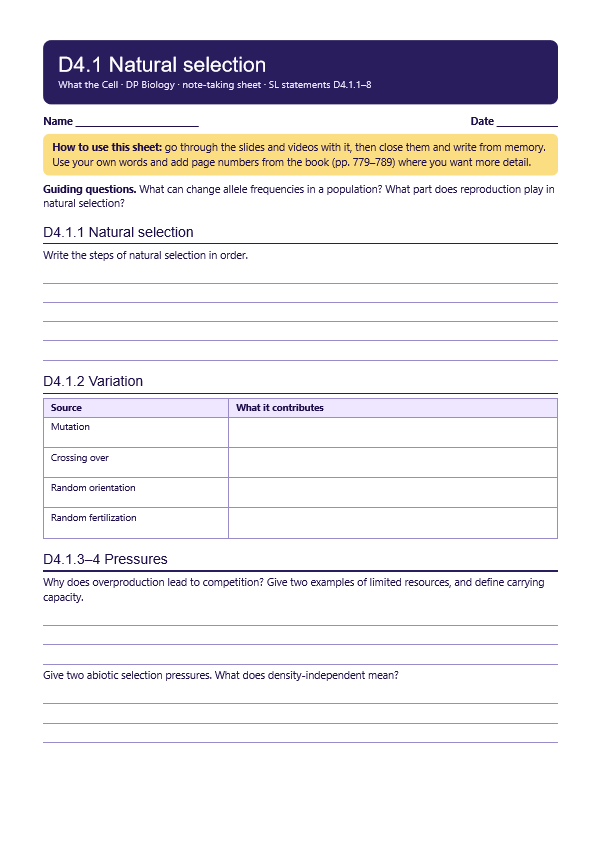
Note-taking sheet

Print this guide and complete it as you work through the slides and videos. It asks for your own explanations, so close the notes while you try each section.

First page of the note-taking sheet

Quick self-check

The self-check needs JavaScript to run.

Practice questions

A printable worksheet covering all eight statements, from quick recall to data questions and a longer answer. It has 36 marks and takes about 35 minutes, or you can do one section at a time.

Your teacher has the mark scheme.

First page of the worksheet

Data-based questions

Questions built on realistic experimental data, in the style of Paper 1B and Paper 2. Work them on paper and show your working. 14 marks in total. Your teacher has the mark scheme.

Mate choice in guppies

8 marks
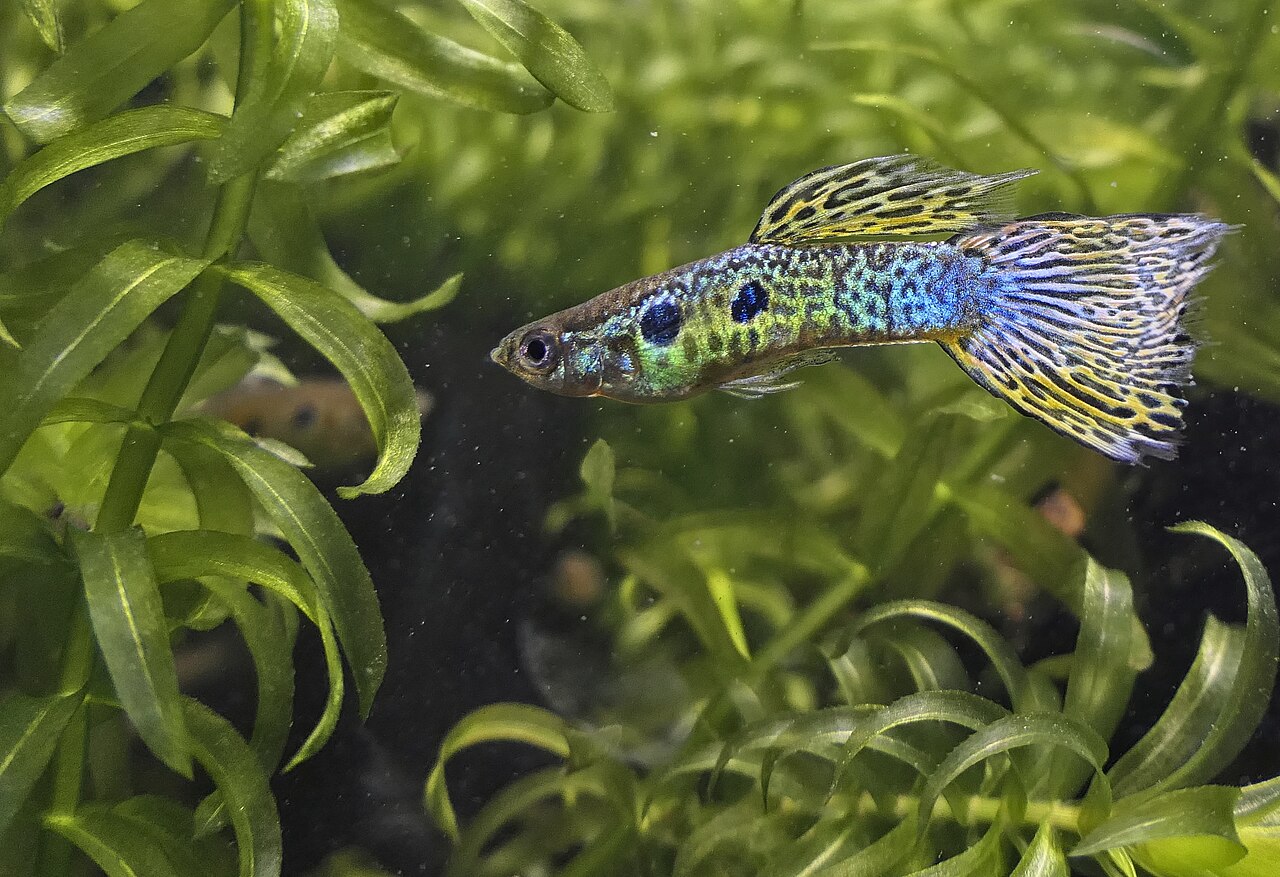
Male guppy
Image: 5snake5, CC0, Wikimedia Commons.

Male guppies (Poecilia reticulata) in Trinidad vary in colour and in behaviour. Males were sorted as bright or dull, and as bold (approaching a predator fish) or timid (swimming away). Forty females were each allowed to choose between males, with and without a predator fish visible in a nearby tank.

Males chosenNo predatorPredator present
Bright and bold1415
Bright and timid135
Dull and bold714
Dull and timid66
  1. State how many females chose dull males when the predator was present. [1]
  2. Calculate the difference in the number of bright, timid males chosen with and without the predator. [1]
  3. Compare the choices made by females with and without the predator. [2]
  4. Suggest reasons for this pattern of mate choice. [2]
  5. Evaluate the hypothesis that boldness is more important than colour when females choose mates. [2]

Body size in marine iguanas

6 marks

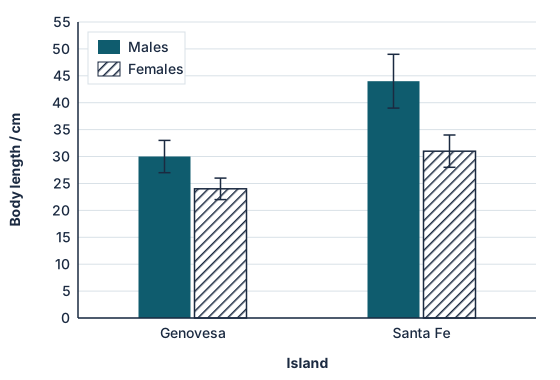
Marine iguanas feed on algae on rocky shores of the Galapagos Islands. Males defend territories where females come to mate. The body length (snout to vent) of adults was measured on two islands. On Genovesa there is much less algae than on Santa Fe. Error bars show ± 1 SD.

Bar chart of mean body length. Genovesa: males 30, females 24 centimetres. Santa Fe: males 44, females 31.
  1. Compare the body length of males and females. [2]
  2. Calculate how much longer, as a percentage, males on Santa Fe are than males on Genovesa. [1]
  3. Suggest why males are larger than females. [2]
  4. Suggest why both sexes are smaller on Genovesa. [1]

Practical

Modelling natural selection with beak tools

Model35 minD4.1.3, D4.1.5

You will need: Forceps, spoons and clothes pegs as beaks, seeds or beads of different sizes, cups, timer

  1. Each student gets one tool, and collects food for 30 seconds
  2. Only those who gather enough food survive to the next round
  3. Survivors pass on their tool type, and the round is repeated
  4. Graph how tool numbers change, and link this to selection

Safety: Keep beads and seeds off the floor to avoid slips.

Carry this out with your teacher's supervision and follow your school's lab rules.

Nature of science and TOK

Syllabus statements

Summarised in our own words. Use each code to find the exact wording in your textbook or the IB subject guide.

  • D4.1.1Natural selection as what drives evolutionp. 779
  • D4.1.2How mutation and sexual reproduction create the variation that selection acts onp. 782
  • D4.1.3How having too many offspring, and competing for resources, promote natural selectionp. 782
  • D4.1.4Non-living factors acting as selection pressuresp. 783
  • D4.1.5Natural selection depends on individuals differing in adaptation, survival and reproductionp. 783
  • D4.1.6Why traits must be inherited for evolution to happenp. 784
  • D4.1.7Sexual selection in animalsp. 786
  • D4.1.8Modelling natural and sexual selection by controlling selection pressures in an experimentp. 788

HL extension

© 2026 Akash Parthi Bendran. Please ask before using or sharing any resources from this site: see permission to use.