What the Cell
B2.2

Organelles and compartmentalization

2 hours3 statementsTextbook pp. 244–247

Guiding questions

  1. How does the structure of each organelle suit its function?
  2. Why is it useful for cells to have separate compartments?

Slides

Slide 1 of 11

Notes

Written for this site from the class slides, with textbook page references for each statement. The chapter is on pages 244–247 of the course textbook. Image credits are on slide 11.

B2.2.1

Organelles are discrete subunits with particular jobs

pp. 244–245

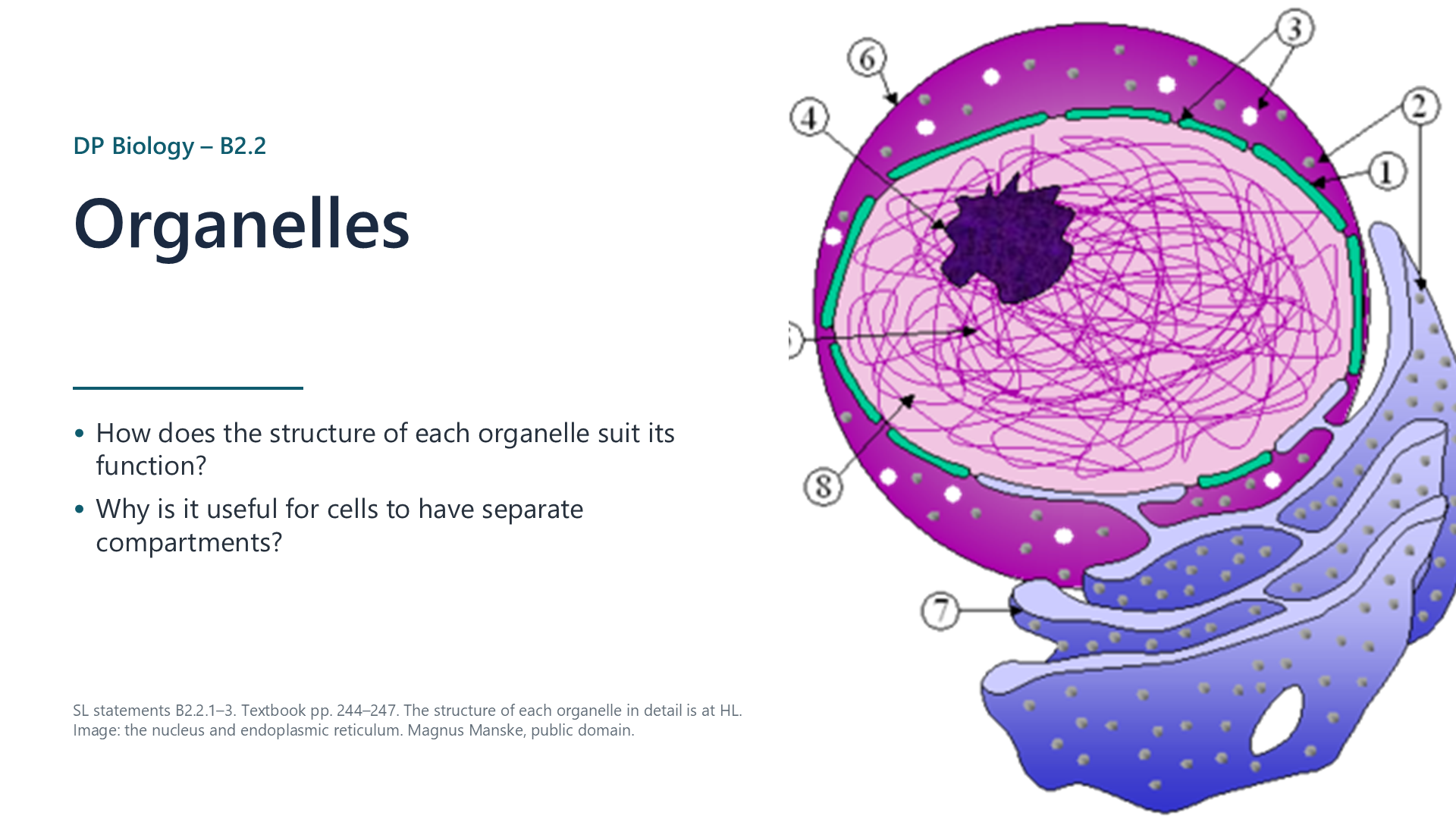
An organelle is a separate part of a cell, adapted to carry out one or more functions. Nuclei, vesicles, ribosomes and the plasma membrane all count.

MembranesExamples
TwoNucleus, mitochondrion, chloroplast
OneVesicle, vacuole, lysosome, ER, Golgi apparatus
NoneRibosome

Watch out: the cell wall, cytoskeleton and cytoplasm are not organelles.
B2.2.2

Why the nucleus is kept separate from the cytoplasm

pp. 246–247

In eukaryotes, transcription happens in the nucleus and translation in the cytoplasm. mRNA can therefore be modified before it meets ribosomes. Prokaryotes have no nuclear membrane, and so ribosomes may start on mRNA as soon as it forms.

B2.2.3

Advantages of compartments in the cytoplasm

p. 247

Compartments concentrate enzymes and substrates, and separate processes that would interfere with one another. They also allow each region to keep its own conditions.

Lysosomes hold digestive enzymes behind a membrane at a low pH. The enzymes work only at this low pH, so any that leak into the neutral cytoplasm do little harm. Phagocytic vacuoles enclose engulfed food or pathogens, so that digestion takes place apart from the cytoplasm.

Videos

Select a video to play it here. Select it again to close it.

Note-taking sheet

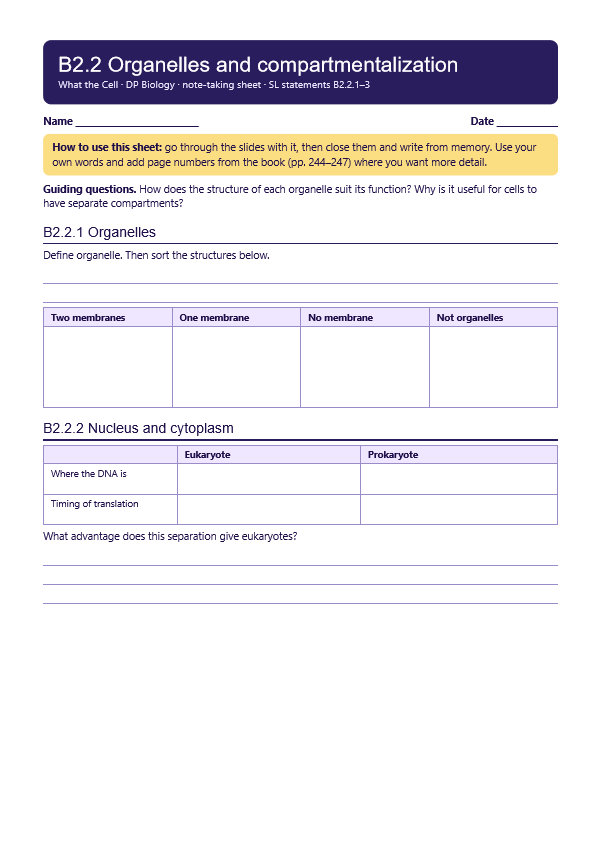
Print this guide and complete it as you work through the slides and videos. It asks for your own explanations, so close the notes while you try each section.

First page of the note-taking sheet

Quick self-check

The self-check needs JavaScript to run.

Practice questions

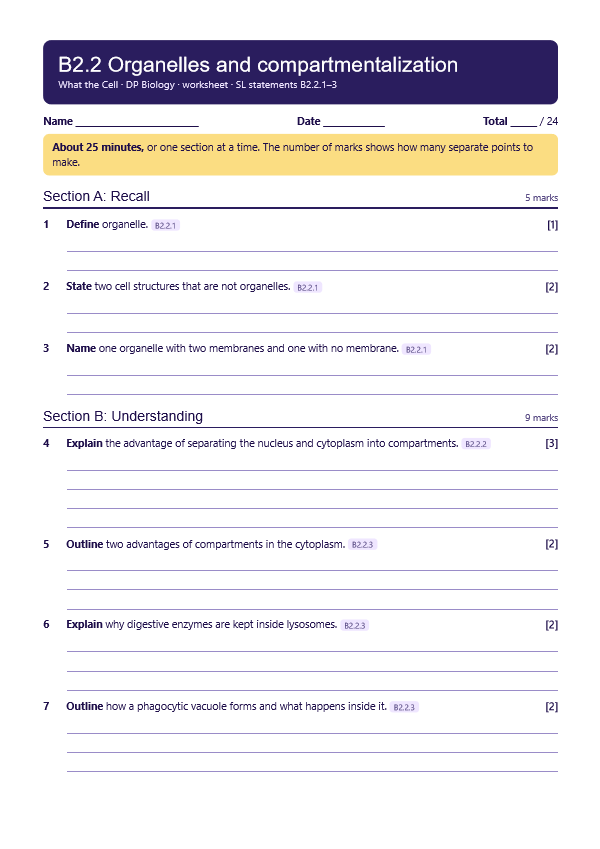
A printable worksheet covering all three statements, from quick recall to data questions and a longer answer. It has 24 marks and takes about 25 minutes, or you can do one section at a time.

Your teacher has the mark scheme.

First page of the worksheet

Practical

Observing chloroplasts in living cells

Lab30 minB2.2.1, B2.2.3

You will need: Elodea or moss leaf, slides, coverslips, microscope

  1. Mount one young leaf in a drop of water
  2. Find a single layer of cells at high power
  3. Draw the cell, showing chloroplasts
  4. Suggest why it helps to keep photosynthesis in separate organelles

Safety: Low risk. Take care with glass slides.

Carry this out with your teacher's supervision and follow your school's lab rules.

Nature of science and TOK

Syllabus statements

Summarised in our own words. Use each code to find the exact wording in your textbook or the IB subject guide.

  • B2.2.1Organelles: separate parts of a cell, each adapted to a particular jobp. 244
  • B2.2.2Why it helps to keep the nucleus and cytoplasm apartp. 246
  • B2.2.3Why it helps to divide the cytoplasm into compartmentsp. 247

HL extension

© 2026 Akash Parthi Bendran. Please ask before using or sharing any resources from this site: see permission to use.