What the Cell
B3.1

Gas exchange

Animal
3 hours6 statementsTextbook pp. 273–282

Guiding questions

  1. What adaptations let multicellular organisms exchange gases?
  2. How do flowering plants and mammals differ, and resemble each other, in gas exchange?

Slides

Slide 1 of 24

Notes

Written for this site from the course textbook and class slides. Use the page numbers to read the book's fuller account. Plant gas exchange (B3.1.7–10) is in Plant Systems. Image credits are on slide 24.

The problem and the surface

B3.1.1

Why every organism needs gas exchange

pp. 273–274

Cells respire continuously. Aerobic respiration consumes oxygen and produces carbon dioxide, and both gases move into or out of cells by diffusion. In a single-celled organism, the whole plasma membrane is enough to serve as the exchange surface.

Growth creates two problems. The surface area-to-volume ratio falls, so there is less surface for each unit of respiring tissue. The distance from the centre of the body to the outside also rises, and diffusion is only fast over very short distances. A tough, protective skin makes things worse.

So large, active animals have a specialized exchange organ, and usually a transport system as well.
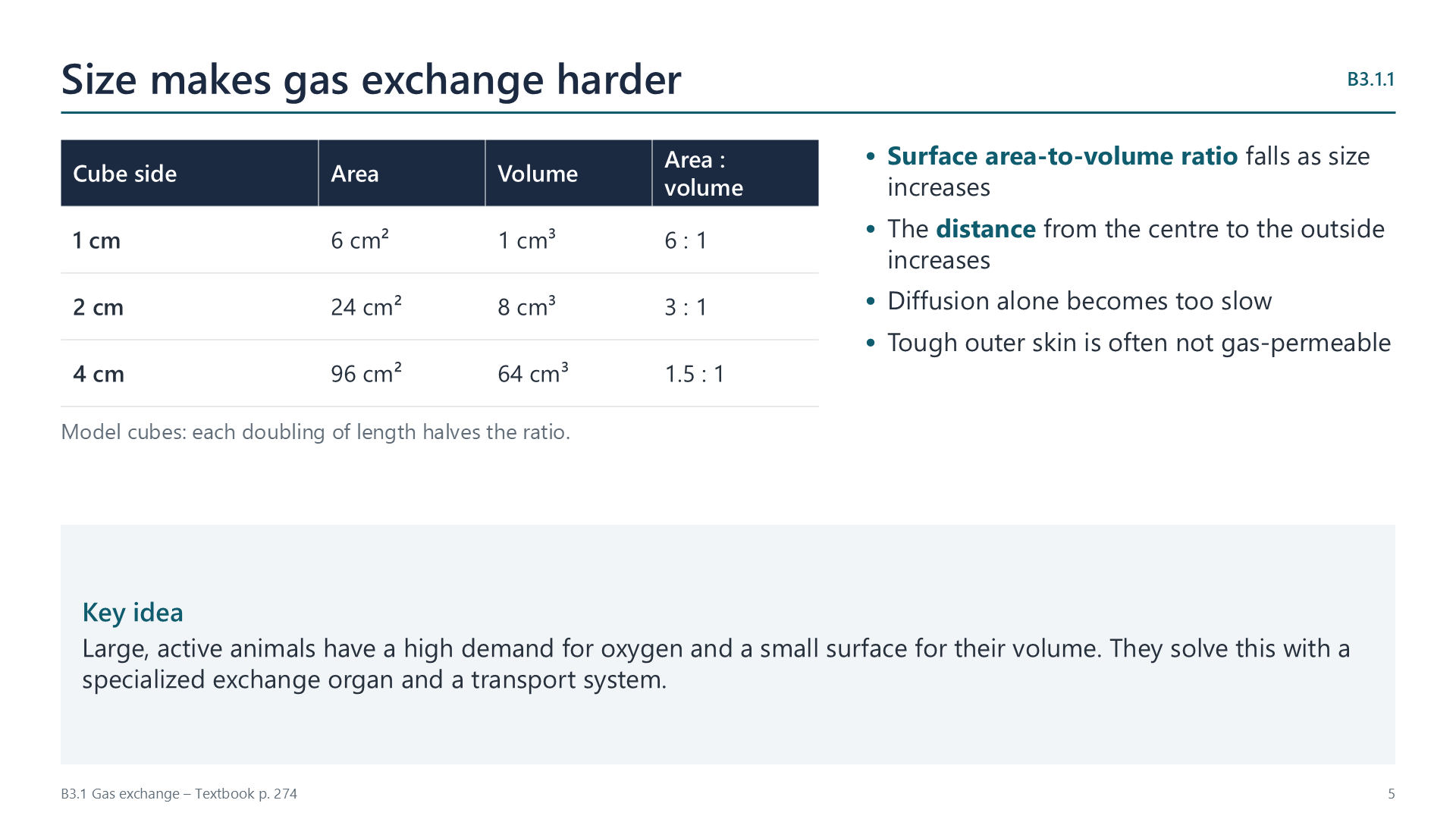
Slide: table of cube sizes showing the area to volume ratio falling as size increases
B3.1.2

What makes a good gas-exchange surface

p. 274
PropertyWhy it helps
PermeableRespiratory gases can actually cross it
ThinShort diffusion distance
MoistGases dissolve first, then diffuse across
Large surface areaMore gas can cross at once
B3.1.3

How animals keep concentration gradients going

p. 275

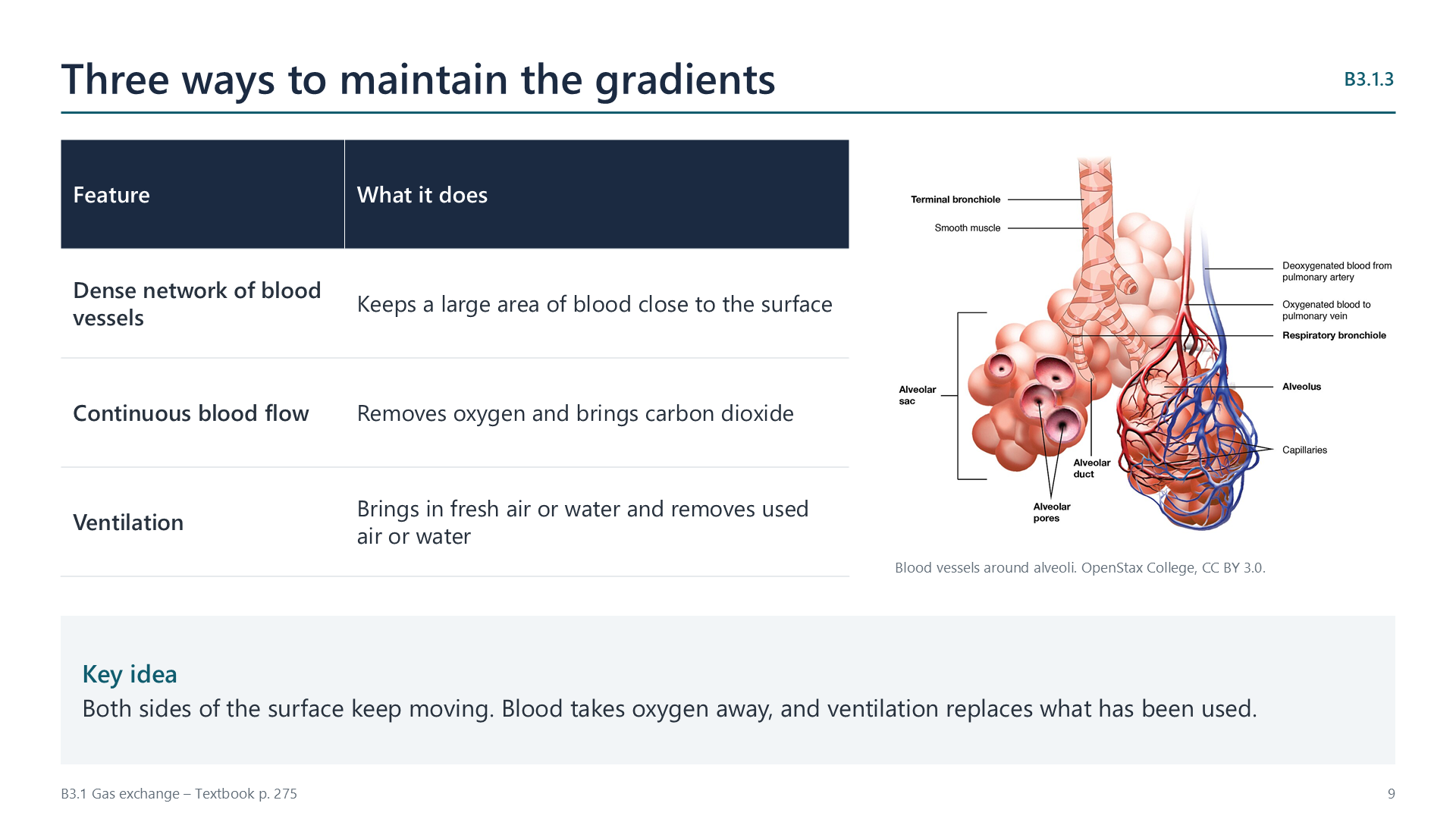
Net diffusion needs a concentration difference, and diffusion itself tends to remove that difference. Three features stop this from happening:

  • Dense networks of blood vessels bring a large area of blood very close to the surface.
  • Continuous blood flow carries oxygen away as soon as it arrives, and delivers more carbon dioxide.
  • Ventilation replaces the medium outside: air for lungs, water for gills.

A fish must keep pumping water over its gills, because water that stops moving soon comes to equilibrium with the blood.

Slide: table of three ways to maintain gradients beside a diagram of blood vessels around alveoli

The mammalian lung

B3.1.4

How mammalian lungs are adapted to exchange gases

pp. 276–279

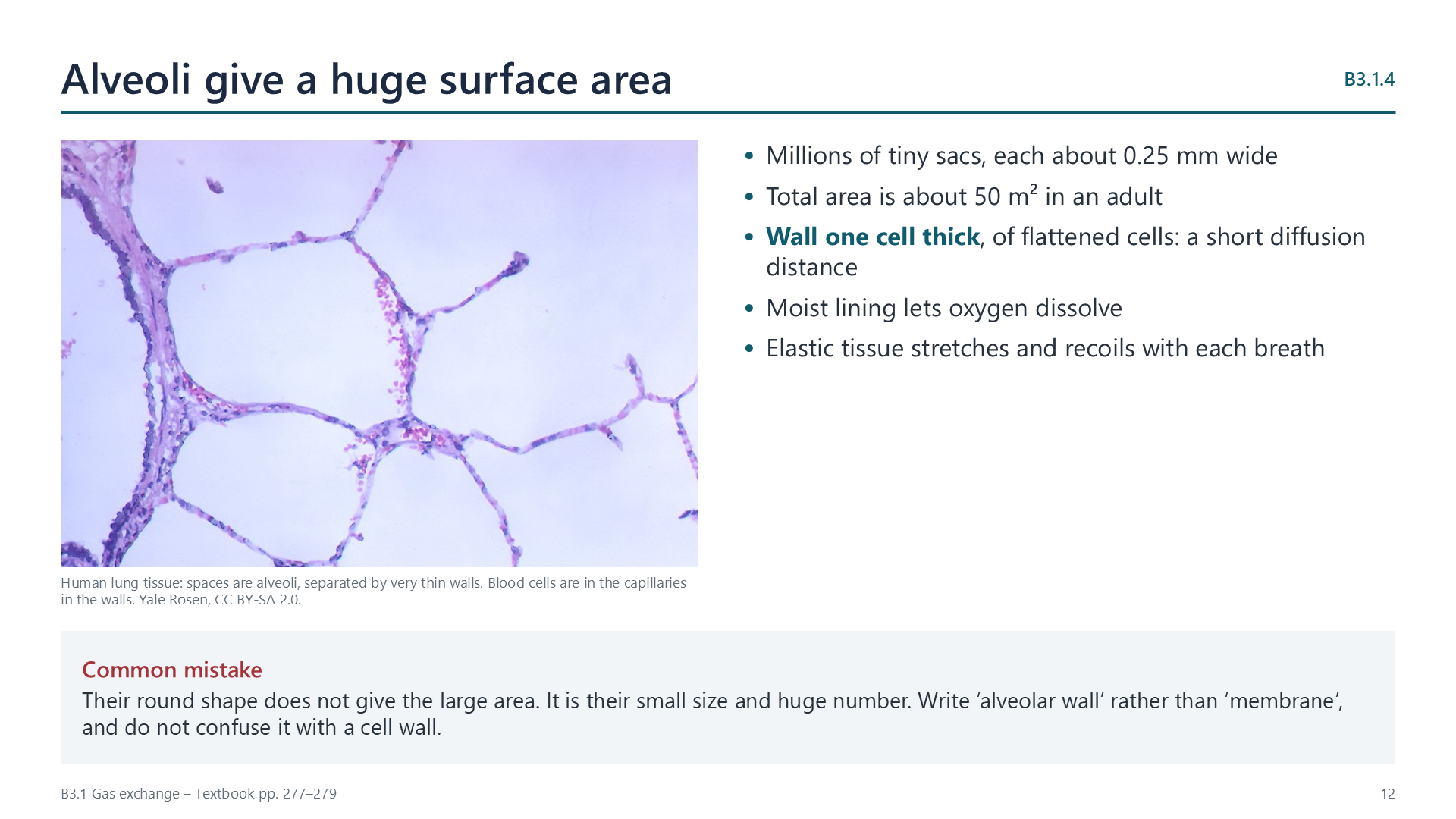
Air passes from the trachea to two bronchi, then through a tree of narrower and narrower bronchioles, ending in clusters of alveoli. Four adaptations are worth learning by name:

  • High surface area: millions of tiny alveoli. The size and number give the area, not the round shape.
  • Branched bronchioles: these distribute air evenly to every part of the lung.
  • Extensive capillary beds: these add area and keep gradients steep. Blood low in oxygen arrives from the pulmonary artery and leaves through the pulmonary vein.
  • Surfactant: a phospholipid-rich secretion that lowers the surface tension of the water lining. Without it, the moist walls would stick together and alveoli would collapse during exhalation.

The alveolar wall is one layer of flattened cells, so the diffusion path is short, and oxygen dissolves in the moist lining before it diffuses into the blood.

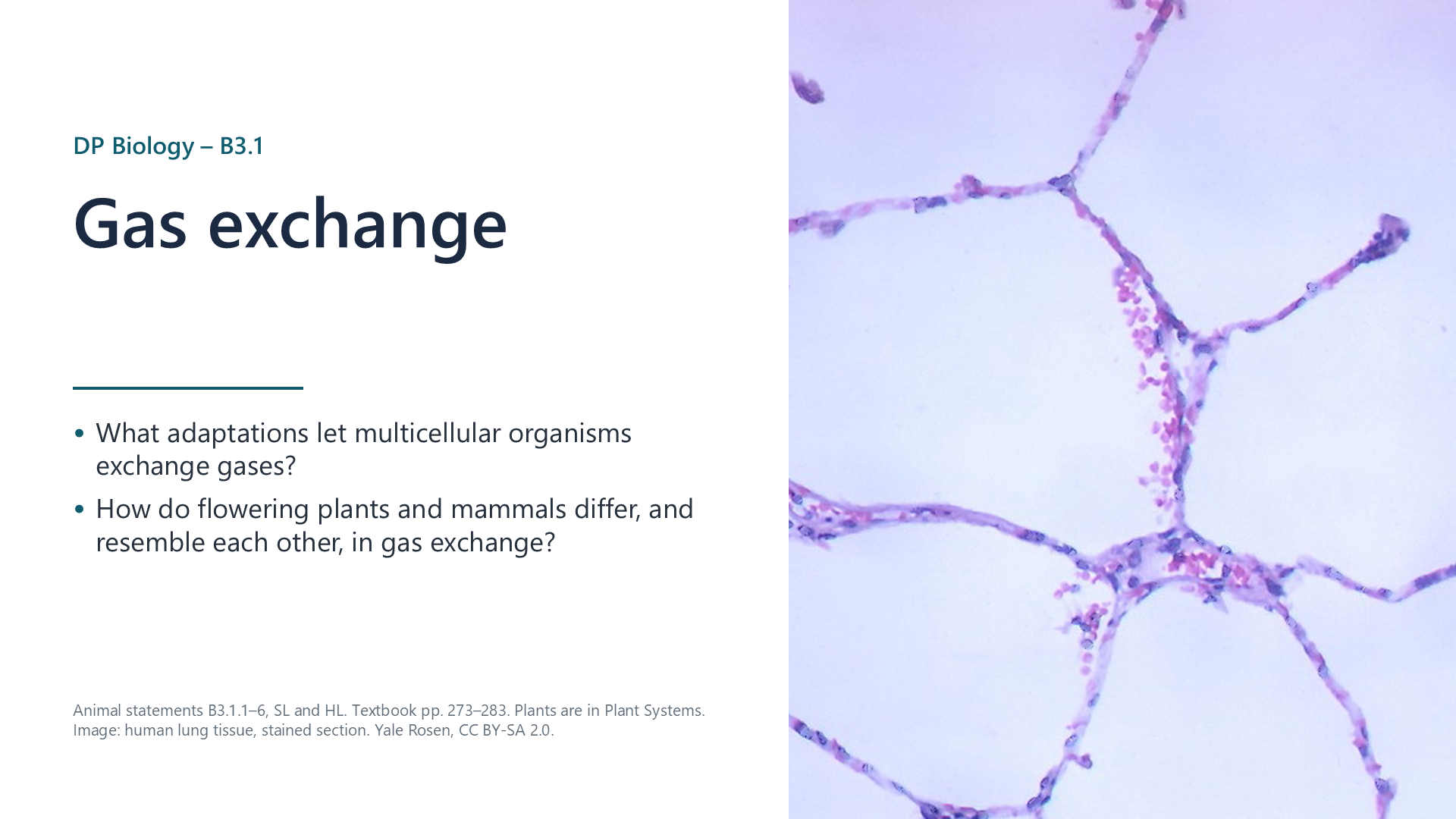
Slide: micrograph of alveoli with very thin walls, beside key points

Watch out: the alveolar wall is one cell thick, not the alveolus. Do not confuse "alveolar wall" with "cell wall". Exhaled air still contains plenty of oxygen, so do not write that we breathe in oxygen and breathe out carbon dioxide.

B3.1.5

How the lungs are ventilated

pp. 279–281

The thorax is airtight, so changing its volume changes the pressure inside it. Air then flows from higher to lower pressure. Muscles can only pull, so opposite movements need antagonistic muscles.

InhalationExhalation
DiaphragmContracts, flattens and moves downRelaxes, returns to a dome
Abdominal musclesRelaxContract, pushing the diaphragm up
External intercostalsContractRelax
Internal intercostalsRelaxContract
RibcageUp and outDown and in
Thorax volumeIncreasesDecreases
PressureFalls below atmosphericRises above atmospheric
Air flowInOut

Watch out: keep the cause before the effect. Muscles change the volume, volume changes the pressure, and pressure moves the air. Say which intercostal muscles you mean every time.

Measuring

B3.1.6

Measuring lung volumes

pp. 281–283
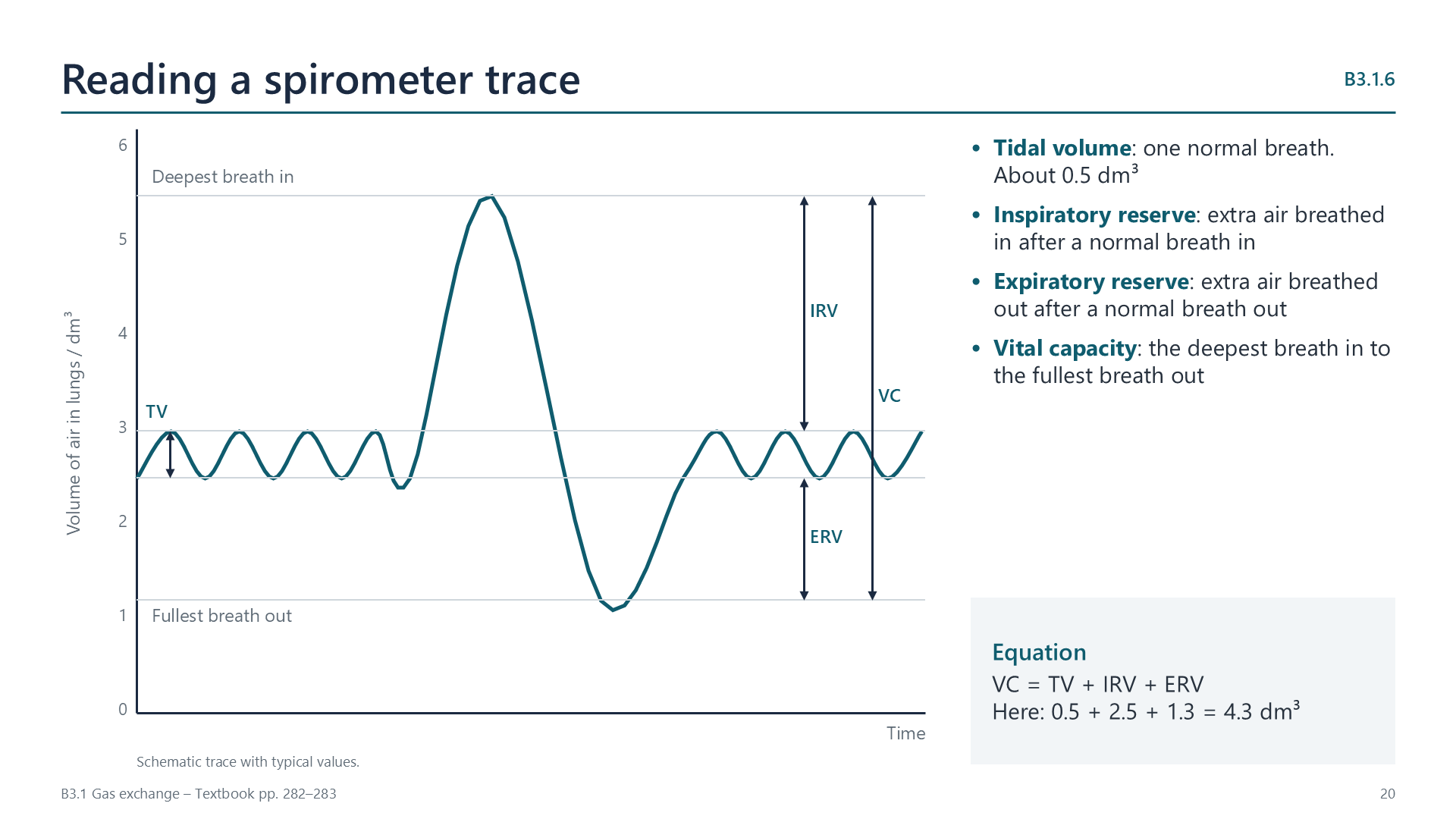
Slide: spirometer trace with tidal volume, inspiratory and expiratory reserves and vital capacity marked
  • Tidal volume (TV): the volume moved in one normal, relaxed breath, about 0.5 dm³.
  • Inspiratory reserve (IRV): the extra volume you can breathe in after a normal breath in.
  • Expiratory reserve (ERV): the extra volume you can force out after a normal breath out.
  • Vital capacity (VC): the largest volume you can breathe out after the deepest possible breath in. VC = TV + IRV + ERV.
  • Ventilation rate: breaths per minute.

A spirometer gives a trace of volume over time. A lung volume bag, water displacement or a balloon give simpler estimates. Vital capacity varies with age, body size and fitness. During exercise, both tidal volume and ventilation rate rise.

Videos

Select a video to play it here. Select it again to close it.

Note-taking sheet

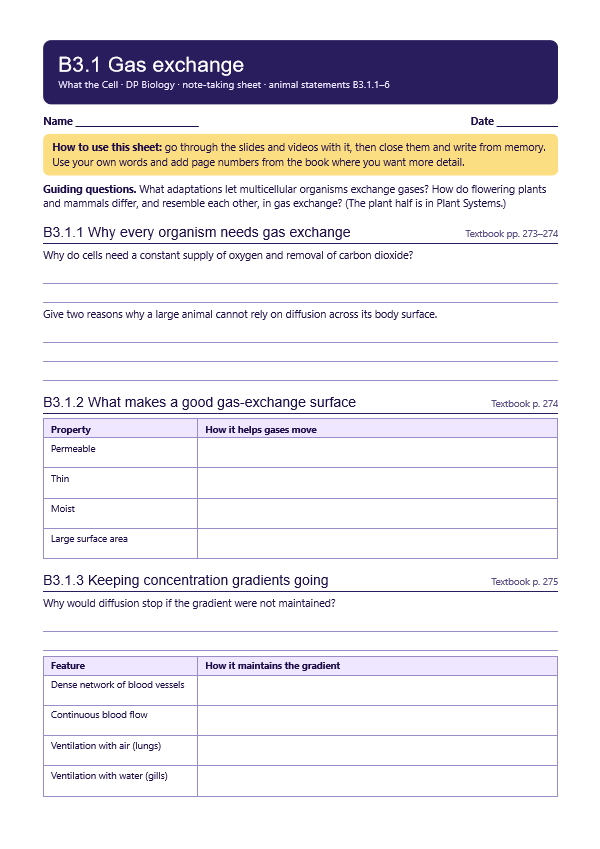
Print this guide and complete it as you work through the slides and videos. It asks for your own explanations, so close the notes while you try each section.

First page of the note-taking sheet

Quick self-check

The self-check needs JavaScript to run.

Practice questions

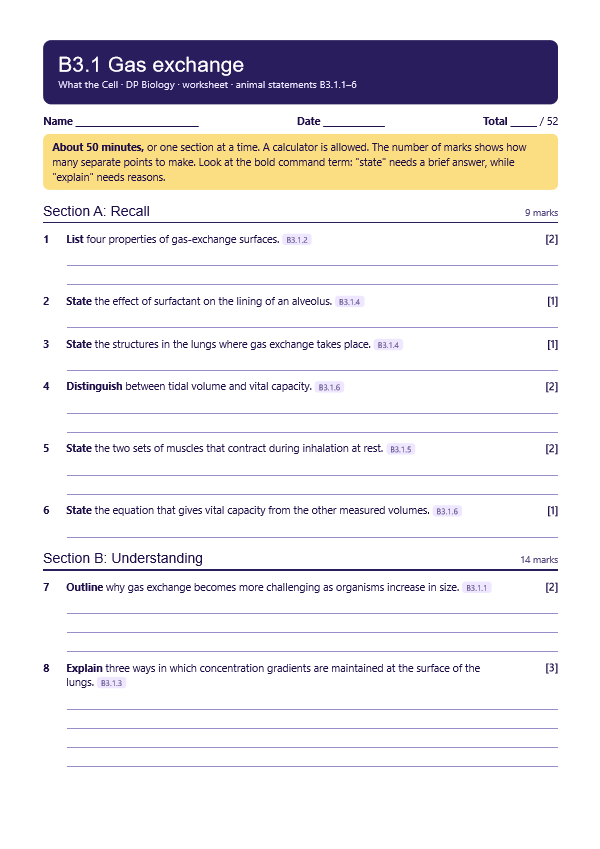
A printable worksheet covering all six statements, from quick recall to data questions and longer answers. It has 52 marks and takes about 50 minutes, or you can do one section at a time.

Your teacher has the mark scheme. Past-paper practice: IB Biology SL, November 2021, Paper 1, question 27. Ask your teacher for a copy.

First page of the worksheet

Data-based questions

Questions built on realistic experimental data, in the style of Paper 1B and Paper 2. Work them on paper and show your working. 11 marks in total. Your teacher has the mark scheme.

Breathing during exercise

11 marks
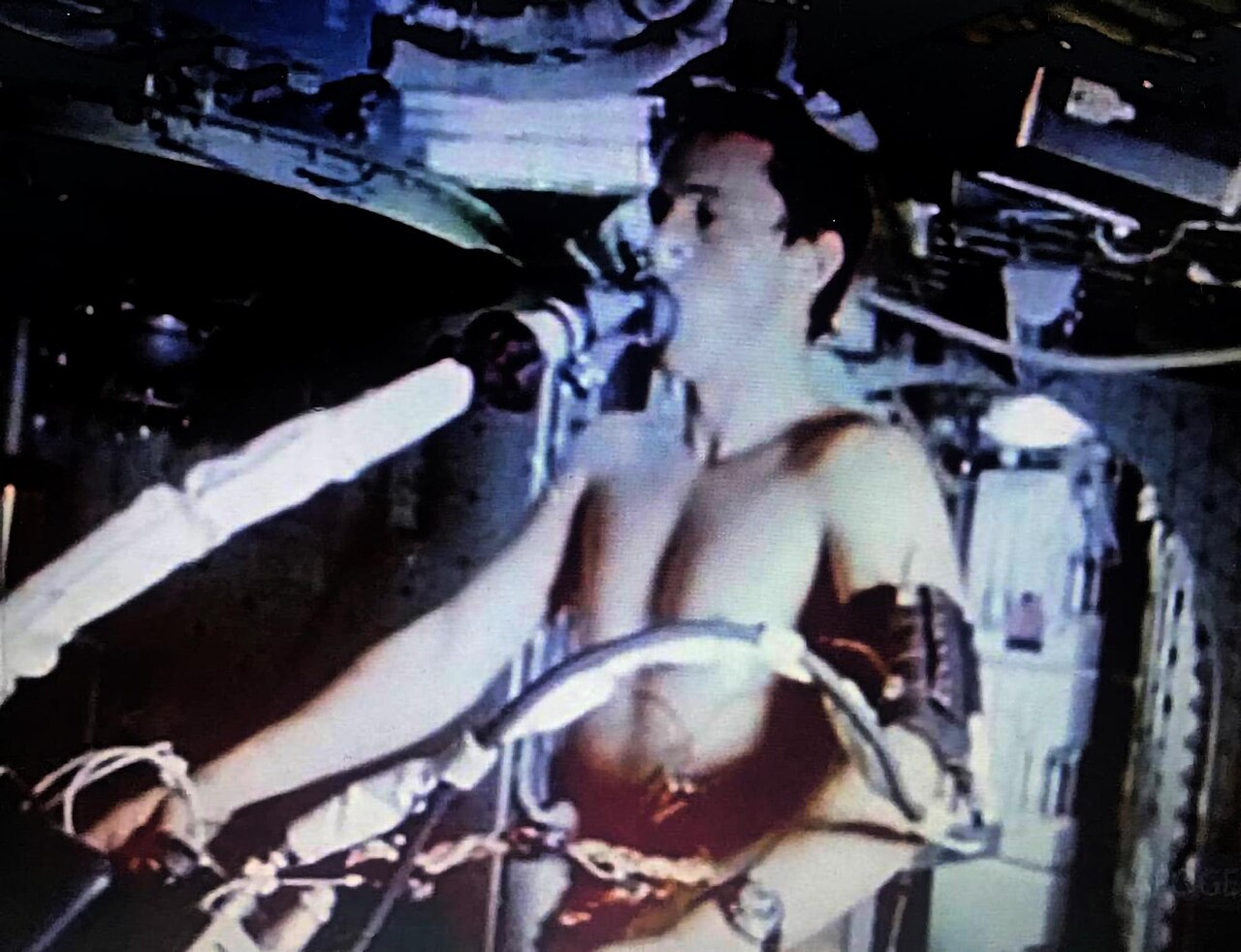
An astronaut pedalling a bicycle ergometer
Photo: NASA, Public domain, Wikimedia Commons.

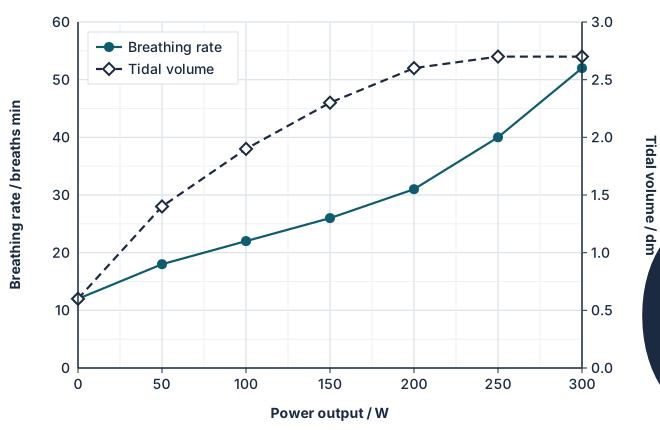
A fit adult pedalled an exercise bike (a cycle ergometer) for 3 minutes at each power output, starting at rest. Breathing rate and tidal volume were measured in the last minute of each stage.

Line graph with two y-axes. Breathing rate rises from 12 per minute at rest to 31 at 200 W, then steeply to 52 at 300 W. Tidal volume rises from 0.6 dm3 at rest to 2.6 dm3 at 200 W, then levels off at 2.7 dm3.
  1. Outline how tidal volume changes with power output (i) from rest to 200 W and (ii) from 200 W to 300 W. [2]
  2. Compare the changes in breathing rate and tidal volume between 200 W and 300 W. [2]
  3. Ventilation rate = breathing rate × tidal volume. Calculate the ventilation rate at 200 W. Give the units. [2]
  4. The ventilation rate at rest is 7.2 dm3 min−1. Calculate the percentage increase in ventilation rate from rest to 300 W. [2]
  5. Explain why ventilation rate needs to increase during exercise. [2]
  6. Suggest one reason why tidal volume stops increasing above 250 W. [1]

Practical

Measuring lung volumes

Lab30 minB3.1.6

You will need: Spirometer, or a balloon and tape measure per student; disposable mouthpieces if sharing

  1. Breathe out one normal breath into your own balloon, then measure its diameter
  2. Calculate the volume, treating the balloon as a sphere, to estimate tidal volume
  3. Repeat after the deepest breath you can manage, to estimate vital capacity
  4. Repeat three times and compare the class's mean values

Safety: Volunteers only. Never share a balloon or mouthpiece. Stop and sit down if dizzy.

Carry this out with your teacher's supervision and follow your school's lab rules.

Nature of science and TOK

Syllabus statements

Summarised in our own words. Use each code to find the exact wording in your textbook or the IB subject guide.

  • B3.1.1Why every organism needs gas exchangep. 273
  • B3.1.2What makes a good gas-exchange surfacep. 274
  • B3.1.3How animals keep concentration gradients going at exchange surfacesp. 275
  • B3.1.4How mammalian lungs are adapted to exchange gasesp. 277
  • B3.1.5How the lungs are ventilatedp. 279
  • B3.1.6Measuring lung volumesp. 281

HL extension

More of B3.1 in this course

© 2026 Akash Parthi Bendran. Please ask before using or sharing any resources from this site: see permission to use.