What the Cell
D2.3

Water potential

2 hours7 statementsTextbook pp. 681–690

Guiding questions

  1. What affects whether water moves into or out of a cell?
  2. In what ways do plant cells and animal cells control water movement differently?

Slides

Slide 1 of 14

Notes

Written for this site from the class slides, with textbook page references for each statement. The chapter is on pages 681–690 of the course textbook. Image credits are on slide 14.

Water and solutes

D2.3.1

Water as a solvent

p. 681

In solvation, water molecules surround a solute. Water is polar, so positive ions attract the partially negative oxygen, and negative ions attract the partially positive hydrogen. Polar molecules such as glucose form hydrogen bonds with water.
D2.3.2

Water moves towards the more concentrated solution

pp. 682–683
TermSolute concentration compared with the other solution
HypotonicLower
HypertonicHigher
IsotonicThe same

Net movement of water is from the hypotonic solution to the hypertonic solution.

D2.3.3

Water entering and leaving cells

p. 683

Water enters a cell in a hypotonic solution, and leaves a cell in a hypertonic solution.

Watch out: in an isotonic solution, water still crosses in both directions, at equal rates. This is a dynamic equilibrium with no net movement.

D2.3.4

Plant tissue in hypotonic and hypertonic solutions

pp. 683–687

Tissue in a hypotonic solution gains mass and length, and tissue in a hypertonic solution loses them. Calculate percentage change, because starting sizes differ. On a graph of percentage change against concentration, the point at zero change gives the isotonic concentration. Standard deviation and standard error show how far you can trust the means.

Effects on cells

D2.3.5

Cells without a wall

p. 688

In a hypotonic medium, these cells swell and may burst. In a hypertonic medium, they shrink, with crenation in red blood cells. Freshwater unicellular organisms use contractile vacuoles to expel water that enters. Multicellular animals keep tissue fluid isotonic with their cells.

D2.3.6

Cells with a wall

p. 689
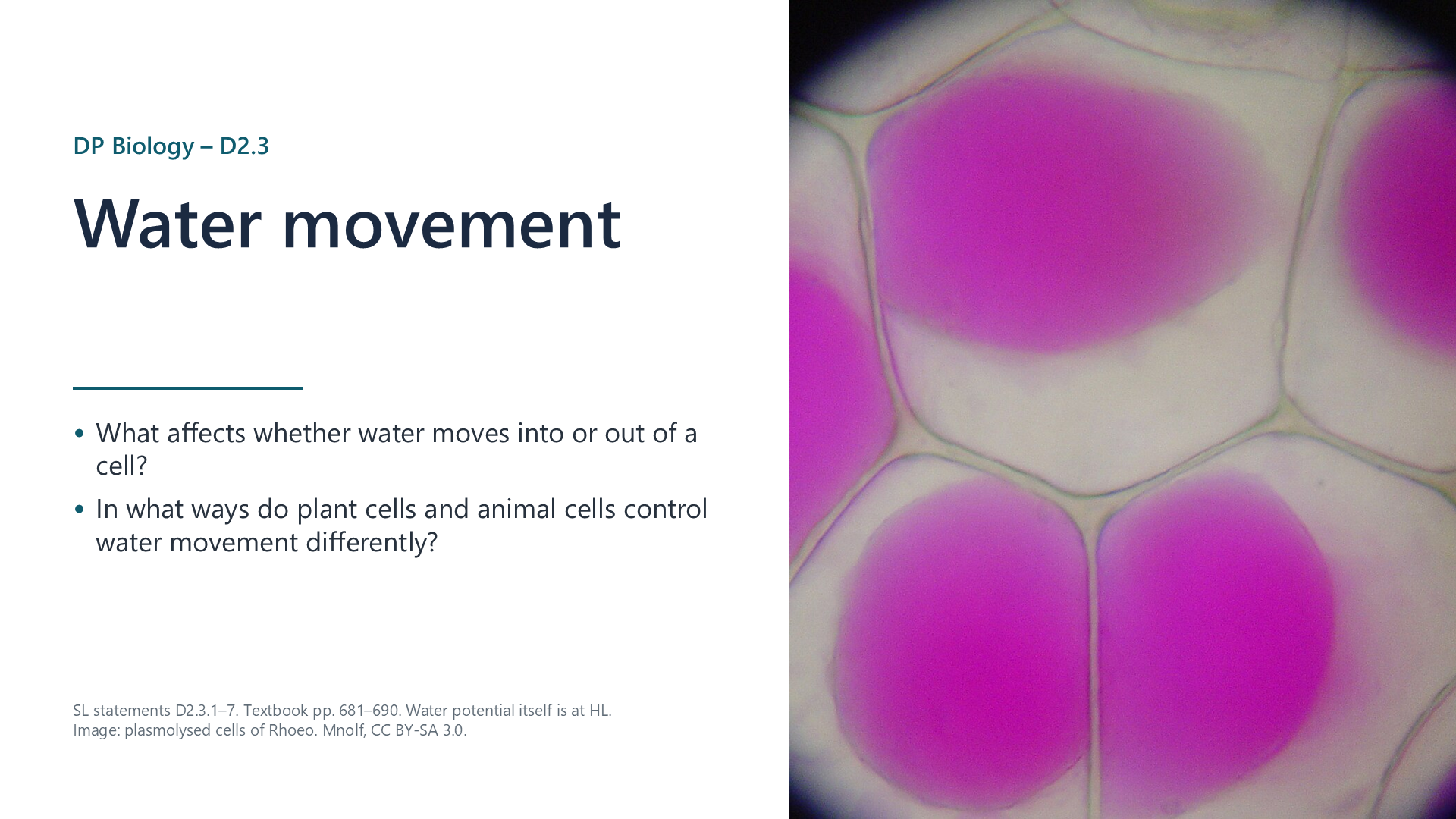
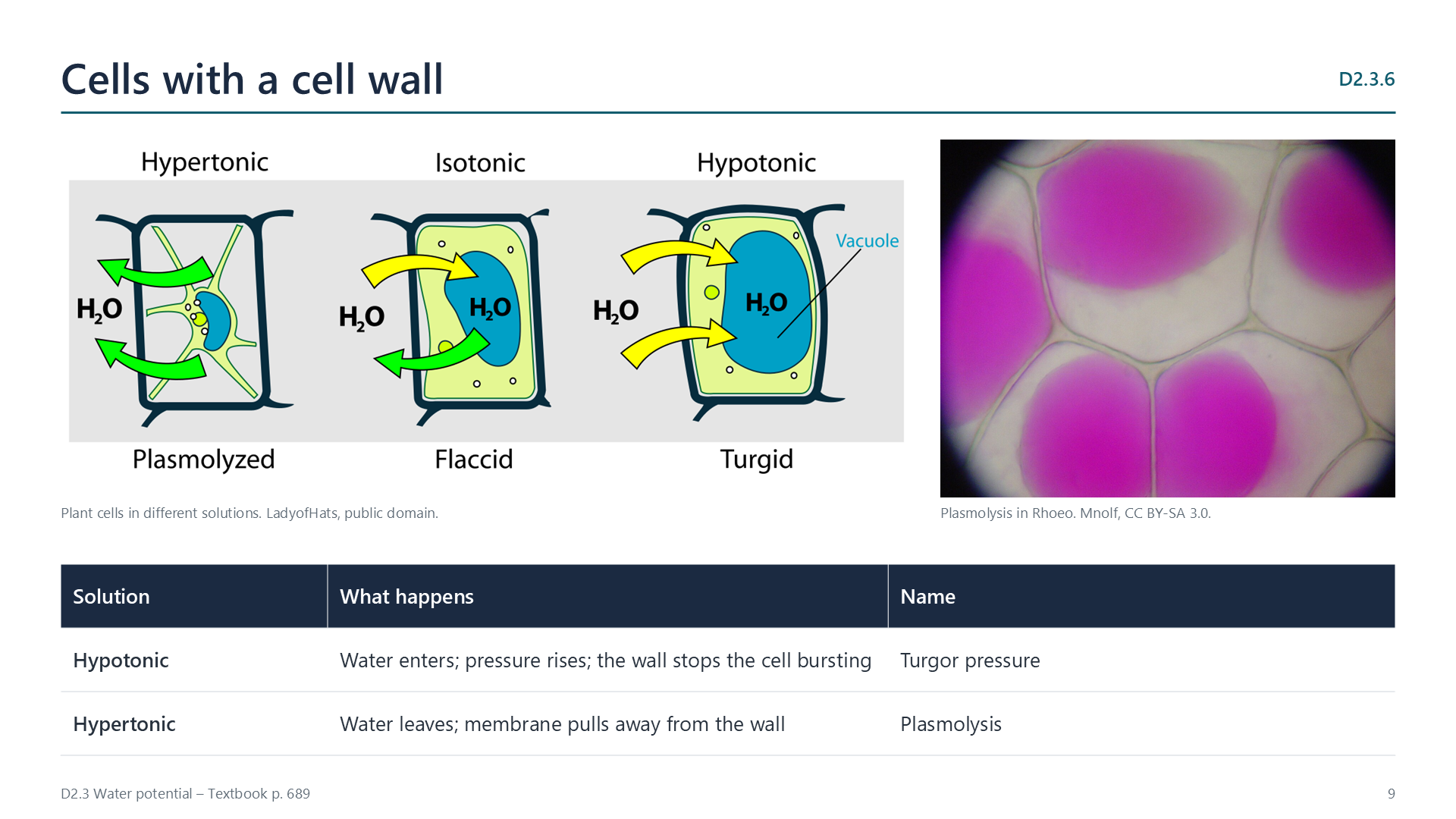
Slide: plant cells in different solutions, with turgor pressure and plasmolysis

In a hypotonic medium, water enters and pressure builds against the wall, giving turgor pressure. The wall stops the cell from bursting. In a hypertonic medium, water leaves and the membrane pulls away from the wall, which is plasmolysis.

D2.3.7

Isotonic solutions in medicine

p. 690

Intravenous fluids, such as 0.9% sodium chloride, and solutions for bathing organs before transplant are isotonic. They prevent net water movement, so cells do not swell, burst or shrink.

Videos

Select a video to play it here. Select it again to close it.

Note-taking sheet

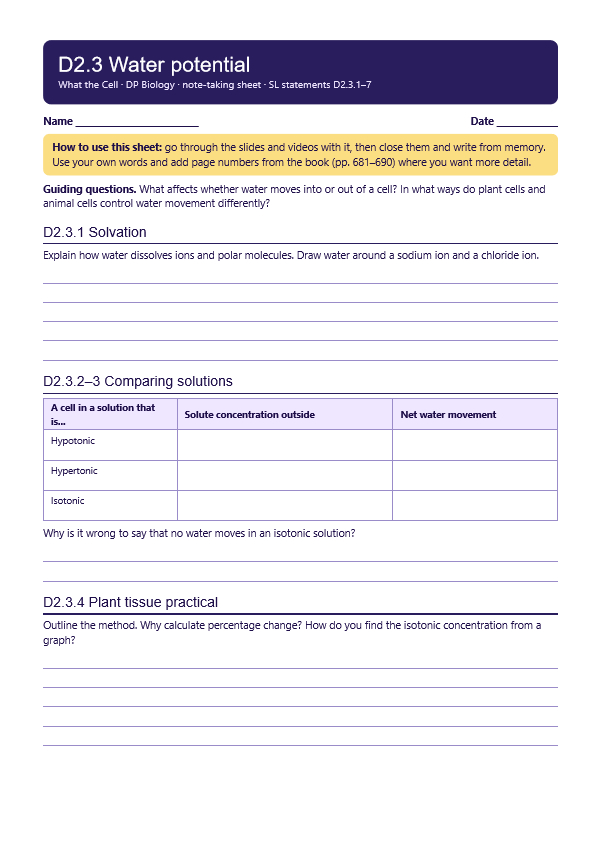
Print this guide and complete it as you work through the slides and videos. It asks for your own explanations, so close the notes while you try each section.

First page of the note-taking sheet

Quick self-check

The self-check needs JavaScript to run.

Practice questions

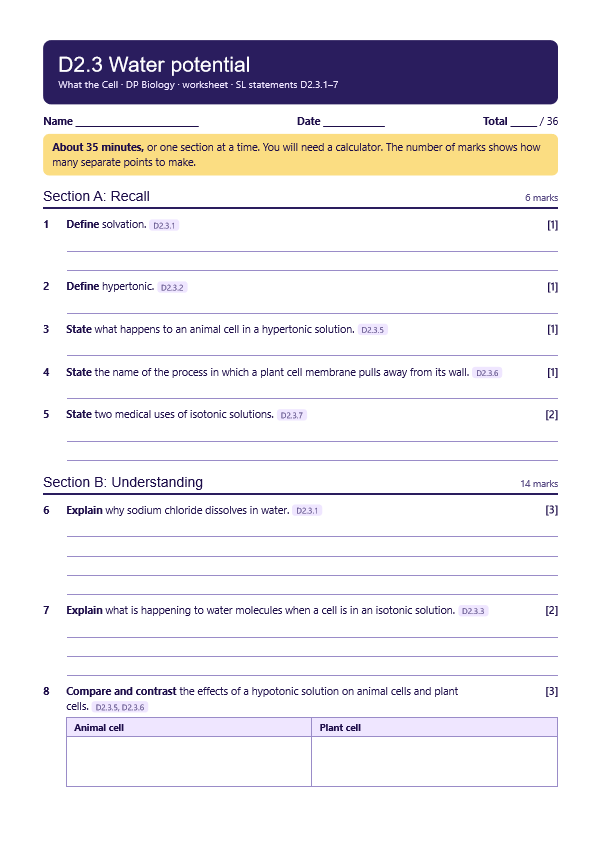
A printable worksheet covering all seven statements, from quick recall to data questions and a longer answer. It has 36 marks and takes about 35 minutes, or you can do one section at a time.

Your teacher has the mark scheme.

First page of the worksheet

Data-based questions

Questions built on realistic experimental data, in the style of Paper 1B and Paper 2. Work them on paper and show your working. 9 marks in total. Your teacher has the mark scheme.

Osmosis in potato tissue

9 marks
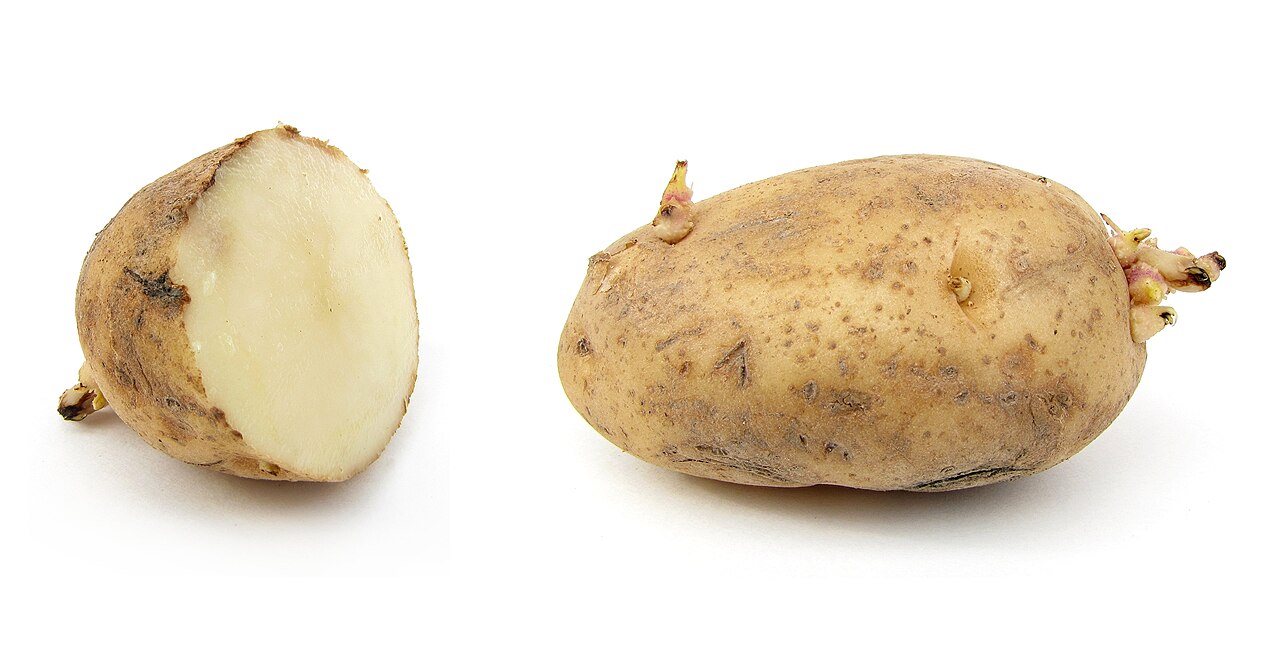
A cut potato tuber
Photo: ZooFari, Public domain, Wikimedia Commons.

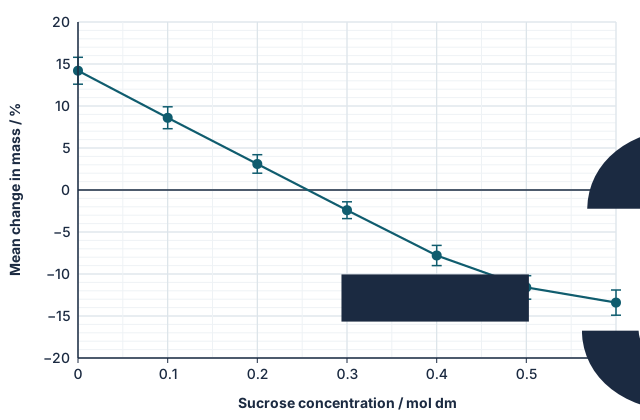
Cylinders of potato tuber (Solanum tuberosum), each about 2.5 g, were blotted, weighed and placed in sucrose solutions at 20 °C. After 24 hours they were blotted and weighed again. Three cylinders were used for each concentration. The graph shows the mean percentage change in mass. Error bars show ± 1 standard deviation.

Line graph: mean percentage change in mass of potato cylinders falls from +14.2% in 0.0 mol dm-3 sucrose to -13.4% in 0.6 mol dm-3, crossing zero at about 0.26 mol dm-3.
  1. Estimate the sucrose concentration that has the same water potential as the potato cells. [1]
  2. One cylinder in 0.4 mol dm−3 sucrose had a mass of 2.48 g at the start and 2.29 g at the end. Calculate its percentage change in mass. [1]
  3. Explain why the results are given as percentage change in mass, not change in mass. [2]
  4. Explain the change in mass of the cylinders in 0.0 mol dm−3 sucrose. [2]
  5. Suggest why the mass changes less between 0.5 and 0.6 mol dm−3 than between 0.0 and 0.1 mol dm−3. [1]
  6. Red blood cells are placed in distilled water. Predict what happens to them, and explain how this differs from the potato cells. [2]

Practical

Osmosis in potato tissue

Lab50 minD2.3.3, D2.3.4

You will need: Potato cylinders, sucrose solutions from 0 to 1.0 M, balance, paper towel, boiling tubes

  1. Blot and weigh a potato cylinder for each concentration
  2. Leave them in the solutions for at least 30 minutes
  3. Blot and reweigh
  4. Plot percentage change in mass against concentration, and describe the texture of each cylinder

Safety: Take care with cork borers and knives. Wipe up spills.

Carry this out with your teacher's supervision and follow your school's lab rules.

Nature of science and TOK

Syllabus statements

Summarised in our own words. Use each code to find the exact wording in your textbook or the IB subject guide.

  • D2.3.1How substances dissolve with water as the solventp. 681
  • D2.3.2Water moves from less concentrated solutions to more concentrated onesp. 682
  • D2.3.3How osmosis moves water into and out of cellsp. 683
  • D2.3.4How plant tissue changes in hypotonic and hypertonic solutionsp. 683
  • D2.3.5What water movement does to cells without a cell wallp. 688
  • D2.3.6What water movement does to cells with a cell wallp. 689
  • D2.3.7How isotonic solutions are used in medicinep. 690

HL extension

© 2026 Akash Parthi Bendran. Please ask before using or sharing any resources from this site: see permission to use.