What the Cell
A2.2

Cell structure

HL extension
2 hours3 statementsTextbook pp. 82–87

Guiding questions

  1. What do all cells share, and how do they differ?
  2. How do we use microscopes to study cell structure?

Slides

Slide 1 of 13

Notes

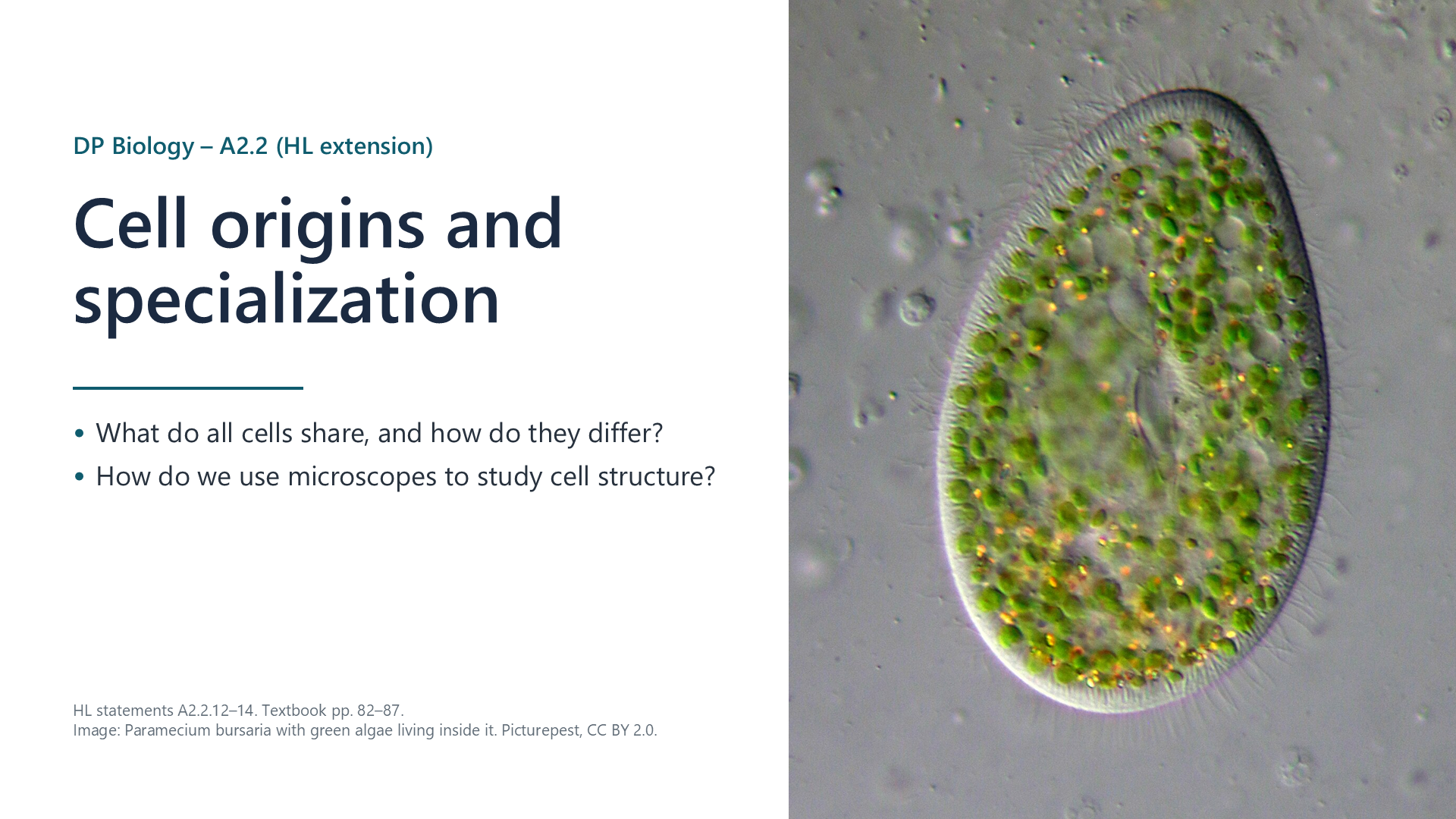
Written for this site from the class slides, with textbook page references for each statement. The chapter is on pages 82–87 of the course textbook. Image credits are on slide 13.

Where eukaryotic cells came from

A2.2.12

Endosymbiosis

pp. 82–85
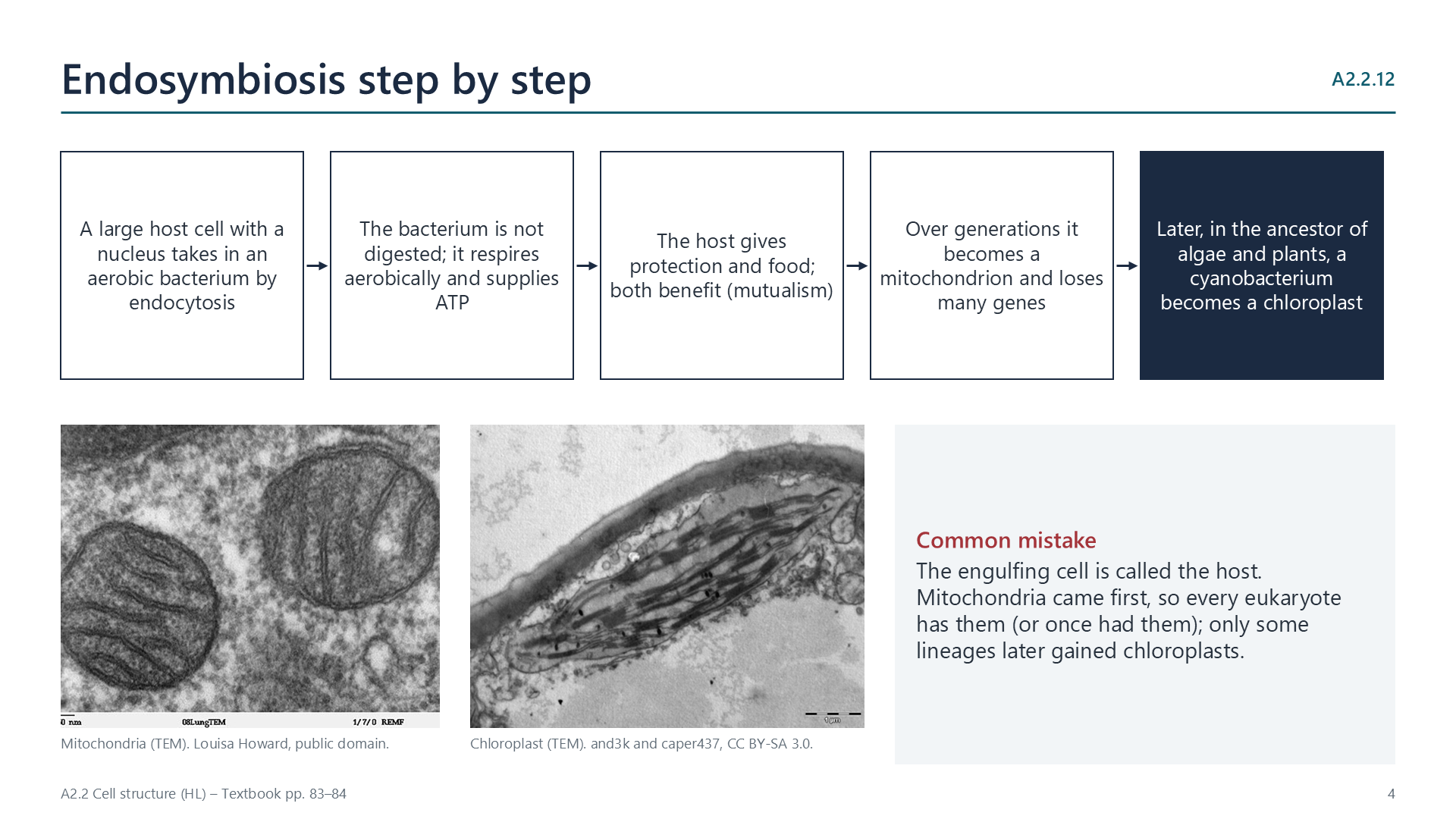
Slide: five steps of endosymbiosis, with electron micrographs of mitochondria and a chloroplast

All eukaryotes probably share one unicellular ancestor that already had a nucleus and reproduced sexually. A host cell took in an aerobic bacterium by endocytosis but did not digest it. The two came to depend on each other (mutualism), and over many generations the bacterium became a mitochondrion. Later, in the ancestor of algae and plants, an engulfed cyanobacterium became a chloroplast.

Evidence: both organelles have 70S ribosomes, naked circular DNA and a double membrane, are about the size of bacteria, and arise only by binary fission of existing organelles. Their DNA sequences are closest to alphaproteobacteria (mitochondria) and cyanobacteria (chloroplasts). The theory made predictions that sequencing later confirmed.
Many cells, many roles

A2.2.13

Differentiation

pp. 85–86

All the cells of an organism come from one zygote by mitosis, so they share the same genome. During differentiation different genes are expressed in different cells, triggered by signals from the environment and by the cell’s position. Each cell type therefore has its own proteome: a developing red blood cell makes large amounts of haemoglobin, a muscle cell makes actin and myosin. Specialized cells form tissues and organs and share the work, but each depends on the others.

A2.2.14

The evolution of multicellularity

p. 87
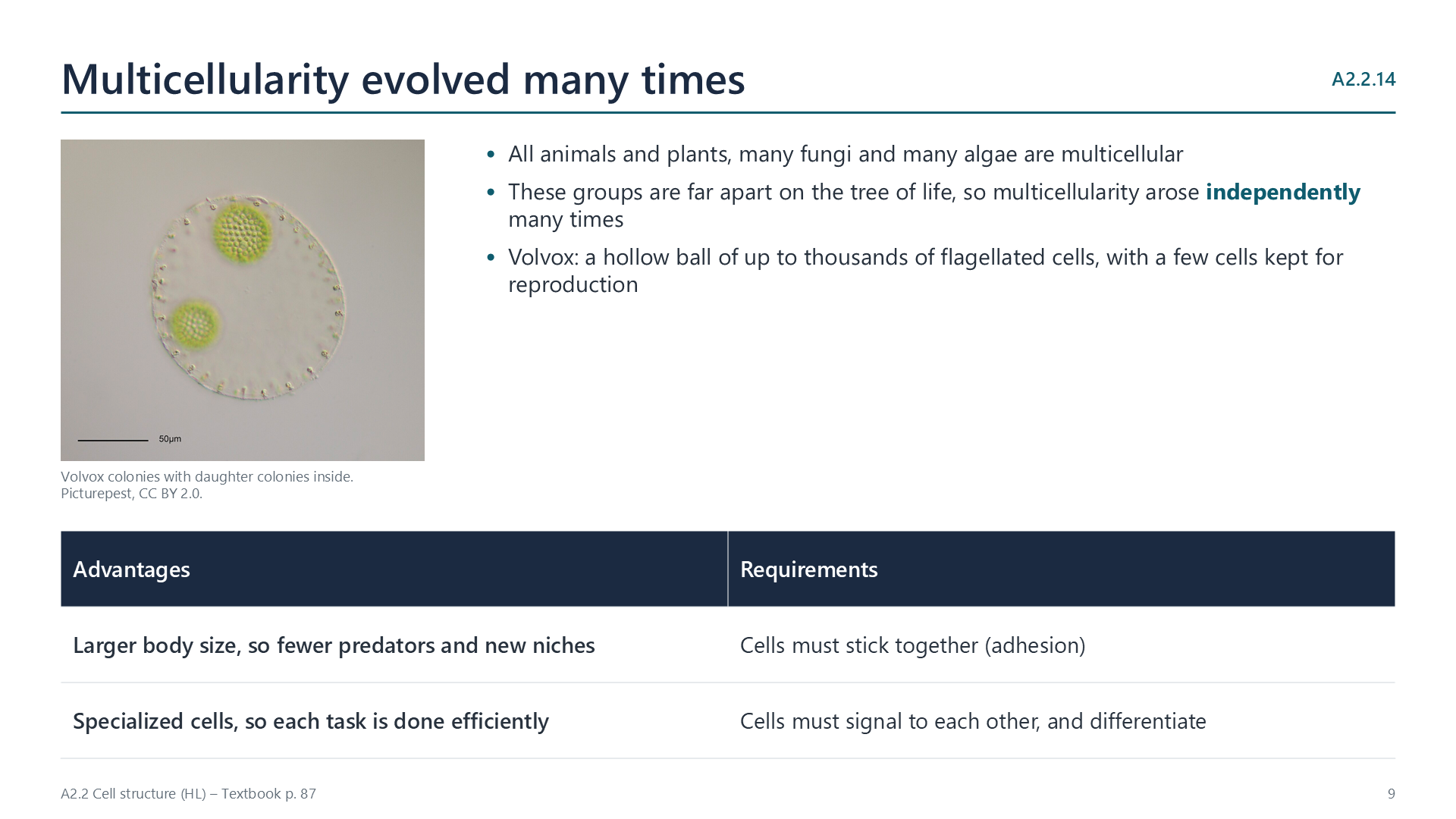
Slide: Volvox colonies, with a table of the advantages and requirements of multicellularity

All animals and plants, many fungi and many algae are multicellular. These groups are separated on the tree of life by unicellular ones, so multicellularity evolved independently many times. It allows a larger body and specialized cells, but needs cells that stick together, signal to each other and differentiate. Volvox colonies and choanoflagellates, the closest living relatives of animals, show how the change may have begun.

Videos

Select a video to play it here. Select it again to close it.

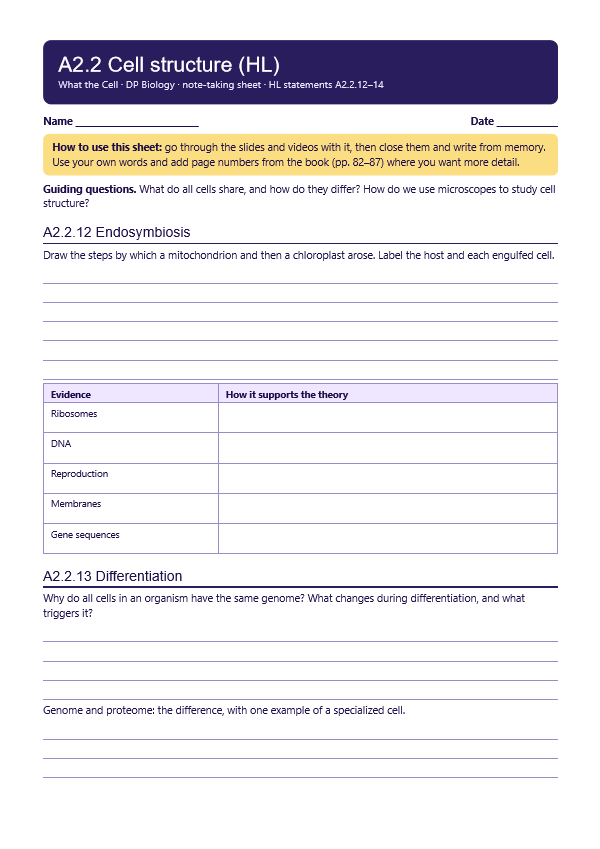
Note-taking sheet

Print this guide and complete it as you work through the slides and videos. It asks for your own explanations, so close the notes while you try each section.

First page of the note-taking sheet

Quick self-check

The self-check needs JavaScript to run.

Practice questions

A printable worksheet covering all three statements, from quick recall to data questions and a longer answer. It has 30 marks and takes about 30 minutes, or you can do one section at a time.

Your teacher has the mark scheme.

First page of the worksheet

Practical

Differentiated tissues under the microscope

Lab40 minA2.2.13, A2.2.14

You will need: Prepared slides or micrographs of single-celled algae, colonial algae, and a leaf section

  1. Observe a single-celled organism, then a colony, then a tissue
  2. Draw one example of each
  3. Annotate where cells look the same and where they differ
  4. Suggest advantages of cells specializing

Safety: Carry microscopes with two hands. Take care with glass slides.

Carry this out with your teacher's supervision and follow your school's lab rules.

Nature of science and TOK

Syllabus statements

Summarised in our own words. Use each code to find the exact wording in your textbook or the IB subject guide.

  • A2.2.12How eukaryotic cells arose through endosymbiosisp. 82
  • A2.2.13How differentiation produces specialized tissues in multicellular organismsp. 85
  • A2.2.14How multicellularity evolvedp. 87

More of A2.2 in this course

© 2026 Akash Parthi Bendran. Please ask before using or sharing any resources from this site: see permission to use.