What the Cell
B3.2

Transport

HL extension
5 hours8 statementsTextbook pp. 310–325

Guiding questions

  1. Which adaptations help animals and plants move fluids around?
  2. How does transport in animals compare with transport in plants?

Slides

Slide 1 of 22

Notes

Written for this site from the class slides, with textbook page references for each statement. The chapter is on pages 310–325 of the course textbook. Image credits are on slide 22.

Tissue fluid and lymph

B3.2.11

Tissue fluid

pp. 310–311
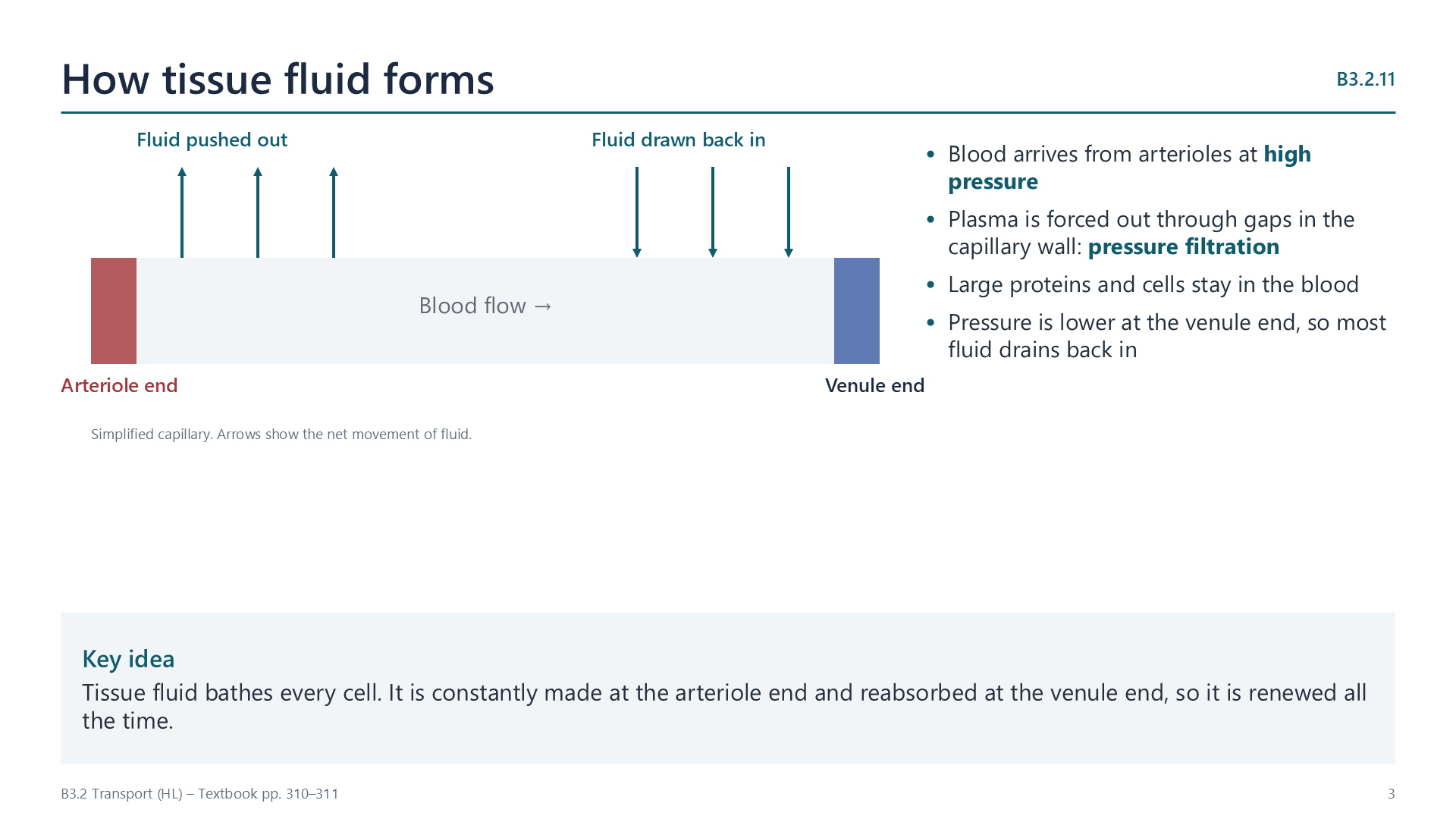
Slide: fluid leaves a capillary at the arteriole end and returns at the venule end

At the arteriole end, high blood pressure forces plasma out through gaps in the capillary wall (pressure filtration), leaving proteins and cells behind. At the venule end, blood pressure is lower than the osmotic pull of the plasma proteins, so most of the fluid drains back in.
B3.2.12

Exchange with cells

pp. 311–312

Tissue fluid is plasma without large proteins or red blood cells. Cells take oxygen, glucose, amino acids and ions from it and release carbon dioxide, urea and other wastes into it, by diffusion and membrane transport.

B3.2.13

Lymph

pp. 312–313

Excess tissue fluid enters lymph capillaries, which have thin walls with gaps. Valves keep lymph flowing one way, and it returns to the blood in veins near the heart. Without drainage, tissues swell (oedema).

Circulation and the heart

B3.2.14

Single and double circulation

pp. 313–314

In bony fish, blood goes heart → gills → body → heart, passing through the heart once, and reaches the body at low pressure. Mammals have a pulmonary and a systemic circuit, so blood passes through the heart twice and is re-pumped to the body at high pressure.

B3.2.15

Adaptations of the heart

pp. 315–318
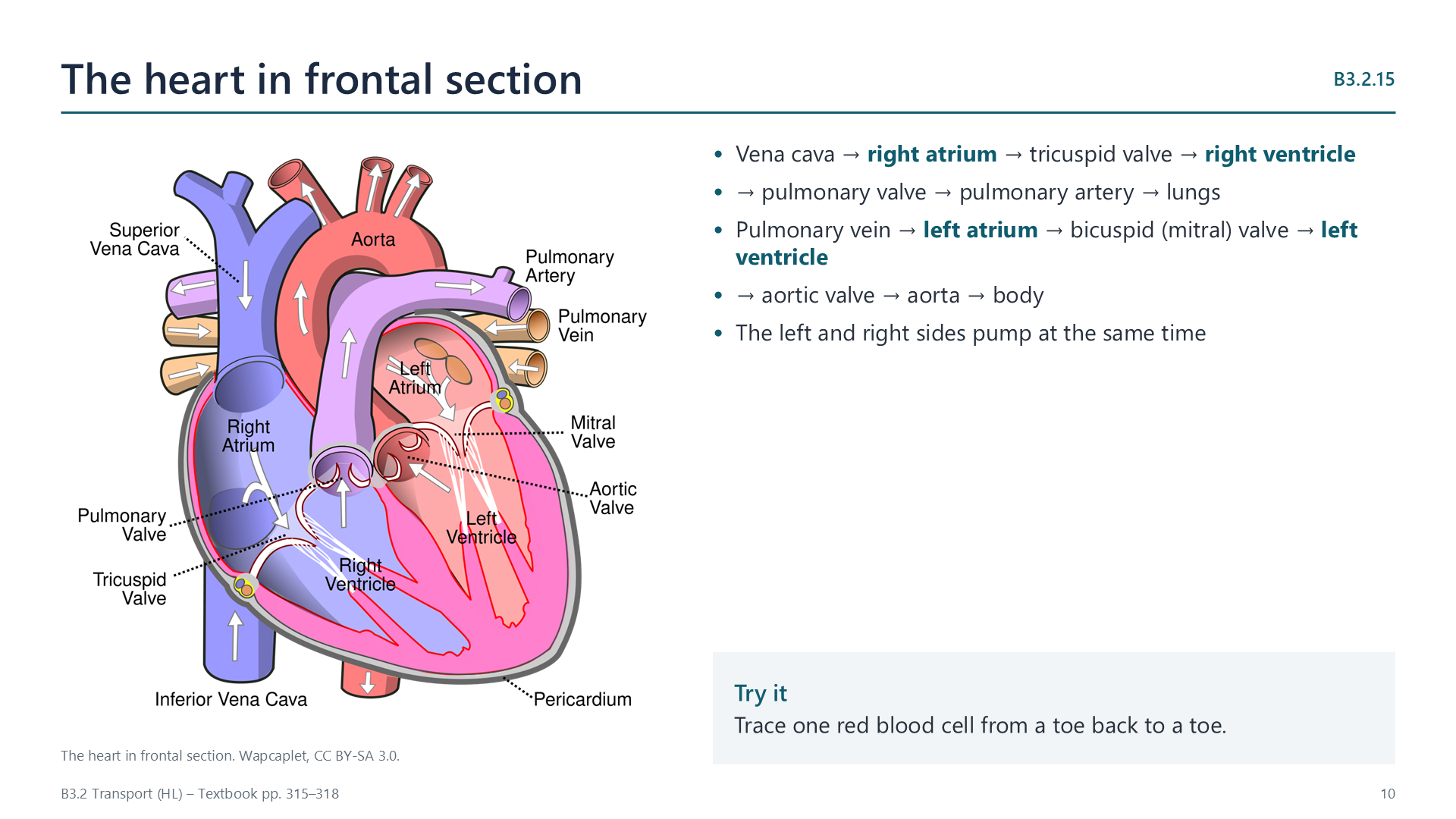
Slide: frontal section of the heart with the route of blood

Branched, myogenic cardiac muscle contracts rhythmically; the SA node sets the pace. Thin-walled atria fill the thick-walled ventricles (left thickest). AV and semilunar valves stop backflow, the septum separates the two sides and coronary vessels supply the muscle.

B3.2.16

The cardiac cycle

pp. 318–321
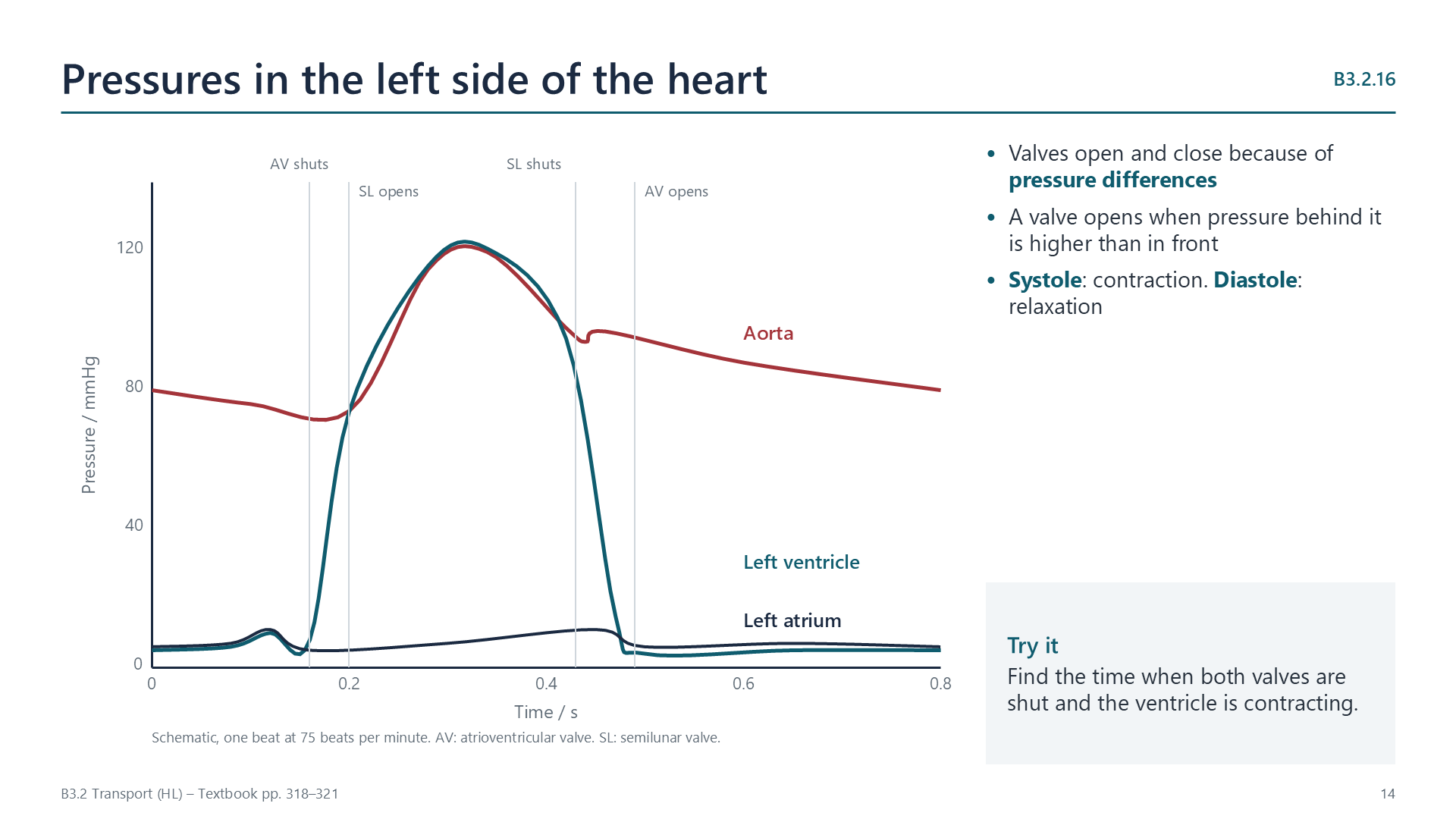
Slide: pressures in the aorta, left ventricle and left atrium during one beat

The SA node fires, the atria contract, the AV node delays the impulse, then the ventricles contract. Valves open and close with pressure differences: AV valves shut as ventricular pressure rises; semilunar valves open when it exceeds arterial pressure and shut when the ventricles relax. Blood pressure is written systolic/diastolic, for example 120/80 mmHg.

Transport in plants

B3.2.17

Root pressure

pp. 321–322

Root cells pump mineral ions into the xylem by active transport. Water follows by osmosis, creating positive pressure that pushes sap up when transpiration is too low, for example in humid air or in spring before leaves open.

B3.2.18

Phloem

pp. 322–325

Sieve tube elements have sieve plates, little cytoplasm and no nucleus, so sap flows easily. Companion cells have many mitochondria and are joined to them by plasmodesmata, supplying ATP for loading sucrose at sources. Sap flows from sources to sinks.

Videos

Select a video to play it here. Select it again to close it.

Note-taking sheet

Print this guide and complete it as you work through the slides and videos. It asks for your own explanations, so close the notes while you try each section.

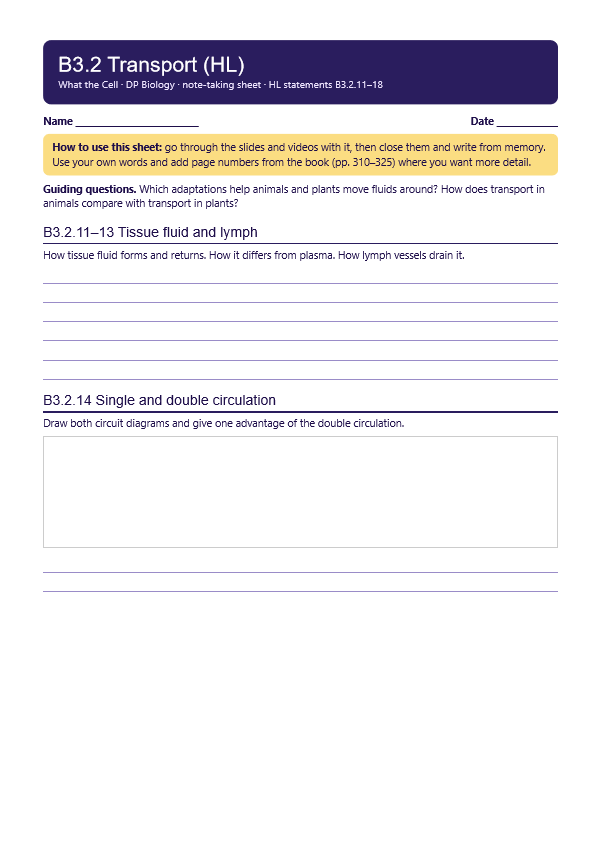
First page of the note-taking sheet

Quick self-check

The self-check needs JavaScript to run.

Practice questions

A printable worksheet covering all eight statements, from quick recall to data questions and a longer answer. It has 40 marks and takes about 40 minutes, or you can do one section at a time.

Your teacher has the mark scheme.

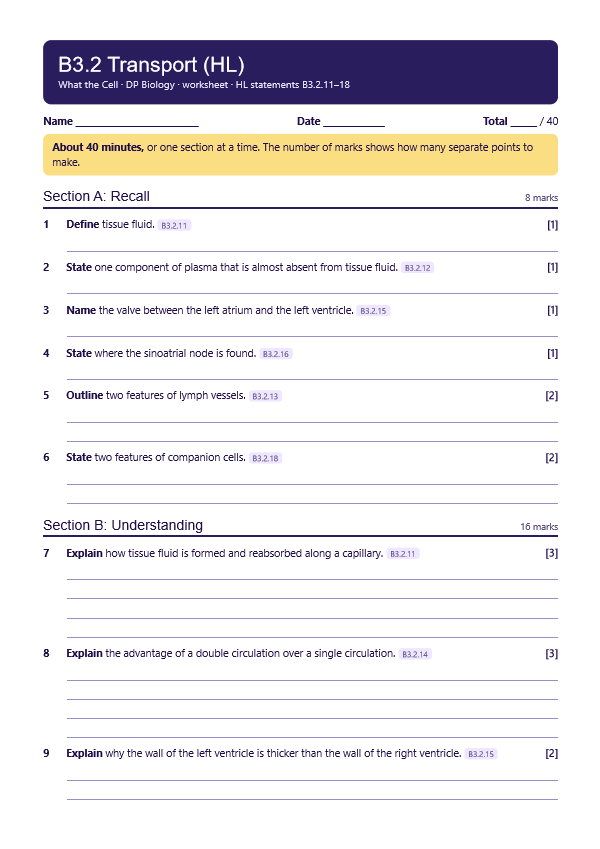
First page of the worksheet

Practical

Examining a mammalian heart

Lab50 minB3.2.15

You will need: Heart from a butcher, dissection tools, tray, disposable gloves. If dissection is not suitable, use a heart model or images

  1. Identify the chambers and major vessels from the outside
  2. Cut open each side and compare the thickness of the walls
  3. Find the valves and tendons
  4. Link each structure to delivering blood under pressure

Safety: Follow your school's dissection policy, and offer an alternative. Take care with blades. Gloves, then disinfect surfaces and wash hands.

Carry this out with your teacher's supervision and follow your school's lab rules.

Nature of science and TOK

Syllabus statements

Summarised in our own words. Use each code to find the exact wording in your textbook or the IB subject guide.

  • B3.2.11How tissue fluid leaves capillaries and returns to themp. 310
  • B3.2.12How substances pass between tissue fluid and body cellsp. 312
  • B3.2.13How surplus tissue fluid drains into lymph ductsp. 312
  • B3.2.14Single circulation in bony fish compared with double circulation in mammalsp. 313
  • B3.2.15How the mammalian heart is adapted to send blood under pressure into the arteriesp. 315
  • B3.2.16The stages of the cardiac cyclep. 318
  • B3.2.17How active transport of mineral ions creates root pressure in xylemp. 321
  • B3.2.18How phloem sieve tubes and companion cells are adapted to translocate sapp. 323

More of B3.2 in this course

© 2026 Akash Parthi Bendran. Please ask before using or sharing any resources from this site: see permission to use.