What the Cell
C2.2

Neural signalling

HL extension
5 hours9 statementsTextbook pp. 479–489

Guiding questions

  1. How do neurons produce electrical signals and pass them along?
  2. How do neurons affect other cells?

Slides

Slide 1 of 16

Notes

Written for this site from the class slides, with textbook page references for each statement. The chapter is on pages 479–489 of the course textbook. Image credits are on slide 16.

Action potentials

C2.2.8

Depolarization and repolarization

pp. 479–481

When the membrane reaches the threshold (about −50 mV), voltage-gated Na+ channels open and Na+ diffuses in: the inside becomes positive (depolarization). At about +30 mV they close and voltage-gated K+ channels open; K+ diffuses out and the inside becomes negative again (repolarization). Below threshold, no action potential occurs: it is all-or-nothing.
C2.2.9

Local currents

pp. 481–482
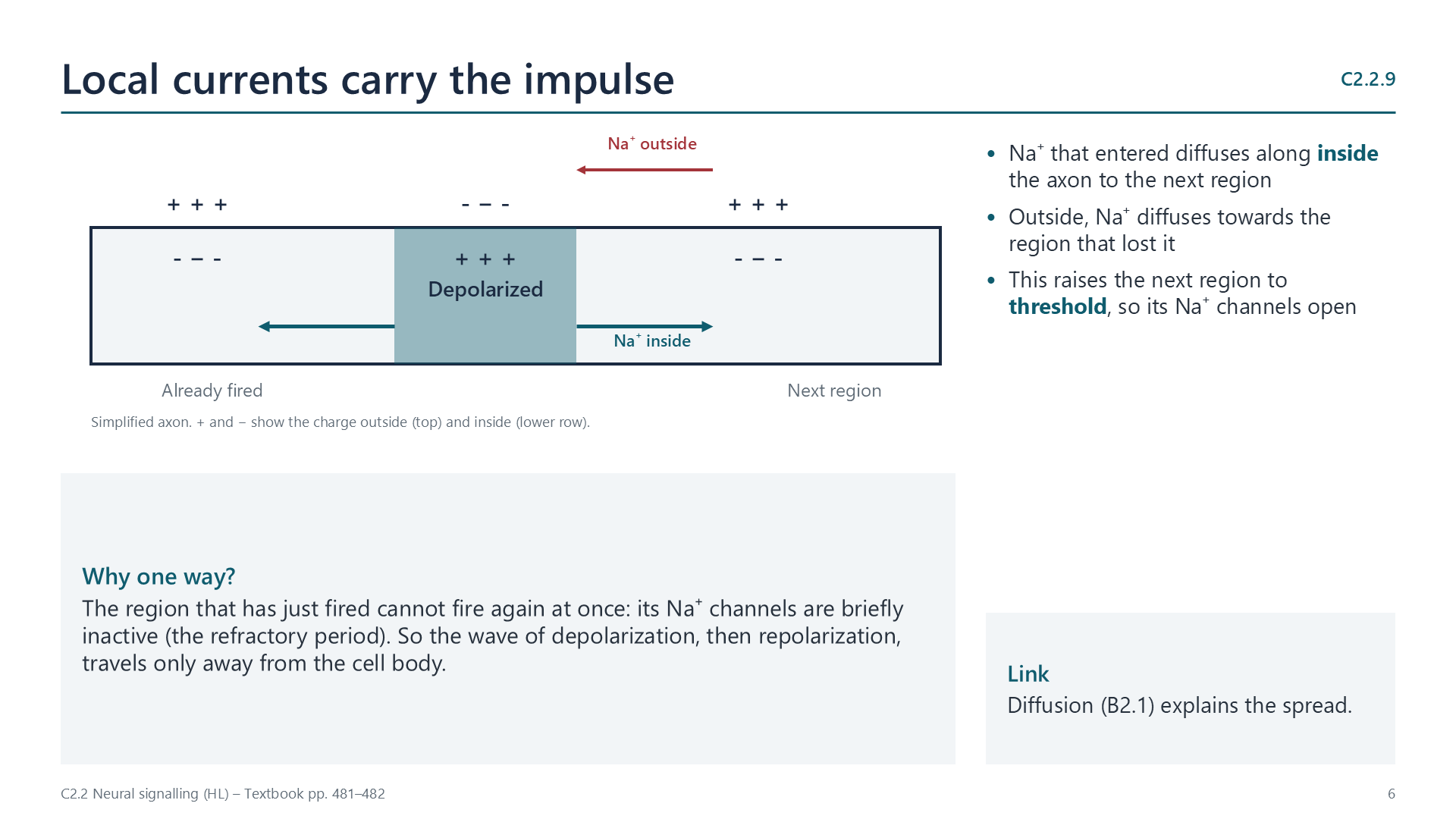
Slide: sodium ions diffusing along inside and outside an axon from a depolarized region

Na+ that has entered diffuses along inside the axon, while Na+ outside diffuses towards the depolarized region. These local currents bring the next region to threshold, so its Na+ channels open and the impulse moves on.

C2.2.10

Oscilloscope traces

p. 482
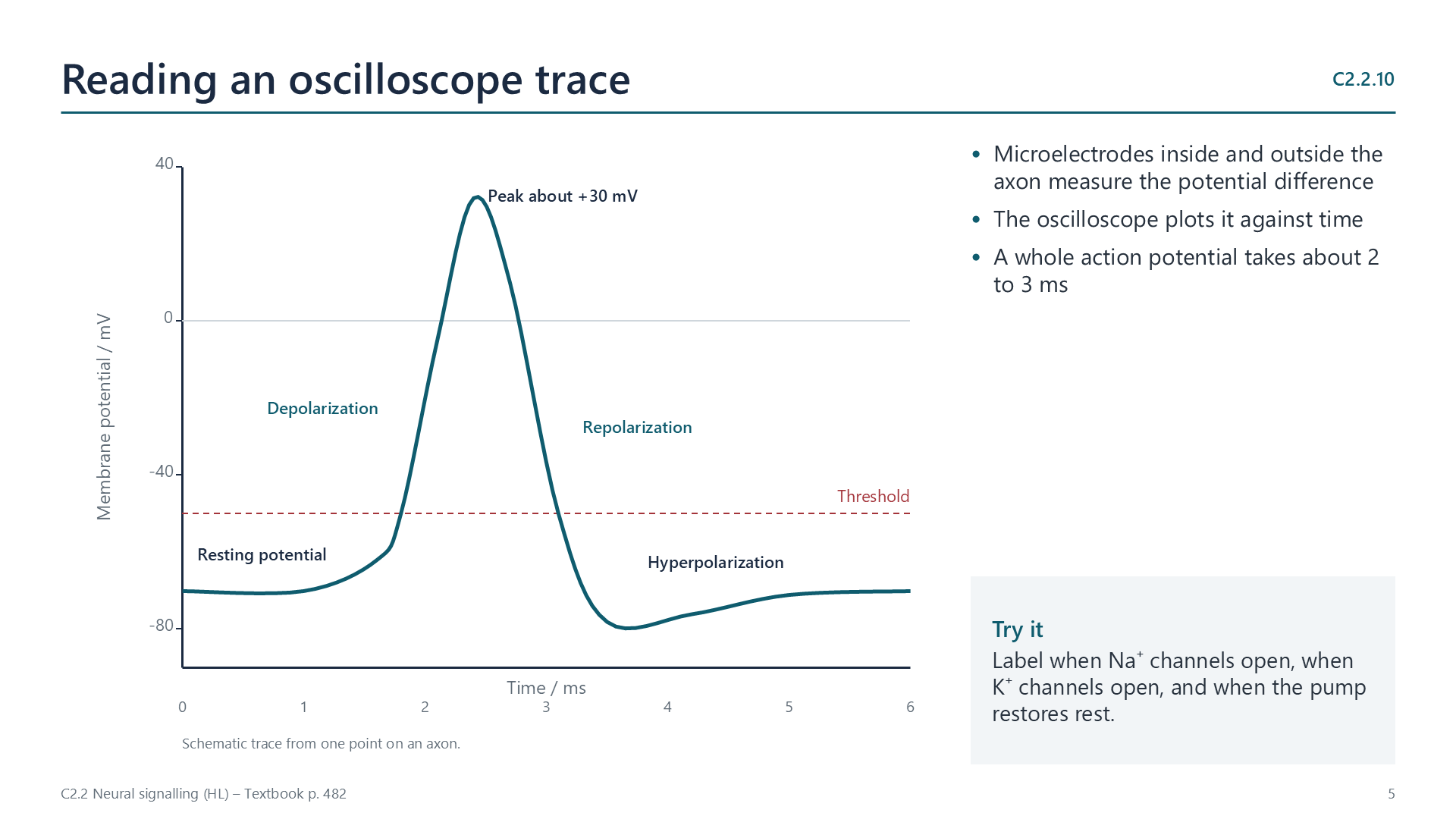
Slide: oscilloscope trace of one action potential

An oscilloscope plots membrane potential against time: a flat resting potential near −70 mV, a steep rise to about +30 mV, a fall, a brief dip below rest, then recovery, all within a few milliseconds.

C2.2.11

Saltatory conduction

pp. 482–483

Myelin insulates the axon. Pumps and channels are clustered at the nodes of Ranvier, so the action potential jumps from node to node. Myelinated axons conduct many times faster than unmyelinated ones of the same width.

Synapses

C2.2.12

Exogenous chemicals

pp. 483–484

Neonicotinoid pesticides bind nicotinic acetylcholine receptors in insects and are not broken down, so transmission is blocked. Cocaine blocks the transporters that reabsorb dopamine, so dopamine stays in the cleft and keeps stimulating.

C2.2.13

Inhibitory neurotransmitters

pp. 484–485

Neurotransmitters such as GABA open channels that let chloride ions in or potassium ions out. The postsynaptic membrane becomes hyperpolarized, an inhibitory postsynaptic potential, so an action potential is less likely.

C2.2.14

Summation

p. 485

A neuron receives many excitatory and inhibitory inputs. Their effects add together; only if the total reaches threshold does the neuron fire, and then fully.

Pain and consciousness

C2.2.15

Pain

pp. 486–487

Free nerve endings in the skin have channels for positive ions that open with heat, acid or chemicals such as capsaicin. Ions enter, threshold is reached and impulses travel to the brain, where pain is perceived.

C2.2.16

Consciousness

pp. 487–489

Consciousness is an emergent property: it is not found in any single neuron but arises from the interactions of billions of neurons in the brain.

Videos

Select a video to play it here. Select it again to close it.

Note-taking sheet

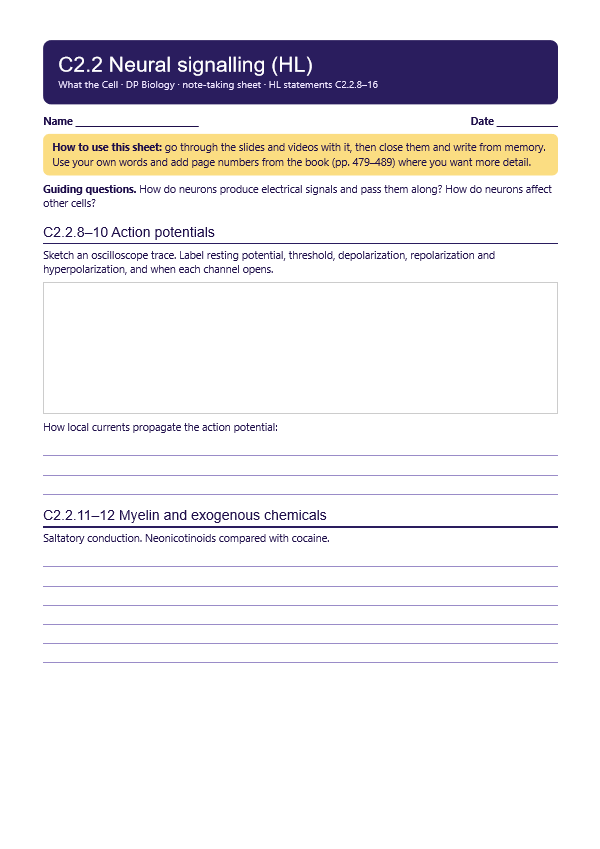
Print this guide and complete it as you work through the slides and videos. It asks for your own explanations, so close the notes while you try each section.

First page of the note-taking sheet

Quick self-check

The self-check needs JavaScript to run.

Practice questions

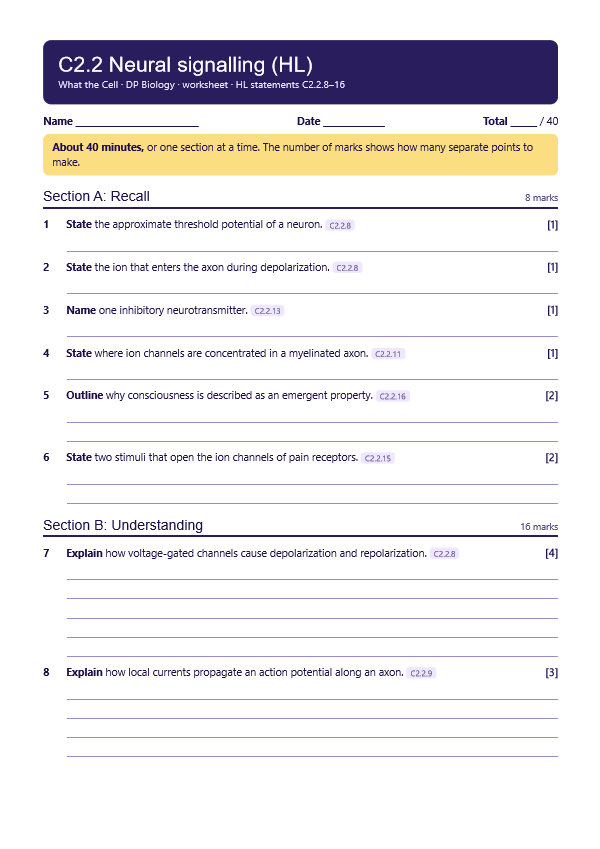
A printable worksheet covering all nine statements, from quick recall to data questions and a longer answer. It has 40 marks and takes about 40 minutes, or you can do one section at a time.

Your teacher has the mark scheme.

First page of the worksheet

Practical

Reading action potential traces

Data30 minC2.2.8, C2.2.10

You will need: Printed oscilloscope trace with scale, ruler

  1. Label the resting potential, depolarization and repolarization
  2. Measure the peak voltage and how long the action potential lasts
  3. Calculate how many could occur per second
  4. Explain each part of the trace using ion movements

Safety: No practical hazards.

Carry this out with your teacher's supervision and follow your school's lab rules.

Nature of science and TOK

Syllabus statements

Summarised in our own words. Use each code to find the exact wording in your textbook or the IB subject guide.

  • C2.2.8What happens in depolarization and repolarization during an action potentialp. 479
  • C2.2.9How local currents carry an action potential along an axonp. 482
  • C2.2.10Reading oscilloscope traces of resting and action potentialsp. 482
  • C2.2.11Saltatory conduction: why impulses travel faster in myelinated fibresp. 483
  • C2.2.12How chemicals from outside the body affect transmission at synapsesp. 483
  • C2.2.13Inhibitory neurotransmitters and how they produce inhibitory postsynaptic potentialsp. 484
  • C2.2.14How a postsynaptic neuron adds up excitatory and inhibitory inputsp. 484
  • C2.2.15How free nerve endings in the skin detect painp. 486
  • C2.2.16Consciousness as something that arises from many neurons interacting in the brainp. 487

More of C2.2 in this course

© 2026 Akash Parthi Bendran. Please ask before using or sharing any resources from this site: see permission to use.