What the Cell
D3.1

Reproduction

Plant
2 hours5 statementsTextbook pp. 702–708

Guiding questions

  1. What does sexual or asexual reproduction show about change and continuity?
  2. How must organisms change in order to reproduce?

Slides

Slide 1 of 16

Notes

Written for this site from the course textbook and class slides. Use the page numbers to read the book's fuller account. Human reproduction (D3.1.1–7) is in Body Systems. Image credits are on slide 16.

From flower to seed

D3.1.8

How flowering plants reproduce sexually

pp. 702–703

Male gametes develop inside pollen grains, and the egg develops inside an ovule in the ovary. Many flowers are hermaphrodite, yet reproduction is still sexual, because gametes fuse.

  1. Pollination: pollen moves from an anther to a stigma.
  2. The pollen germinates, and a pollen tube grows down the style to the ovule.
  3. Fertilization: a male nucleus fuses with the egg, forming a zygote. The other male nucleus triggers the formation of a food store.
  4. The zygote divides by mitosis to form an embryo. The ovule becomes the seed, and the ovary the fruit.
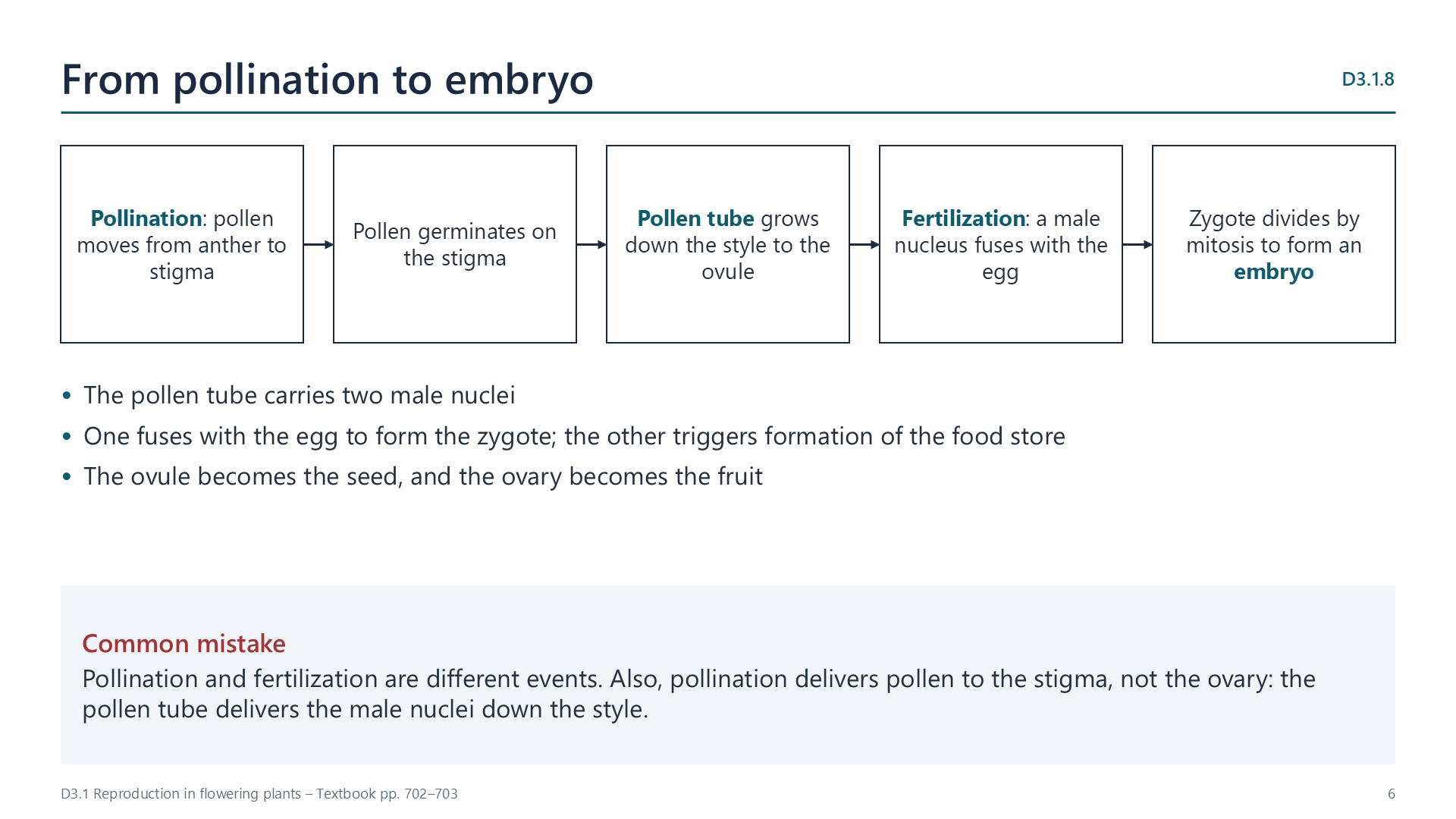
Slide: five steps from pollination to embryo

Watch out: pollination delivers pollen to the stigma, not to the ovary.
D3.1.9

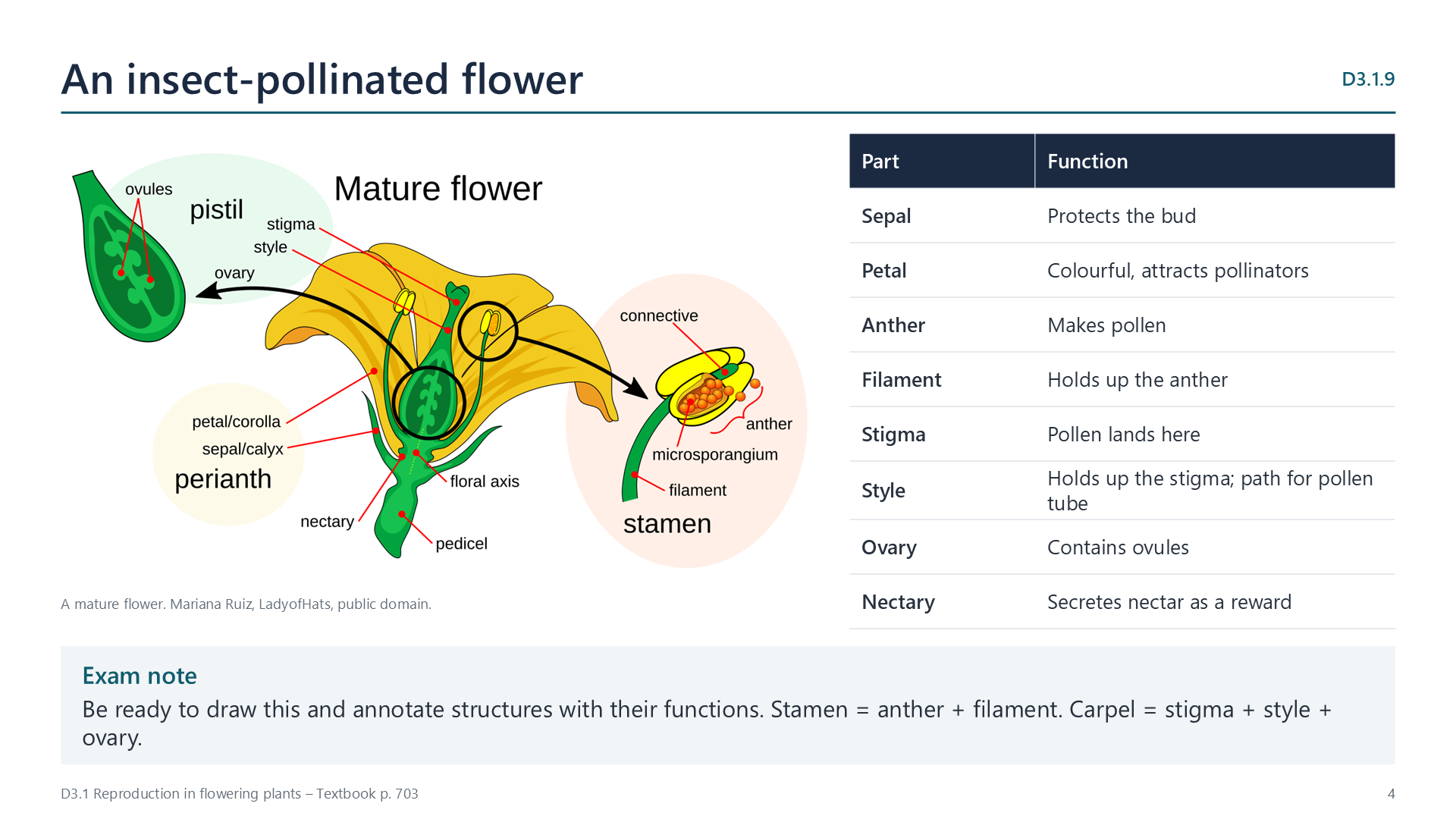
The features of a flower pollinated by insects

p. 703
Slide: labelled diagram of a flower beside a table of parts and functions

Sepals protect the bud. Colourful petals and sugary nectar attract pollinators. The stamen is an anther, which makes pollen, on a filament. The carpel is a stigma, where pollen lands, with a style and an ovary containing ovules.

Avoiding self-pollination

D3.1.10

Ways of encouraging cross-pollination

pp. 704–705

Cross-pollination moves pollen between plants of the same species, often by animals or wind. It increases variation. Plants encourage it in these ways:

  • Pollen and stigma mature at different times.
  • Separate male and female flowers grow on one plant, as in birch.
  • Separate male and female plants exist, as in holly.
D3.1.11

How self-incompatibility raises genetic variation

p. 705

Self-pollination leads to inbreeding, which decreases genetic diversity and vigour. In many species, genes let a plant recognise its own pollen. If the pollen carries the same self-incompatibility allele as the style, the pollen tube stops growing. So gametes that fuse come from different plants.

Seeds

D3.1.12

How seeds disperse and germinate

pp. 706–708

Dispersal moves seeds away from the parent by wind, water, animals or explosive pods. This reduces competition for space, light, nutrients and water.

Germination needs water to rehydrate the cells, oxygen for aerobic respiration, and a temperature suitable for enzymes.

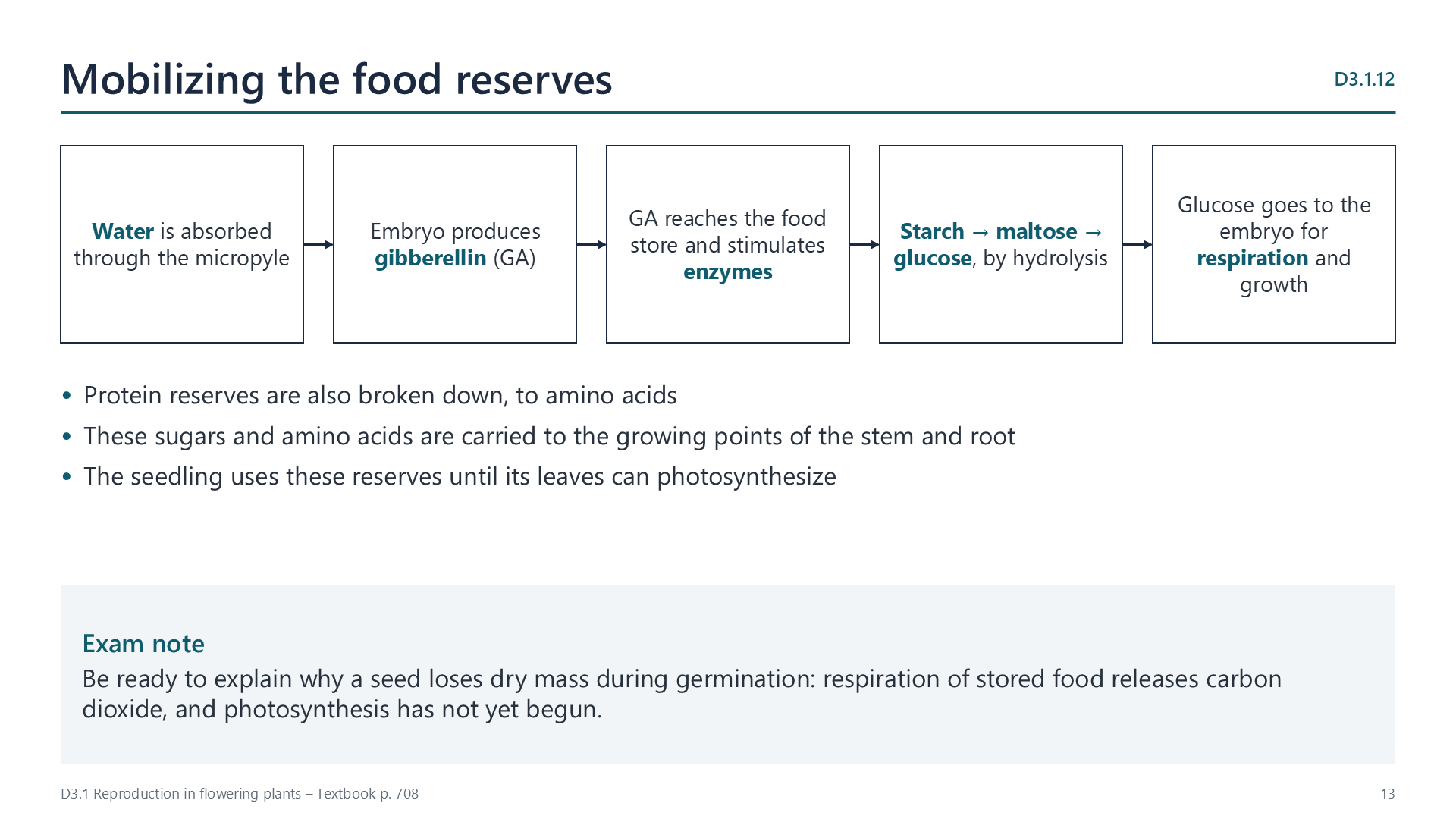
  1. Water enters through the micropyle.
  2. The embryo produces gibberellin.
  3. Gibberellin stimulates enzymes in the food store.
  4. Starch is hydrolysed to maltose, and then glucose.
  5. Glucose and amino acids move to the growing points, for respiration and growth.
Slide: five steps of food mobilization during germination

Watch out: pollination and dispersal are different events. Pollination comes before fertilization, and dispersal after it.

Videos

Select a video to play it here. Select it again to close it.

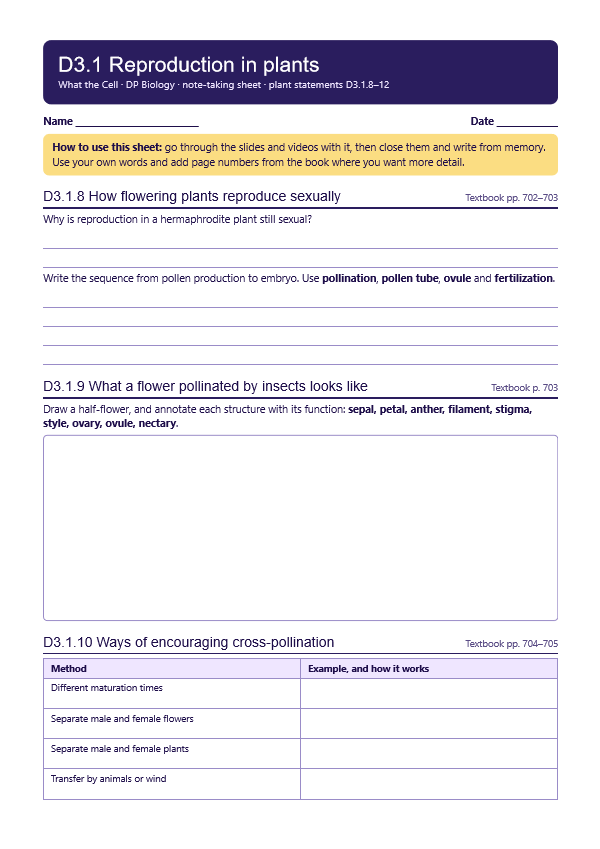
Note-taking sheet

Print this guide and complete it as you work through the slides and videos. It asks for your own explanations, so close the notes while you try each section.

First page of the note-taking sheet

Quick self-check

The self-check needs JavaScript to run.

Practice questions

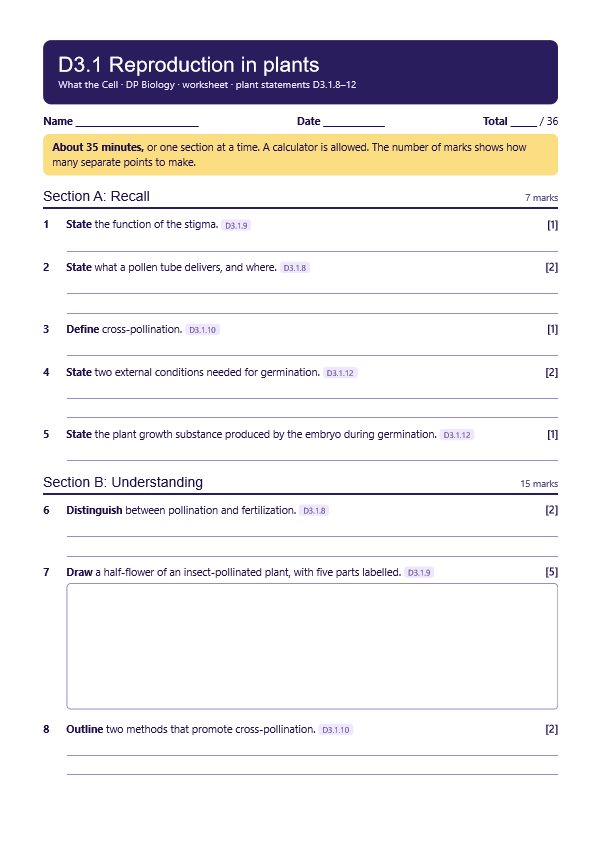
A printable worksheet covering all five statements, from quick recall to data questions. It has 36 marks and takes about 35 minutes, or you can do one section at a time.

Your teacher has the mark scheme.

First page of the worksheet

Data-based questions

Questions built on realistic experimental data, in the style of Paper 1B and Paper 2. Work them on paper and show your working. 17 marks in total. Your teacher has the mark scheme.

Seed dispersal

10 marks

Sycamore seeds have a wing. Seeds were dropped one at a time in a steady wind of 3 m s−1, with their wings intact or with the wings cut off. The time to fall and the distance travelled sideways were measured for 50 seeds of each kind.

SeedsDrop height / mMean fall time / sMean distance travelled / m ± SD
Winged21.93.4 ± 0.8
Wings removed20.70.6 ± 0.2
Winged108.816 ± 4
  1. Calculate how many times further winged seeds travelled than seeds without wings, from 2 m. [1]
  2. Explain how the wing increases the distance a seed travels. [2]
  3. Suggest one advantage to a tree of dispersing seeds far from itself. [1]
  4. Many seeds are dispersed by animals that eat fruit. The table shows the mean composition of fruits from temperate and tropical forests.

    FruitsLipid / % dry massCarbohydrate / % dry massProtein / % dry mass
    Temperate (12 species)4825
    Tropical (15 species)21607
    Compare the composition of tropical and temperate fruits. [2]
  5. Lipid releases about 39 kJ g−1 and carbohydrate about 17 kJ g−1. Explain which type of fruit gives more energy per gram. [2]
  6. State one advantage and one disadvantage of seed dispersal by animals. [2]

Timing that prevents self-pollination

7 marks

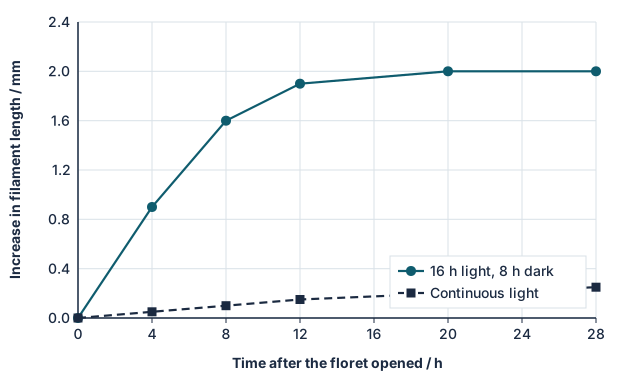
In sunflowers, the anthers of a floret release pollen before the stigma of the same floret is ready to receive it. The filaments that hold the anthers grow longer early in the morning, raising the anthers. Sunflower plants were grown in continuous white light or in 16 hours of light and 8 hours of dark. The increase in filament length was measured from the time the floret opened.

Line graph. In light and dark, filament length increases quickly to 1.6 mm at 8 hours and 2.0 mm by 20 hours. In continuous light it increases slowly to only 0.25 mm at 28 hours.
  1. State the increase in filament length after 28 hours in light and dark. [1]
  2. Calculate how many times greater this is than in continuous light. [1]
  3. Explain how releasing pollen before the stigma is ready reduces self-pollination. [2]
  4. The percentage of ovules that developed into seeds was measured on 30 plants in each condition (mean ± SD).

    ConditionOvules developed into seeds / %
    Continuous light62 ± 14
    16 h light, 8 h dark88 ± 5
    Explain how the standard deviations help in comparing the two conditions. [3]

Practical

Dissecting an insect-pollinated flower

Lab35 minD3.1.8, D3.1.9

You will need: A large flower such as a lily, forceps, hand lens, card and clear tape

  1. Remove the parts in order from the outside: sepals, petals, stamens, then carpel
  2. Tape each part to card and label it
  3. Examine pollen with a hand lens
  4. Link each feature to attracting insects or to pollination

Safety: Check for pollen allergies. Lily pollen stains, and lilies are toxic to cats.

Carry this out with your teacher's supervision and follow your school's lab rules.

Nature of science and TOK

Syllabus statements

Summarised in our own words. Use each code to find the exact wording in your textbook or the IB subject guide.

  • D3.1.8How flowering plants reproduce sexuallyp. 702
  • D3.1.9The features of a flower pollinated by insectsp. 703
  • D3.1.10Ways of encouraging cross-pollinationp. 704
  • D3.1.11How self-incompatibility raises genetic variation within a speciesp. 705
  • D3.1.12How seeds disperse and germinatep. 706

HL extension

More of D3.1 in this course

© 2026 Akash Parthi Bendran. Please ask before using or sharing any resources from this site: see permission to use.