What the Cell
D3.1

Reproduction

Human
4 hours7 statementsTextbook pp. 693–701

Guiding questions

  1. What does sexual or asexual reproduction show about change and continuity?
  2. How must organisms change in order to reproduce?

Slides

Slide 1 of 24

Notes

Written for this site from the course textbook and class slides. Use the page numbers to read the book's fuller account. Reproduction in flowering plants (D3.1.8–12) is in Plant Systems. Image credits are on slide 24.

Why reproduce sexually?

D3.1.1

How sexual and asexual reproduction differ

pp. 693–694
AsexualSexual
ParentsOneUsually two
GametesNoneHaploid gametes fuse
OffspringGenetically identicalNew combinations of genes
Relative advantageSuits individuals already adapted to an existing environmentProvides the variation needed to adapt to a changed environment
ExamplesYeast, hydra, strawberry runnersMost animals and plants

Some organisms do both. Aphids reproduce asexually when conditions are stable in spring and summer, and sexually in autumn.
D3.1.2

What meiosis and the fusion of gametes do in a sexual life cycle

pp. 694–695

Meiosis halves the chromosome number to make haploid gametes. Fertilization, the fusion of gametes, restores the diploid number. Without meiosis, the number would double every generation.

These two events also create variation. Meiosis breaks up parental combinations of alleles, and random fusion of gametes produces new combinations, unique to the new individual.

Watch out: 23 and 46 apply to humans only. Define a haploid cell as having one set of chromosomes.

D3.1.3

How male and female sexes differ in sexual reproduction

p. 695

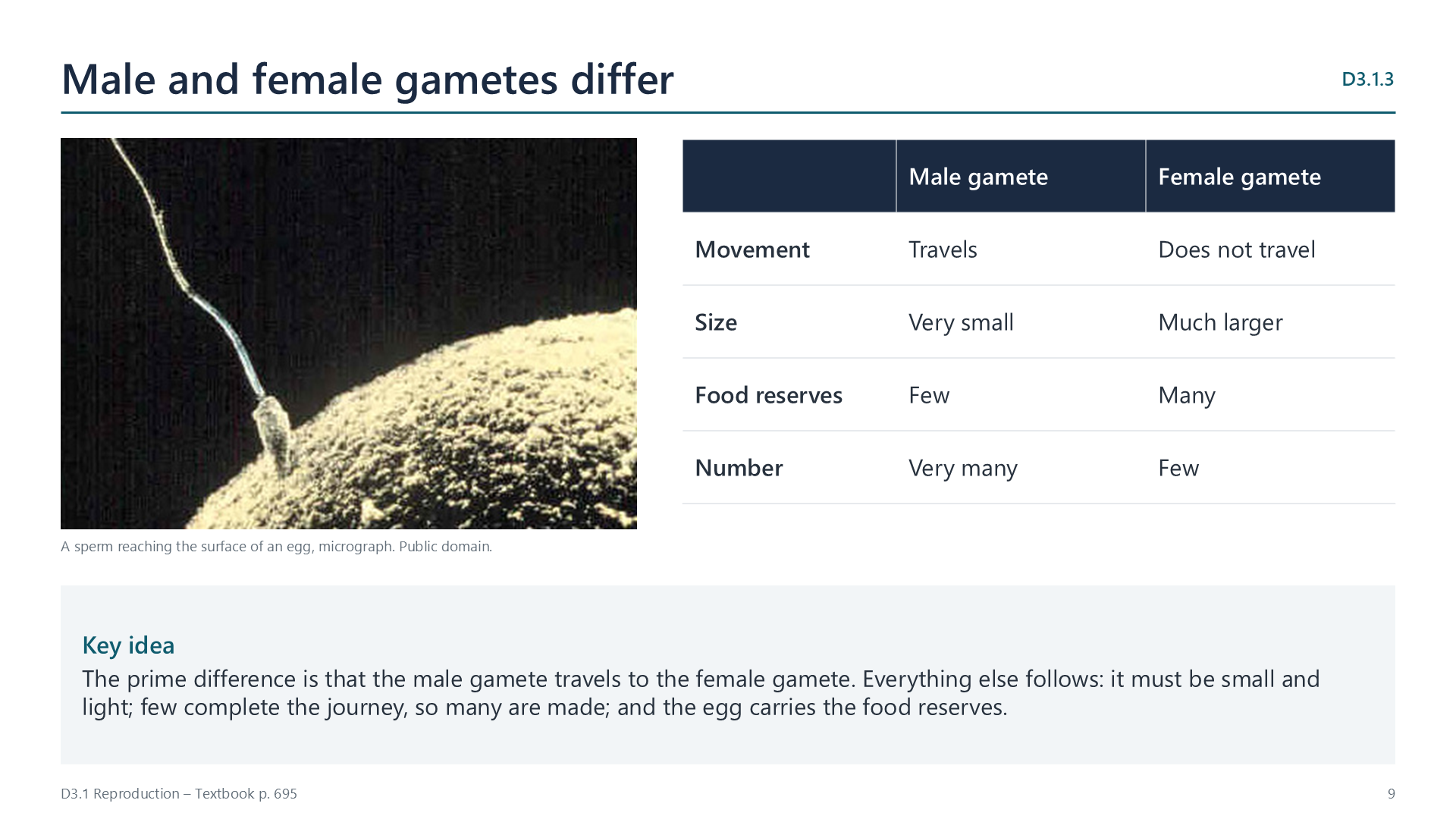
The prime difference is that the male gamete travels to the female gamete. So it is small, with few food reserves. Few reach the egg, so very large numbers must be made.

The female gamete does not travel. It is larger, with food reserves for the early embryo, and far fewer are made.

In many animal species, this difference leads to different reproductive strategies: males compete and can mate many times, while females invest more in each offspring and may be more selective. These are broad patterns across species, with many exceptions.

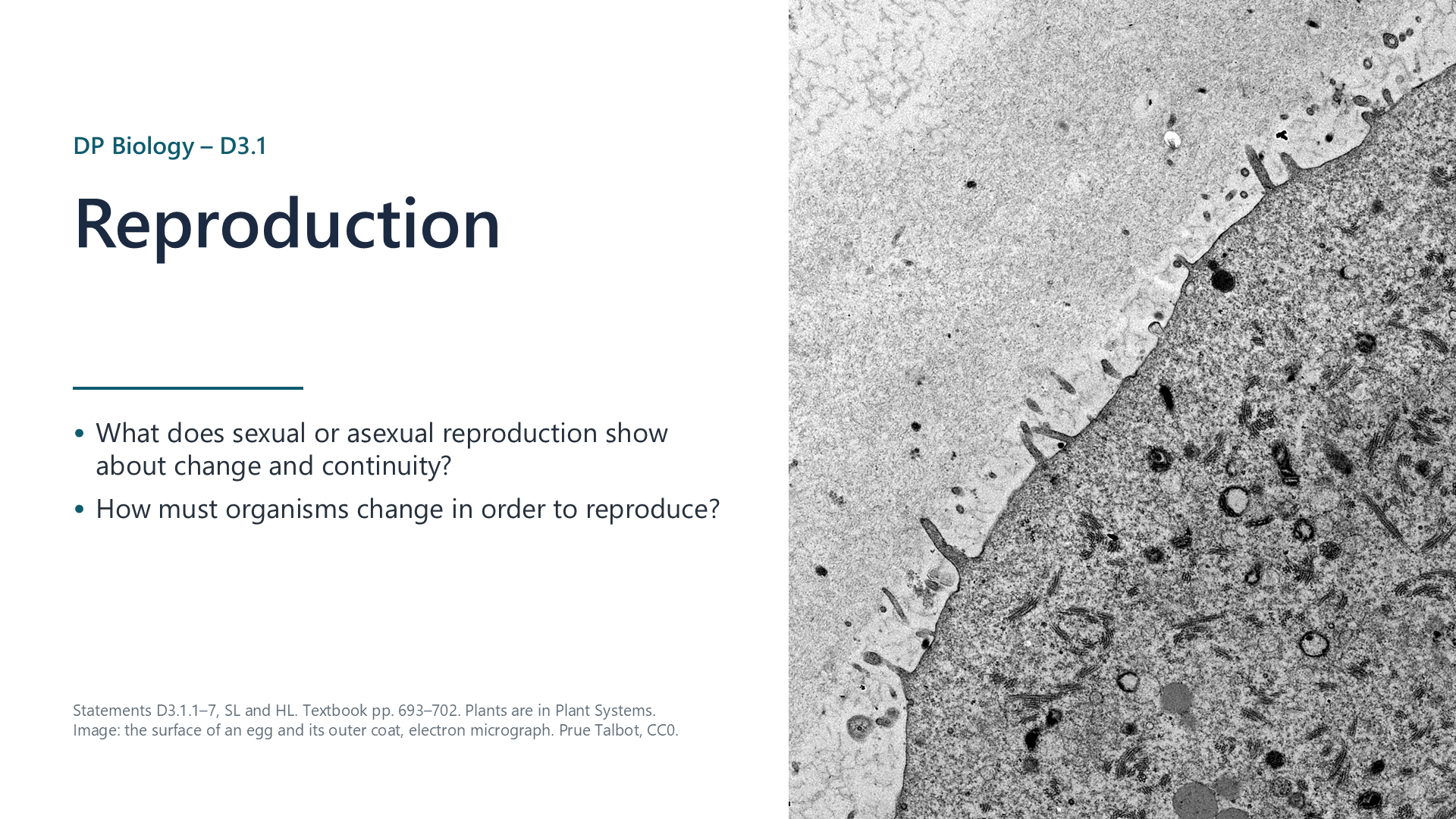
Slide: micrograph of sperm at the surface of an egg, beside a table comparing the gametes

Human reproductive systems

D3.1.4

The parts of the human male and female reproductive tracts

pp. 695–697
Male-typicalFunctionFemale-typicalFunction
TestesMake sperm and testosteroneOvariesMake eggs, oestradiol and progesterone
ScrotumKeeps testes cooler than the bodyOviductsCarry the egg; site of fertilization
EpididymisStores spermUterusMuscular wall; embryo develops here
Sperm ductCarries sperm to the urethraEndometriumLining rebuilt each cycle
Seminal vesicles and prostateAdd fluid to make semenCervixConnects uterus and vagina
Urethra and penisCarry semen out during ejaculationVaginaMuscular tube to the outside

Exam note: you need to be able to draw and annotate both systems. Side views show positions best. Check your connections: the sperm duct must join the urethra, and each oviduct must open into the space inside the uterus.

D3.1.5

What happens in the ovarian and uterine cycles, and how hormones control them

pp. 698–700

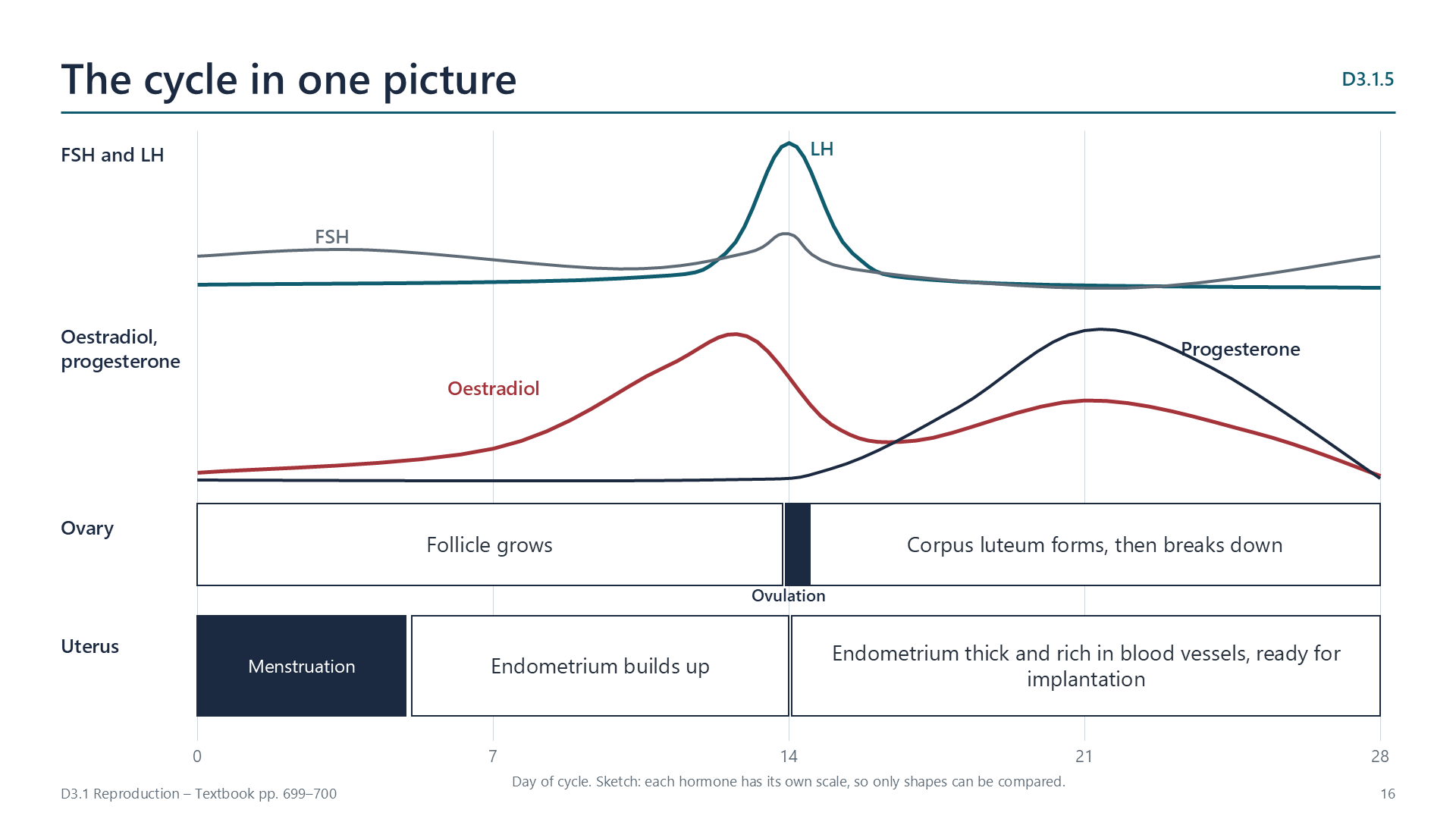
The menstrual cycle lasts about 28 days and combines an ovarian cycle, preparing and releasing an egg, and a uterine cycle, building up and shedding the endometrium.

Slide: sketch of four hormone levels across 28 days, above strips showing events in the ovary and uterus
  1. Menstruation marks day 1. The pituitary gland secretes FSH, which stimulates follicles to develop.
  2. A follicle secretes oestradiol, which rebuilds the endometrium. It also increases FSH receptors in the follicle, so more oestradiol is made: positive feedback.
  3. High oestradiol inhibits FSH, so no more follicles develop: negative feedback.
  4. High oestradiol also stimulates a surge of LH, which triggers ovulation at about day 14.
  5. LH converts the empty follicle into a corpus luteum, which secretes progesterone and some oestradiol.
  6. Progesterone maintains the endometrium and inhibits FSH and LH: negative feedback.
  7. Low LH and FSH let the corpus luteum break down. Progesterone and oestradiol fall, and the endometrium is shed.

If an embryo implants, it secretes a hormone that keeps the corpus luteum going, so progesterone stays high.

Watch out: FSH stimulates follicle growth, while LH triggers ovulation. When progesterone falls and FSH rises, that is the removal of negative feedback and not positive feedback.

Fertilization and IVF

D3.1.6

How fertilization happens in humans

p. 701

Fertilization is internal, usually in the upper part of the oviduct.

  1. The cell membranes of the sperm and egg fuse.
  2. The sperm nucleus enters the egg. The tail and mitochondria of the sperm are destroyed, so all of the new cell's mitochondria come from the egg.
  3. The nuclear membranes of both nuclei break down.
  4. The condensed chromosomes from both nuclei take part in a joint mitosis, producing two diploid nuclei.

Watch out: avoid saying that the two nuclei fuse into one.

D3.1.7

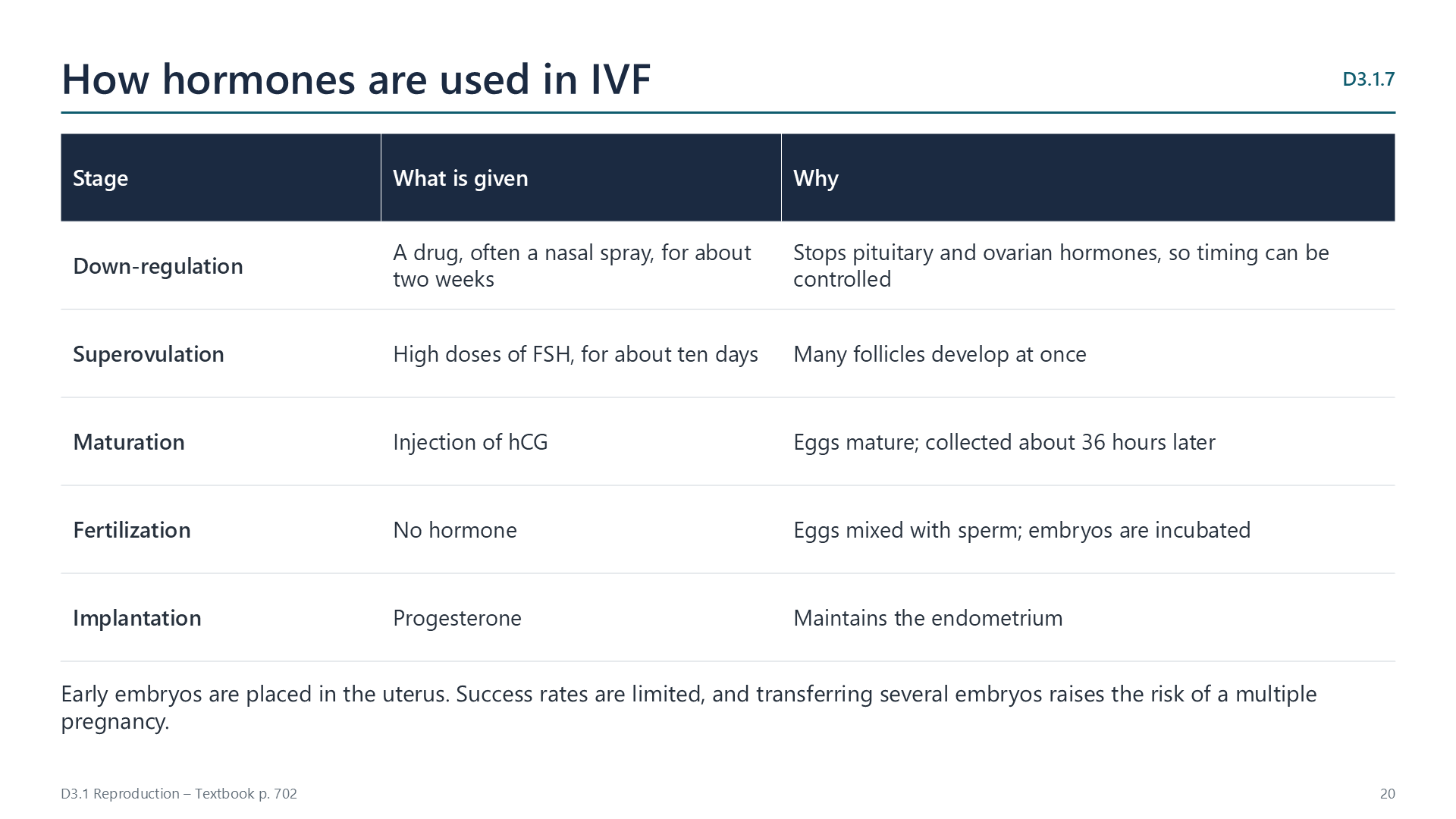
How hormones are used in in vitro fertilization (IVF)

pp. 701–702

IVF is fertilization outside the body. Normal secretion of hormones is first suspended, so that doctors control the timing.

  • Down-regulation: a drug, often a nasal spray, stops pituitary and ovarian hormones for about two weeks.
  • Superovulation: high doses of FSH make many follicles develop together.
  • Maturation: an injection of hCG brings the eggs to maturity. They are collected about 36 hours later.
  • Fertilization and transfer: eggs are mixed with sperm. The embryos are incubated, and one or more are placed in the uterus.
  • Progesterone is given to maintain the endometrium.

Not every treatment leads to a birth, and transferring several embryos raises the risk of a multiple pregnancy.

Slide: table of the hormones used at each stage of IVF

Videos

Select a video to play it here. Select it again to close it.

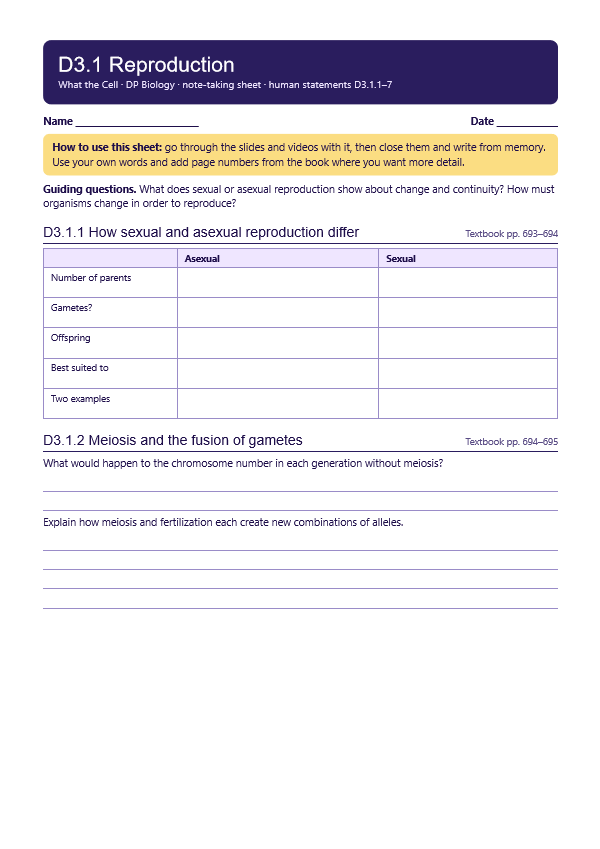
Note-taking sheet

Print this guide and complete it as you work through the slides and videos. It asks for your own explanations, so close the notes while you try each section.

First page of the note-taking sheet

Quick self-check

The self-check needs JavaScript to run.

Practice questions

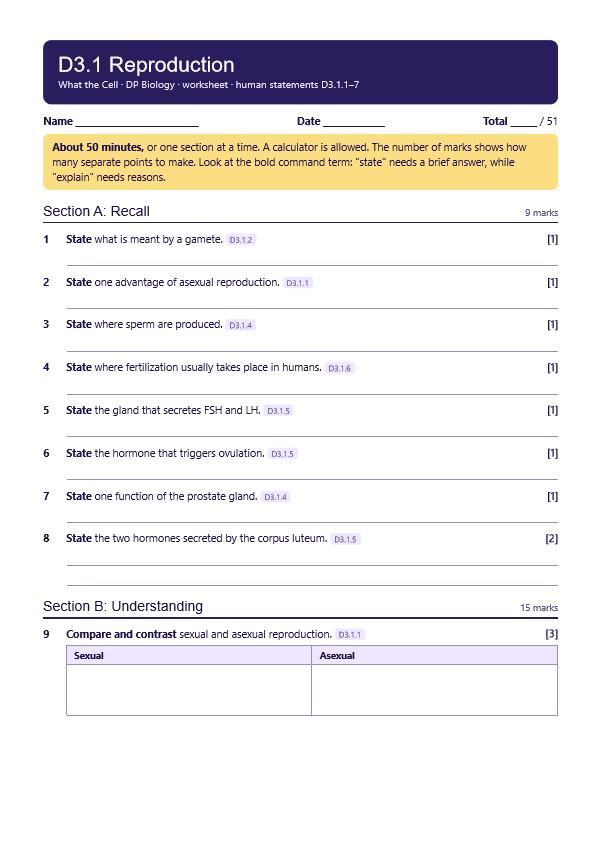
A printable worksheet covering all seven statements, from quick recall to data questions and longer answers. It has 51 marks and takes about 50 minutes, or you can do one section at a time.

Your teacher has the mark scheme. Past-paper practice: IB Biology SL, November 2021, Paper 1, question 30. Ask your teacher for a copy.

First page of the worksheet

Practical

Plotting hormones across the menstrual cycle

Data35 minD3.1.5

You will need: Published FSH, LH, oestradiol and progesterone values from a textbook, graph paper or spreadsheet

  1. Plot all four hormones against day of the cycle on one graph
  2. Mark ovulation and menstruation
  3. Annotate where each hormone rises and falls
  4. Explain two feedback links that the graph shows

Safety: No practical hazards. Handle the topic sensitively.

Carry this out with your teacher's supervision and follow your school's lab rules.

Nature of science and TOK

Syllabus statements

Summarised in our own words. Use each code to find the exact wording in your textbook or the IB subject guide.

  • D3.1.1How sexual and asexual reproduction differp. 693
  • D3.1.2What meiosis and the fusion of gametes do in a sexual life cyclep. 694
  • D3.1.3How male and female sexes differ in sexual reproductionp. 695
  • D3.1.4The parts of the human male and female reproductive tractsp. 695
  • D3.1.5What happens in the ovarian and uterine cycles, and how hormones control themp. 698
  • D3.1.6How fertilization happens in humansp. 701
  • D3.1.7How hormones are used in in vitro fertilization (IVF)p. 701

HL extension

More of D3.1 in this course

© 2026 Akash Parthi Bendran. Please ask before using or sharing any resources from this site: see permission to use.